3TAD | pdb_00003tad

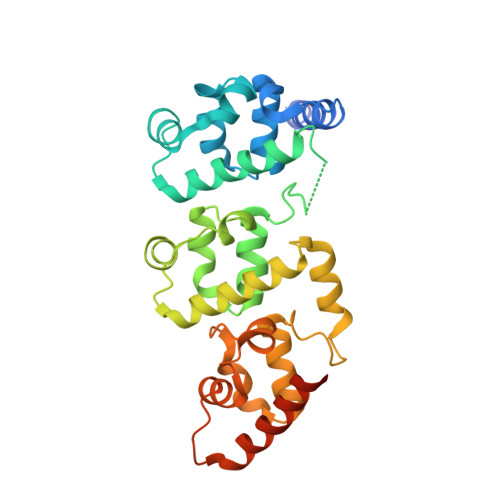
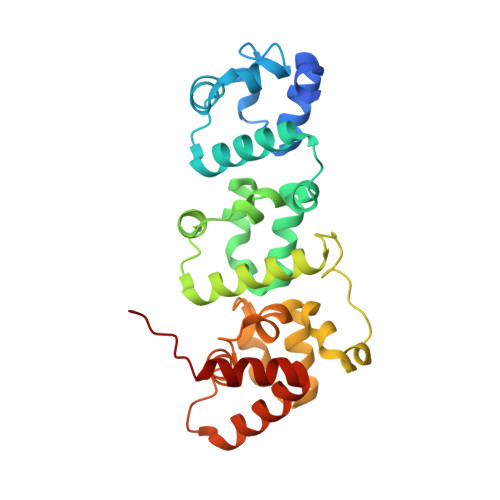
Crystal Structure of the Liprin-alpha/Liprin-beta complex


Experimental Data Snapshot

  • Method: X-RAY DIFFRACTION
  • Resolution: 2.90 Å
  • R-Value Free: 
    0.258 (Depositor), 0.261 (DCC) 
  • R-Value Work: 
    0.214 (Depositor), 0.227 (DCC) 
  • R-Value Observed: 
    0.216 (Depositor) 

wwPDB Validation 3D Report Full Report

Validation slider image for 3TAD

This is version 1.1 of the entry. See complete history

Literature

Liprin-mediated large signaling complex organization revealed by the liprin-alpha/CASK and liprin-alpha/liprin-beta complex structures

Wei, Z.Zheng, S.Spangler, S.A.Yu, C.Hoogenraad, C.C.Zhang, M.

(2011) Mol Cell 43: 586-598

  • DOI: https://doi.org/10.1016/j.molcel.2011.07.021
  • Primary Citation Related Structures: 
    3TAC, 3TAD

  • PubMed Abstract: 

    Liprins are highly conserved scaffold proteins that regulate cell adhesion, cell migration, and synapse development by binding to diverse target proteins. The molecular basis governing liprin/target interactions is poorly understood. The liprin-α2/CASK complex structure solved here reveals that the three SAM domains of liprin-α form an integrated supramodule that binds to the CASK kinase-like domain. As supported by biochemical and cellular studies, the interaction between liprin-α and CASK is unique to vertebrates, implying that the liprin-α/CASK interaction is likely to regulate higher-order brain functions in mammals. Consistently, we demonstrate that three recently identified X-linked mental retardation mutants of CASK are defective in binding to liprin-α. We also solved the liprin-α/liprin-β SAM domain complex structure, which uncovers the mechanism underlying liprin heterodimerizaion. Finally, formation of the CASK/liprin-α/liprin-β ternary complex suggests that liprins can mediate assembly of target proteins into large protein complexes capable of regulating numerous cellular activities.


  • Organizational Affiliation
    • Division of Life Science, State Key Laboratory of Molecular Neuroscience, Molecular Neuroscience Center, Hong Kong University of Science and Technology, Clear Water Bay, Kowloon, Hong Kong, China.

Macromolecule Content 

  • Total Structure Weight: 129.77 kDa 
  • Atom Count: 8,163 
  • Modeled Residue Count: 1,031 
  • Deposited Residue Count: 1,124 
  • Unique protein chains: 2

Macromolecules

Find similar proteins by:|  3D Structure
Entity ID: 1
MoleculeChains  Sequence LengthOrganismDetailsImage
Liprin-alpha-2
A, B
297Homo sapiensMutation(s): 0 
Gene Names: PPFIA2
UniProt & NIH Common Fund Data Resources
Find proteins for O75334 (Homo sapiens)
Explore O75334 
Go to UniProtKB:  O75334
PHAROS:  O75334
GTEx:  ENSG00000139220 
Entity Groups
Sequence Clusters30% Identity50% Identity70% Identity90% Identity95% Identity100% Identity
UniProt GroupO75334
Sequence Annotations
Expand
Reference Sequence
Find similar proteins by:|  3D Structure
Entity ID: 2
MoleculeChains  Sequence LengthOrganismDetailsImage
Liprin-beta-1
C, D
265Mus musculusMutation(s): 0 
Gene Names: Ppfibp1
UniProt & NIH Common Fund Data Resources
Find proteins for Q8C8U0 (Mus musculus)
Explore Q8C8U0 
Go to UniProtKB:  Q8C8U0
IMPC:  MGI:1914783
Entity Groups
Sequence Clusters30% Identity50% Identity70% Identity90% Identity95% Identity100% Identity
UniProt GroupQ8C8U0
Sequence Annotations
Expand
Reference Sequence

Experimental Data & Validation

Experimental Data

  • Method: X-RAY DIFFRACTION
  • Resolution: 2.90 Å
  • R-Value Free:  0.258 (Depositor), 0.261 (DCC) 
  • R-Value Work:  0.214 (Depositor), 0.227 (DCC) 
  • R-Value Observed: 0.216 (Depositor) 
Space Group: P 61
Unit Cell:
Length ( Å )Angle ( ˚ )
a = 141.88α = 90
b = 141.88β = 90
c = 181.059γ = 120
Software Package:
Software NamePurpose
PHASERphasing
REFMACrefinement
PDB_EXTRACTdata extraction
HKL-2000data reduction
HKL-2000data scaling

Structure Validation

View Full Validation Report


Entry History 

Deposition Data

Revision History  (Full details and data files)

  • Version 1.0: 2011-10-12
    Type: Initial release
  • Version 1.1: 2024-03-20
    Changes: Data collection, Database references, Derived calculations, Refinement description