Download Mendeley
Binding of ReO(4) (-) with an engineered MoO (4) (2-)-binding protein: towards a new approach in radiopharmaceutical applications.
Aryal, B.P., Brugarolas, P., He, C.(2012) J Biol Inorg Chem 17: 97-106
- PubMed: 21861186 Search on PubMed
- DOI: https://doi.org/10.1007/s00775-011-0833-4
- Primary Citation Related Structures:
3AXF, 3R26 - PubMed Abstract:
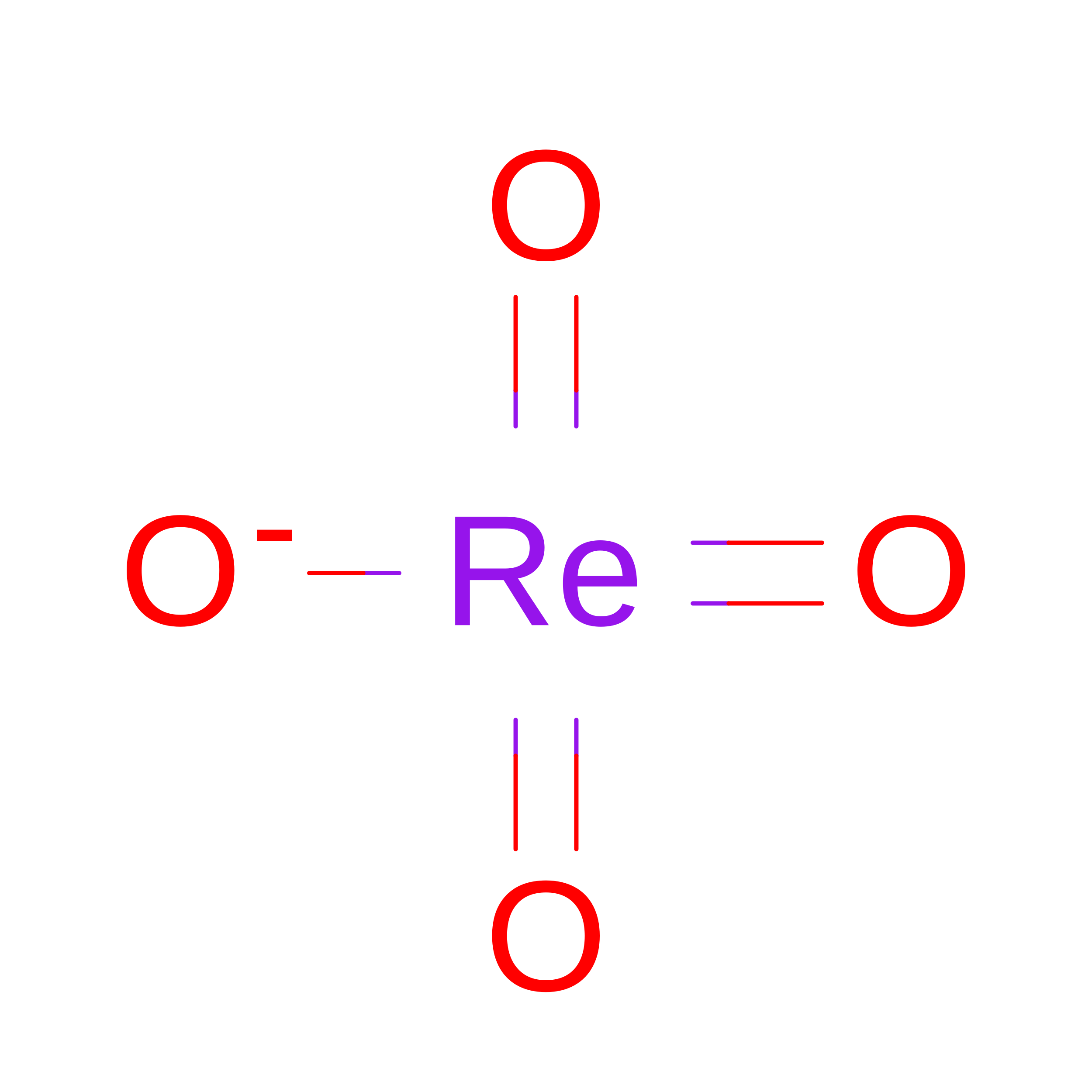
Radiolabeled biomolecules are routinely used for clinical diagnostics. (99m)Tc is the most commonly used radioactive tracer in radiopharmaceuticals. (188)Re and (186)Re are also commonly used as radioactive tracers in medicine. However, currently available methods for radiolabeling are lengthy and involve several steps in bioconjugation processes. In this work we present a strategy to engineer proteins that may selectively recognize the perrhenate (ReO(4)(-)) ion as a new way to label proteins. We found that a molybdate (MoO(4)(2-))-binding protein (ModA) from Escherichia coli can bind perrhenate with high affinity. Using fluorescence and isothermal titration calorimetry measurements, we determined the dissociation constant of ModA for ReO(4)(-) to be 541 nM and we solved a crystal structure of ModA with a bound ReO(4)(-). On the basis of the structure we created a mutant protein containing a disulfide linkage, which exhibited increased affinity for perrhenate (K(d) = 104 nM). High-resolution crystal structures of ModA (1.7 Å) and A11C/R153C mutant (2.0 Å) were solved with bound perrhenate. Both structures show that a perrhenate ion occupies the molybdate binding site using the same amino acid residues that are involved in molybdate binding. The overall structure of the perrhenate-bound ModA is unchanged compared with that of the molybdate-bound form. In the mutant protein, the bound perrhenate is further stabilized by the engineered disulfide bond.
- Department of Chemistry, Institute for Biophysical Dynamics, The University of Chicago, 929 East 57th Street, Chicago, IL 60637, USA.
Organizational Affiliation: