3QDD | pdb_00003qdd

HSP90A N-terminal domain in complex with BIIB021


Experimental Data Snapshot

  • Method: X-RAY DIFFRACTION
  • Resolution: 1.79 Å
  • R-Value Free: 
    0.209 (Depositor), 0.215 (DCC) 
  • R-Value Work: 
    0.172 (Depositor), 0.175 (DCC) 
  • R-Value Observed: 
    0.173 (Depositor) 

wwPDB Validation 3D Report Full Report

Validation slider image for 3QDD

Ligand Structure Quality Assessment 


This is version 1.4 of the entry. See complete history

Literature

EC144 Is a Potent Inhibitor of the Heat Shock Protein 90.

Shi, J.Van de Water, R.Hong, K.Lamer, R.B.Weichert, K.W.Sandoval, C.M.Kasibhatla, S.R.Boehm, M.F.Chao, J.Lundgren, K.Timple, N.Lough, R.Ibanez, G.Boykin, C.Burrows, F.J.Kehry, M.R.Yun, T.J.Harning, E.K.Ambrose, C.Thompson, J.Bixler, S.A.Dunah, A.Snodgrass-Belt, P.Arndt, J.Enyedy, I.J.Li, P.Hong, V.S.McKenzie, A.Biamonte, M.A.

(2012) J Med Chem 55: 7786-7795

  • DOI: https://doi.org/10.1021/jm300810x
  • Primary Citation Related Structures: 
    3QDD

  • PubMed Abstract: 

    Alkyne 40, 5-(2-amino-4-chloro-7-((4-methoxy-3,5-dimethylpyridin-2-yl)methyl)-7H-pyrrolo[2,3-d]pyrimidin-5-yl)-2-methylpent-4-yn-2-ol (EC144), is a second generation inhibitor of heat shock protein 90 (Hsp90) and is substantially more potent in vitro and in vivo than the first generation inhibitor 14 (BIIB021) that completed phase II clinical trials. Alkyne 40 is more potent than 14 in an Hsp90α binding assay (IC(50) = 1.1 vs 5.1 nM) as well as in its ability to degrade Her-2 in MCF-7 cells (EC(50) = 14 vs 38 nM). In a mouse model of gastric tumors (N87), 40 stops tumor growth at 5 mg/kg and causes partial tumor regressions at 10 mg/kg (po, qd × 5). Under the same conditions, 14 stops tumor growth only at 120 mg/kg, and does not induce partial regressions. Thus, alkyne 40 is approximately 20-fold more efficacious than 14 in mice.


  • Organizational Affiliation
    • Biogen Idec, 5200 Research Place, San Diego, California 92122, USA.

Macromolecule Content 

  • Total Structure Weight: 27.06 kDa 
  • Atom Count: 1,950 
  • Modeled Residue Count: 209 
  • Deposited Residue Count: 237 
  • Unique protein chains: 1

Macromolecules

Find similar proteins by:|  3D Structure
Entity ID: 1
MoleculeChains  Sequence LengthOrganismDetailsImage
Heat shock protein HSP 90-alpha237Homo sapiensMutation(s): 0 
Gene Names: HSP90AA1HSP90AHSPC1HSPCA
EC: 3.6.4.10
UniProt & NIH Common Fund Data Resources
Find proteins for P07900 (Homo sapiens)
Explore P07900 
Go to UniProtKB:  P07900
PHAROS:  P07900
GTEx:  ENSG00000080824 
Entity Groups
Sequence Clusters30% Identity50% Identity70% Identity90% Identity95% Identity100% Identity
UniProt GroupP07900
Sequence Annotations
Expand
Reference Sequence

Small Molecules

Ligands 1 Unique
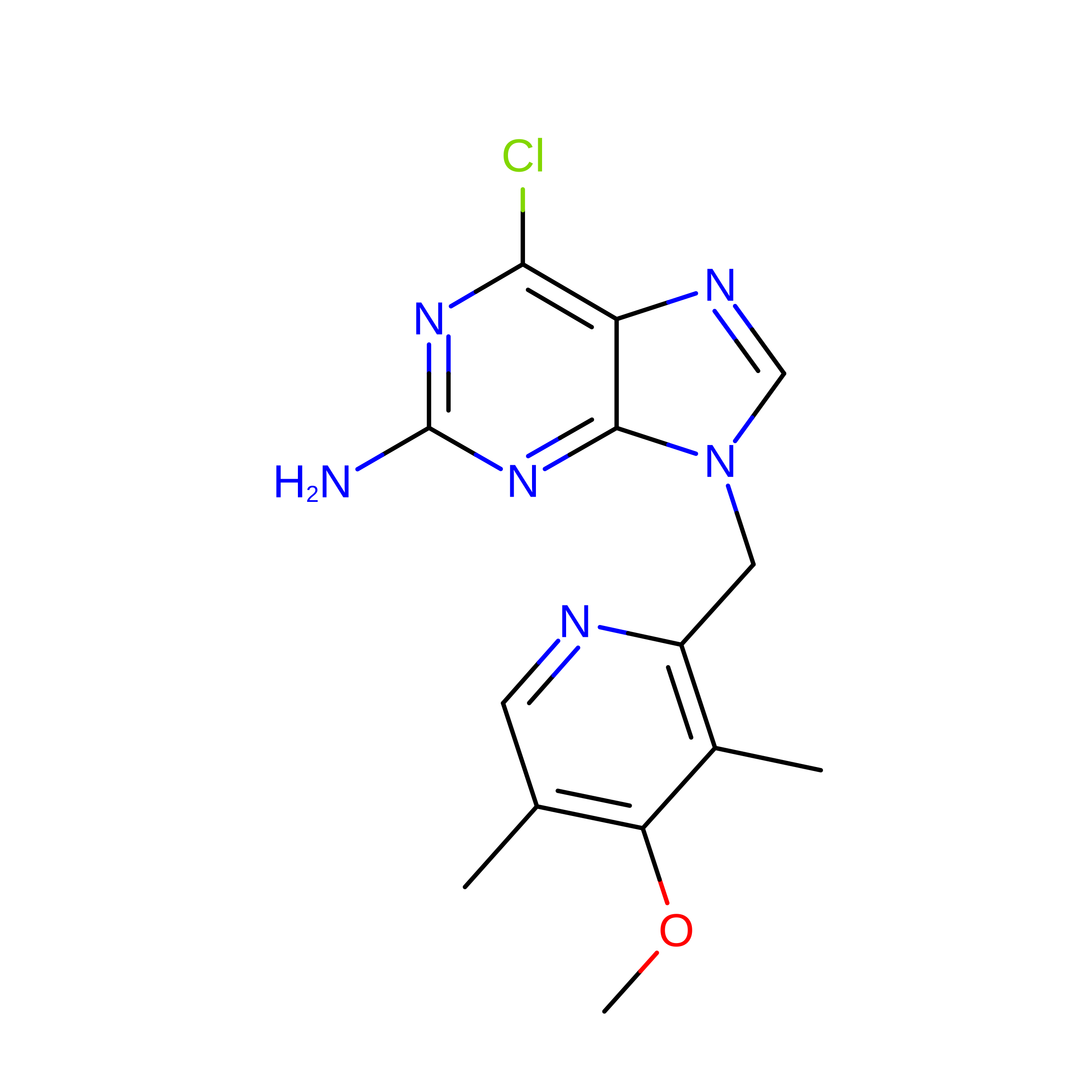
IDChains Name / Formula / InChI Key2D Diagram3D Interactions
94M

Query on 94M


Download:Ideal Coordinates CCD File
B [auth A]6-chloro-9-[(4-methoxy-3,5-dimethylpyridin-2-yl)methyl]-9H-purin-2-amine
C14 H15 Cl N6 O
QULDDKSCVCJTPV-UHFFFAOYSA-N
Binding Affinity Annotations 
IDSourceBinding Affinity
94M BindingDB:  3QDD Ki: min: 1.7, max: 26 (nM) from 4 assay(s)
Kd: min: 1.7, max: 140 (nM) from 3 assay(s)
IC50: min: 5.1, max: 140 (nM) from 9 assay(s)
EC50: min: 30, max: 38 (nM) from 2 assay(s)

Experimental Data & Validation

Experimental Data

  • Method: X-RAY DIFFRACTION
  • Resolution: 1.79 Å
  • R-Value Free:  0.209 (Depositor), 0.215 (DCC) 
  • R-Value Work:  0.172 (Depositor), 0.175 (DCC) 
  • R-Value Observed: 0.173 (Depositor) 
Space Group: I 2 2 2
Unit Cell:
Length ( Å )Angle ( ˚ )
a = 66.625α = 90
b = 91.064β = 90
c = 99.205γ = 90
Software Package:
Software NamePurpose
CrystalCleardata collection
MOLREPphasing
REFMACrefinement
HKL-2000data reduction
HKL-2000data scaling

Structure Validation

View Full Validation Report


Ligand Structure Quality Assessment 


Entry History 

Deposition Data

Revision History  (Full details and data files)

  • Version 1.0: 2012-07-18
    Type: Initial release
  • Version 1.1: 2012-09-19
    Changes: Database references
  • Version 1.2: 2012-09-26
    Changes: Database references
  • Version 1.3: 2022-10-05
    Changes: Database references, Derived calculations, Structure summary
  • Version 1.4: 2024-05-22
    Changes: Data collection