3POA | pdb_00003poa

Structural and functional analysis of phosphothreonine-dependent FHA domain interactions


Experimental Data Snapshot

  • Method: X-RAY DIFFRACTION
  • Resolution: 2.01 Å
  • R-Value Free: 
    0.237 (Depositor), 0.252 (DCC) 
  • R-Value Work: 
    0.179 (Depositor), 0.188 (DCC) 
  • R-Value Observed: 
    0.182 (Depositor) 

wwPDB Validation 3D Report Full Report

Validation slider image for 3POA

This is version 1.2 of the entry. See complete history

Literature

Structural and functional analysis of phosphothreonine-dependent FHA domain interactions

Pennell, S.Westcott, S.Ortiz-Lombardia, M.Patel, D.Li, J.Nott, T.J.Mohammed, D.Buxton, R.S.Yaffe, M.B.Verma, C.Smerdon, S.J.

(2010) Structure 18: 1587-1595

  • DOI: https://doi.org/10.1016/j.str.2010.09.014
  • Primary Citation Related Structures: 
    3PO8, 3POA

  • PubMed Abstract: 

    FHA domains are well established as phospho-dependent binding modules mediating signal transduction in Ser/Thr kinase signaling networks in both eukaryotic and prokaryotic species. Although they are unique in binding exclusively to phosphothreonine, the basis for this discrimination over phosphoserine has remained elusive. Here, we attempt to dissect overall binding specificity at the molecular level. We first determined the optimal peptide sequence for Rv0020c FHA domain binding by oriented peptide library screening. This served as a basis for systematic mutagenic and binding analyses, allowing us to derive relative thermodynamic contributions of conserved protein and peptide residues to binding and specificity. Structures of phosphopeptide-bound and uncomplexed Rv0020c FHA domain then directed molecular dynamics simulations which show how the extraordinary discrimination in favor of phosphothreonine occurs through formation of additional hydrogen-bonding networks that are ultimately stabilized by van der Waals interactions of the phosphothreonine γ-methyl group with a conserved pocket on the FHA domain surface.


  • Organizational Affiliation
    • Division of Molecular Structure, MRC National Institute for Medical Research, The Ridgeway, London NW71AA, UK. spennel@nimr.mrc.ac.uk

Macromolecule Content 

  • Total Structure Weight: 12.46 kDa 
  • Atom Count: 1,038 
  • Modeled Residue Count: 103 
  • Deposited Residue Count: 112 
  • Unique protein chains: 2

Macromolecules

Find similar proteins by:|  3D Structure
Entity ID: 1
MoleculeChains  Sequence LengthOrganismDetailsImage
Putative uncharacterized protein TB39.8100Mycobacterium tuberculosisMutation(s): 0 
Gene Names: Rv0020c
UniProt
Find proteins for P71590 (Mycobacterium tuberculosis (strain ATCC 25618 / H37Rv))
Explore P71590 
Go to UniProtKB:  P71590
Entity Groups
Sequence Clusters30% Identity50% Identity70% Identity90% Identity95% Identity100% Identity
UniProt GroupP71590
Sequence Annotations
Expand
Reference Sequence
Find similar proteins by:  Sequence   |   3D Structure  
Entity ID: 2
MoleculeChains  Sequence LengthOrganismDetailsImage
synthetic phosphopeptide12N/AMutation(s): 0 

Small Molecules

Ligands 1 Unique
IDChains Name / Formula / InChI Key2D Diagram3D Interactions
ZN

Query on ZN


Download:Ideal Coordinates CCD File
C [auth A]ZINC ION
Zn
PTFCDOFLOPIGGS-UHFFFAOYSA-N
Modified Residues  1 Unique
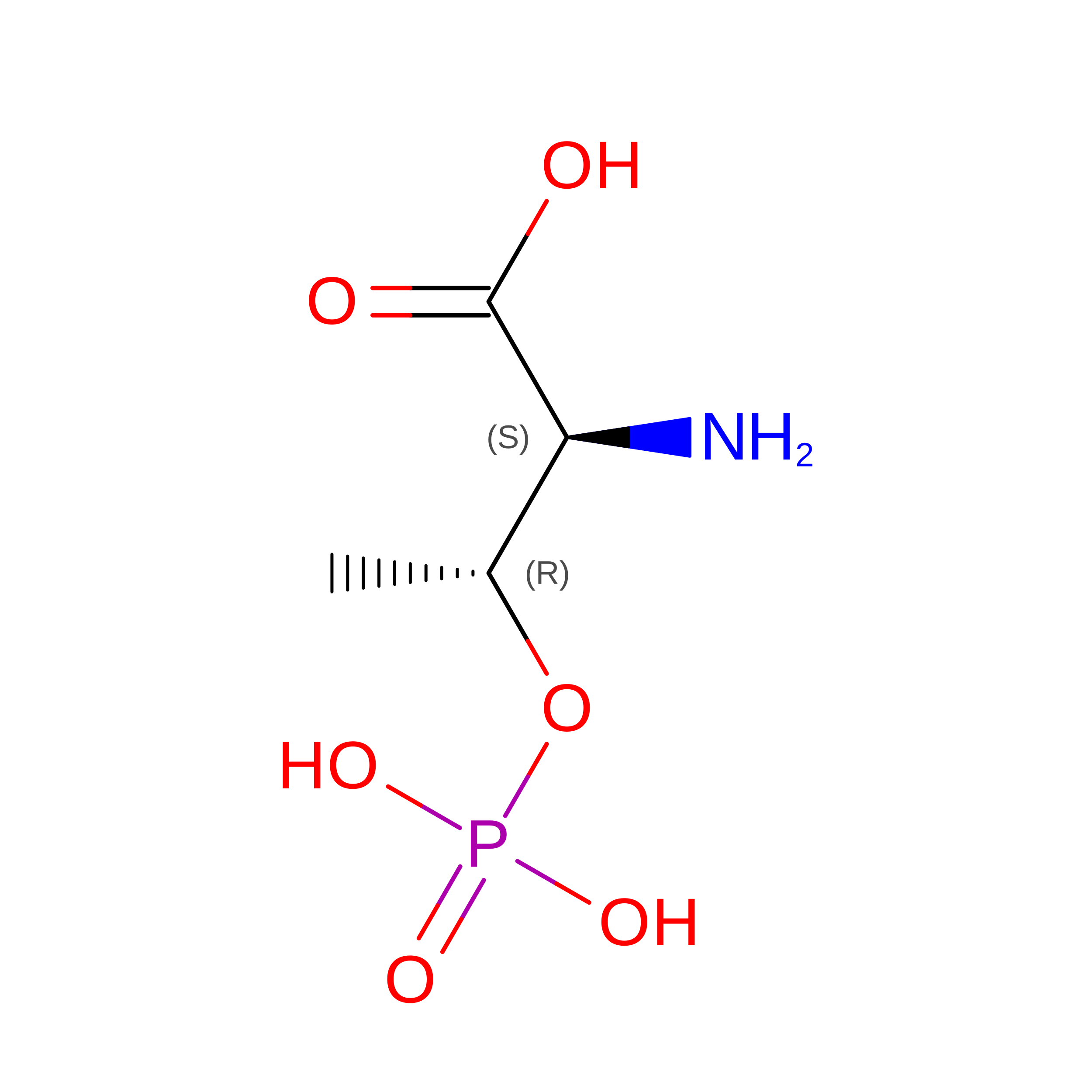
IDChains TypeFormula2D DiagramParent
TPO
Query on TPO
B
L-PEPTIDE LINKINGC4 H10 N O6 PTHR

Experimental Data & Validation

Experimental Data

  • Method: X-RAY DIFFRACTION
  • Resolution: 2.01 Å
  • R-Value Free:  0.237 (Depositor), 0.252 (DCC) 
  • R-Value Work:  0.179 (Depositor), 0.188 (DCC) 
  • R-Value Observed: 0.182 (Depositor) 
Space Group: C 2 2 21
Unit Cell:
Length ( Å )Angle ( ˚ )
a = 57.016α = 90
b = 74.425β = 90
c = 63.016γ = 90
Software Package:
Software NamePurpose
REFMACrefinement

Structure Validation

View Full Validation Report


Entry History 

Deposition Data

Revision History  (Full details and data files)

  • Version 1.0: 2011-01-26
    Type: Initial release
  • Version 1.1: 2011-07-13
    Changes: Version format compliance
  • Version 1.2: 2024-11-13
    Changes: Data collection, Database references, Derived calculations, Structure summary