3PHT | pdb_00003pht

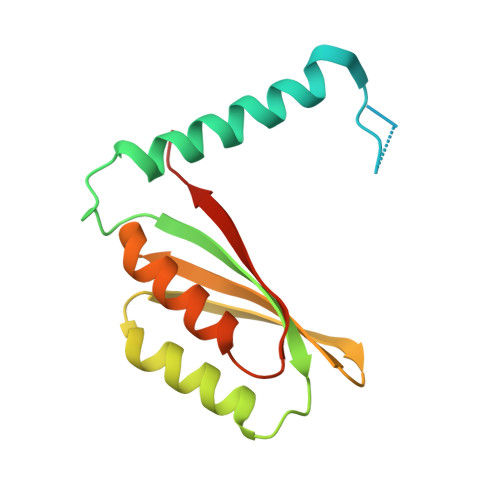
Crystal structure of H74A mutant of Helicobacter Pylori NikR


Experimental Data Snapshot

  • Method: X-RAY DIFFRACTION
  • Resolution: 2.04 Å
  • R-Value Free: 
    0.230 (Depositor), 0.247 (DCC) 
  • R-Value Work: 
    0.191 (Depositor), 0.211 (DCC) 
  • R-Value Observed: 
    0.193 (Depositor) 

Starting Model: experimental
View more details

wwPDB Validation 3D Report Full Report

Validation slider image for 3PHT

This is version 1.4 of the entry. See complete history

Literature

Ni(II) coordination to mixed sites modulates DNA binding of HpNikR via a long-range effect.

West, A.L.Evans, S.E.Gonzalez, J.M.Carter, L.G.Tsuruta, H.Pozharski, E.Michel, S.L.

(2012) Proc Natl Acad Sci U S A 109: 5633-5638

  • DOI: https://doi.org/10.1073/pnas.1120283109
  • Primary Citation Related Structures: 
    3PHT, 3QSI

  • PubMed Abstract: 

    Helicobacter pylori NikR (HpNikR) is a nickel-dependent transcription factor that regulates multiple genes in the H. pylori pathogen. There are conflicting data regarding the locations of the Ni(II) sites and the role of Ni(II) coordination in DNA recognition. Herein, we report crystal structures of (i) the metal-binding domain (MBD) of HpNikR (3.08 Å) and (ii) a mutant, H74A (2.04 Å), designed to disrupt native Ni(II) coordination. In the MBD structure, four nickel ions are coordinated to two different types of nickel sites (4-coordinate, square planar, and 5/6-coordinate, square pyramidal/octahedral). In the H74A structure, all four nickel ions are coordinated to 4-coordinate square-planar sites. DNA-binding studies reveal tighter binding for target DNA sequences for holo-HpNikR compared with the affinities of Ni(II) reconstituted apo-HpNikR and H74A for these same DNA targets, supporting a role for Ni(II) coordination to 5/6 sites in DNA recognition. Small-angle X-ray scattering studies of holo-HpNikR and H74A reveal a high degree of conformational flexibility centered at the DNA-binding domains of H74A, which is consistent with disorder observed in the crystal structure of the protein. A model of DNA recognition by HpNikR is proposed in which Ni(II) coordination to specific sites in the MBD have a long-range effect on the flexibility of the DNA-binding domains and, consequently, the DNA recognition properties.


  • Organizational Affiliation
    • Department of Pharmaceutical Sciences, School of Pharmacy, University of Maryland, Baltimore, MD 21201, USA.

Macromolecule Content 

  • Total Structure Weight: 34.32 kDa 
  • Atom Count: 1,718 
  • Modeled Residue Count: 197 
  • Deposited Residue Count: 296 
  • Unique protein chains: 1

Macromolecules

Find similar proteins by:|  3D Structure
Entity ID: 1
MoleculeChains  Sequence LengthOrganismDetailsImage
Putative nickel-responsive regulator
A, B
148Helicobacter pyloriMutation(s): 1 
Gene Names: HP_1338
UniProt
Find proteins for O25896 (Helicobacter pylori (strain ATCC 700392 / 26695))
Explore O25896 
Go to UniProtKB:  O25896
Entity Groups
Sequence Clusters30% Identity50% Identity70% Identity90% Identity95% Identity100% Identity
UniProt GroupO25896
Sequence Annotations
Expand
Reference Sequence

Experimental Data & Validation

Experimental Data

  • Method: X-RAY DIFFRACTION
  • Resolution: 2.04 Å
  • R-Value Free:  0.230 (Depositor), 0.247 (DCC) 
  • R-Value Work:  0.191 (Depositor), 0.211 (DCC) 
  • R-Value Observed: 0.193 (Depositor) 
Space Group: P 43 21 2
Unit Cell:
Length ( Å )Angle ( ˚ )
a = 73.174α = 90
b = 73.174β = 90
c = 114.441γ = 90
Software Package:
Software NamePurpose
StructureStudiodata collection
PHASERphasing
REFMACrefinement
DENZOdata reduction
SCALEPACKdata scaling

Structure Validation

View Full Validation Report


Entry History 

Deposition Data

Revision History  (Full details and data files)

  • Version 1.0: 2011-11-23
    Type: Initial release
  • Version 1.1: 2012-04-04
    Changes: Database references
  • Version 1.2: 2012-04-11
    Changes: Database references
  • Version 1.3: 2012-04-25
    Changes: Database references
  • Version 1.4: 2023-09-06
    Changes: Data collection, Database references, Derived calculations, Refinement description