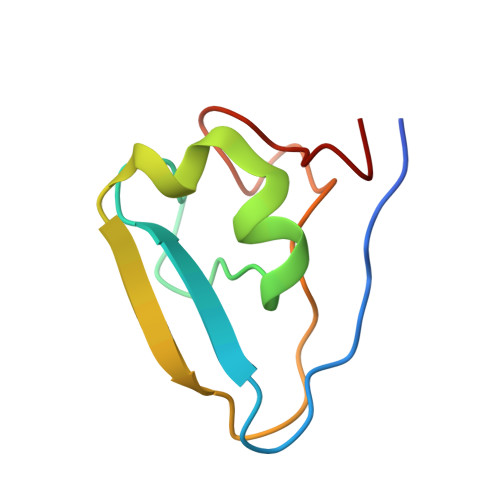
3NY2 | pdb_00003ny2

Structure of the ubr-box of UBR2 ubiquitin ligase


Experimental Data Snapshot

  • Method: X-RAY DIFFRACTION
  • Resolution: 2.61 Å
  • R-Value Free: 
    0.288 (Depositor), 0.284 (DCC) 
  • R-Value Work: 
    0.230 (Depositor), 0.228 (DCC) 
  • R-Value Observed: 
    0.233 (Depositor) 

wwPDB Validation 3D Report Full Report

Validation slider image for 3NY2

This is version 1.2 of the entry. See complete history

Literature

Structural basis of substrate recognition and specificity in the N-end rule pathway.

Matta-Camacho, E.Kozlov, G.Li, F.F.Gehring, K.

(2010) Nat Struct Mol Biol 17: 1182-1187

  • DOI: https://doi.org/10.1038/nsmb.1894
  • Primary Citation Related Structures: 
    3NY1, 3NY2, 3NY3

  • PubMed Abstract: 

    The N-end rule links the half-life of a protein to the identity of its N-terminal residue. Destabilizing N-terminal residues are recognized by E3 ubiquitin ligases, termed N-recognins. A conserved structural domain called the UBR box is responsible for their specificity. Here we report the crystal structures of the UBR boxes of the human N-recognins UBR1 and UBR2, alone and in complex with an N-end rule peptide, Arg-Ile-Phe-Ser. These structures show that the UBR box adopts a previously undescribed fold stabilized through the binding of three zinc ions to form a binding pocket for type 1 N-degrons. NMR experiments reveal a preference for N-terminal arginine. Peptide binding is abrogated by N-terminal acetylation of the peptide or loss of the positive charge of the N-terminal residue. These results rationalize and refine the empirical rules for the classification of type 1 N-degrons. We also confirm that a missense mutation in UBR1 that is responsible for Johanson-Blizzard syndrome leads to UBR box unfolding and loss of function.


  • Organizational Affiliation
    • Department of Biochemistry, McGill University, Montreal, Quebec, Canada.

Macromolecule Content 

  • Total Structure Weight: 67.47 kDa 
  • Atom Count: 4,357 
  • Modeled Residue Count: 575 
  • Deposited Residue Count: 600 
  • Unique protein chains: 1

Macromolecules

Find similar proteins by:|  3D Structure
Entity ID: 1
MoleculeChains  Sequence LengthOrganismDetailsImage
E3 ubiquitin-protein ligase UBR2
A, B, C, D, E
A, B, C, D, E, F, G, H
75Homo sapiensMutation(s): 0 
Gene Names: UBR2C6orf133KIAA0349
EC: 6.3.2 (PDB Primary Data), 2.3.2.27 (UniProt)
UniProt & NIH Common Fund Data Resources
Find proteins for Q8IWV8 (Homo sapiens)
Explore Q8IWV8 
Go to UniProtKB:  Q8IWV8
PHAROS:  Q8IWV8
GTEx:  ENSG00000024048 
Entity Groups
Sequence Clusters30% Identity50% Identity70% Identity90% Identity95% Identity100% Identity
UniProt GroupQ8IWV8
Sequence Annotations
Expand
Reference Sequence

Small Molecules

Ligands 1 Unique
IDChains Name / Formula / InChI Key2D Diagram3D Interactions
ZN

Query on ZN


Download:Ideal Coordinates CCD File
AA [auth G]
BA [auth G]
CA [auth G]
DA [auth H]
EA [auth H]
AA [auth G],
BA [auth G],
CA [auth G],
DA [auth H],
EA [auth H],
FA [auth H],
I [auth A],
J [auth A],
K [auth A],
L [auth B],
M [auth B],
N [auth B],
O [auth C],
P [auth C],
Q [auth C],
R [auth D],
S [auth D],
T [auth D],
U [auth E],
V [auth E],
W [auth E],
X [auth F],
Y [auth F],
Z [auth F]
ZINC ION
Zn
PTFCDOFLOPIGGS-UHFFFAOYSA-N

Experimental Data & Validation

Experimental Data

  • Method: X-RAY DIFFRACTION
  • Resolution: 2.61 Å
  • R-Value Free:  0.288 (Depositor), 0.284 (DCC) 
  • R-Value Work:  0.230 (Depositor), 0.228 (DCC) 
  • R-Value Observed: 0.233 (Depositor) 
Space Group: P 1
Unit Cell:
Length ( Å )Angle ( ˚ )
a = 29.39α = 65.05
b = 61.456β = 89.98
c = 72.806γ = 90.01
Software Package:
Software NamePurpose
ADSCdata collection
PHASERphasing
REFMACrefinement
HKL-2000data reduction
HKL-2000data scaling

Structure Validation

View Full Validation Report


Entry History 

Deposition Data

Revision History  (Full details and data files)

  • Version 1.0: 2010-08-11
    Type: Initial release
  • Version 1.1: 2011-07-13
    Changes: Version format compliance
  • Version 1.2: 2024-02-21
    Changes: Data collection, Database references, Derived calculations, Refinement description