3NNF | pdb_00003nnf

Halogenase domain from CurA module with Fe, chloride, and alpha-ketoglutarate


Experimental Data Snapshot

  • Method: X-RAY DIFFRACTION
  • Resolution: 2.20 Å
  • R-Value Free: 
    0.231 (Depositor), 0.233 (DCC) 
  • R-Value Work: 
    0.195 (Depositor), 0.205 (DCC) 
  • R-Value Observed: 
    0.197 (Depositor) 

Starting Model: experimental
View more details

wwPDB Validation 3D Report Full Report

Validation slider image for 3NNF

This is version 1.4 of the entry. See complete history

Literature

Conformational switch triggered by alpha-ketoglutarate in a halogenase of curacin A biosynthesis

Khare, D.Wang, B.Gu, L.Razelun, J.Sherman, D.H.Gerwick, W.H.Hakansson, K.Smith, J.L.

(2010) Proc Natl Acad Sci U S A 107: 14099-14104

  • DOI: https://doi.org/10.1073/pnas.1006738107
  • Primary Citation Related Structures: 
    3NNF, 3NNJ, 3NNL, 3NNM

  • PubMed Abstract: 

    The CurA halogenase (Hal) catalyzes a cryptic chlorination leading to cyclopropane ring formation in the synthesis of the natural product curacin A. Hal belongs to a family of enzymes that use Fe(2+), O(2) and alpha-ketoglutarate (alphaKG) to perform a variety of halogenation reactions in natural product biosynthesis. Crystal structures of the enzyme in five ligand states reveal strikingly different open and closed conformations dependent on alphaKG binding. The open form represents ligand-free enzyme, preventing substrate from entering the active site until both alphaKG and chloride are bound, while the closed form represents the holoenzyme with alphaKG and chloride coordinated to iron. Candidate amino acid residues involved in substrate recognition were identified by site-directed mutagenesis. These new structures provide direct evidence of a conformational switch driven by alphaKG leading to chlorination of an early pathway intermediate.


  • Organizational Affiliation
    • Life Sciences Institute, University of Michigan, Ann Arbor, MI 48109, USA.

Macromolecule Content 

  • Total Structure Weight: 40.42 kDa 
  • Atom Count: 2,763 
  • Modeled Residue Count: 318 
  • Deposited Residue Count: 344 
  • Unique protein chains: 1

Macromolecules

Find similar proteins by:|  3D Structure
Entity ID: 1
MoleculeChains  Sequence LengthOrganismDetailsImage
CurA344Lyngbya majusculaMutation(s): 0 
Gene Names: curA
UniProt
Find proteins for Q6DNF2 (Lyngbya majuscula)
Explore Q6DNF2 
Go to UniProtKB:  Q6DNF2
Entity Groups
Sequence Clusters30% Identity50% Identity70% Identity90% Identity95% Identity100% Identity
UniProt GroupQ6DNF2
Sequence Annotations
Expand
Reference Sequence

Small Molecules

Ligands 4 Unique
IDChains Name / Formula / InChI Key2D Diagram3D Interactions
AKG

Query on AKG


Download:Ideal Coordinates CCD File
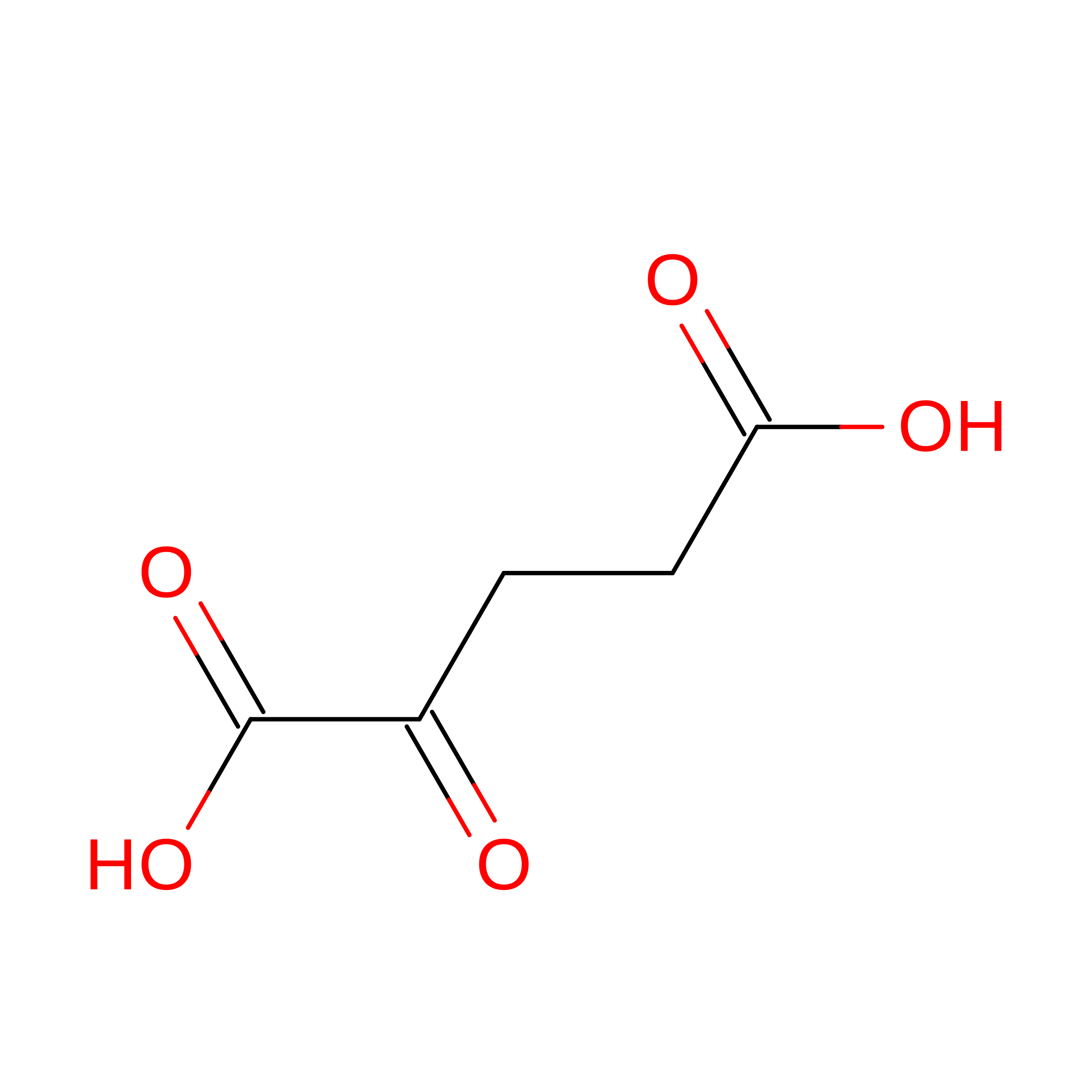
I [auth A]2-OXOGLUTARIC ACID
C5 H6 O5
KPGXRSRHYNQIFN-UHFFFAOYSA-N
FE

Query on FE


Download:Ideal Coordinates CCD File
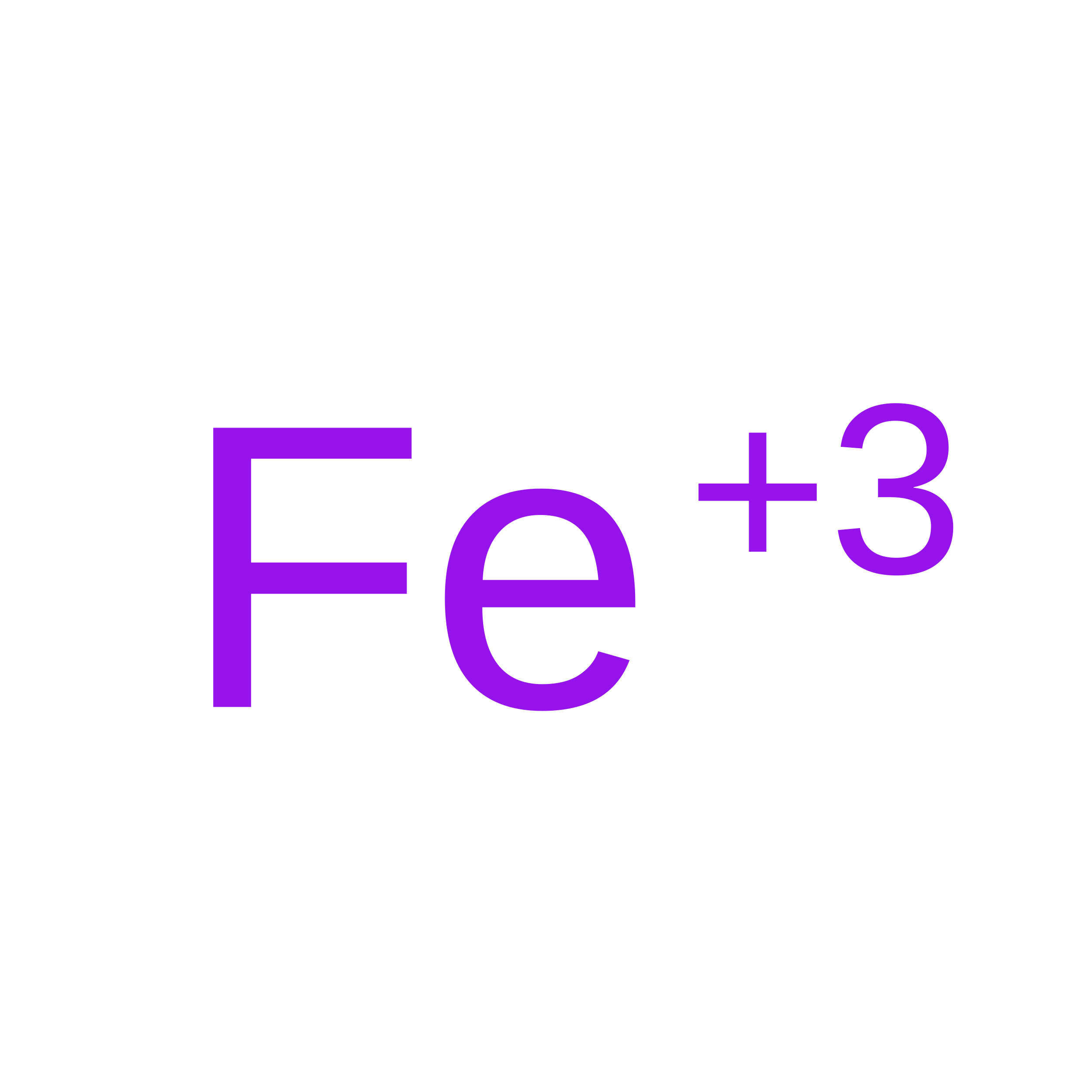
B [auth A]FE (III) ION
Fe
VTLYFUHAOXGGBS-UHFFFAOYSA-N
FMT

Query on FMT


Download:Ideal Coordinates CCD File
C [auth A]
D [auth A]
E [auth A]
F [auth A]
G [auth A]
C [auth A],
D [auth A],
E [auth A],
F [auth A],
G [auth A],
H [auth A]
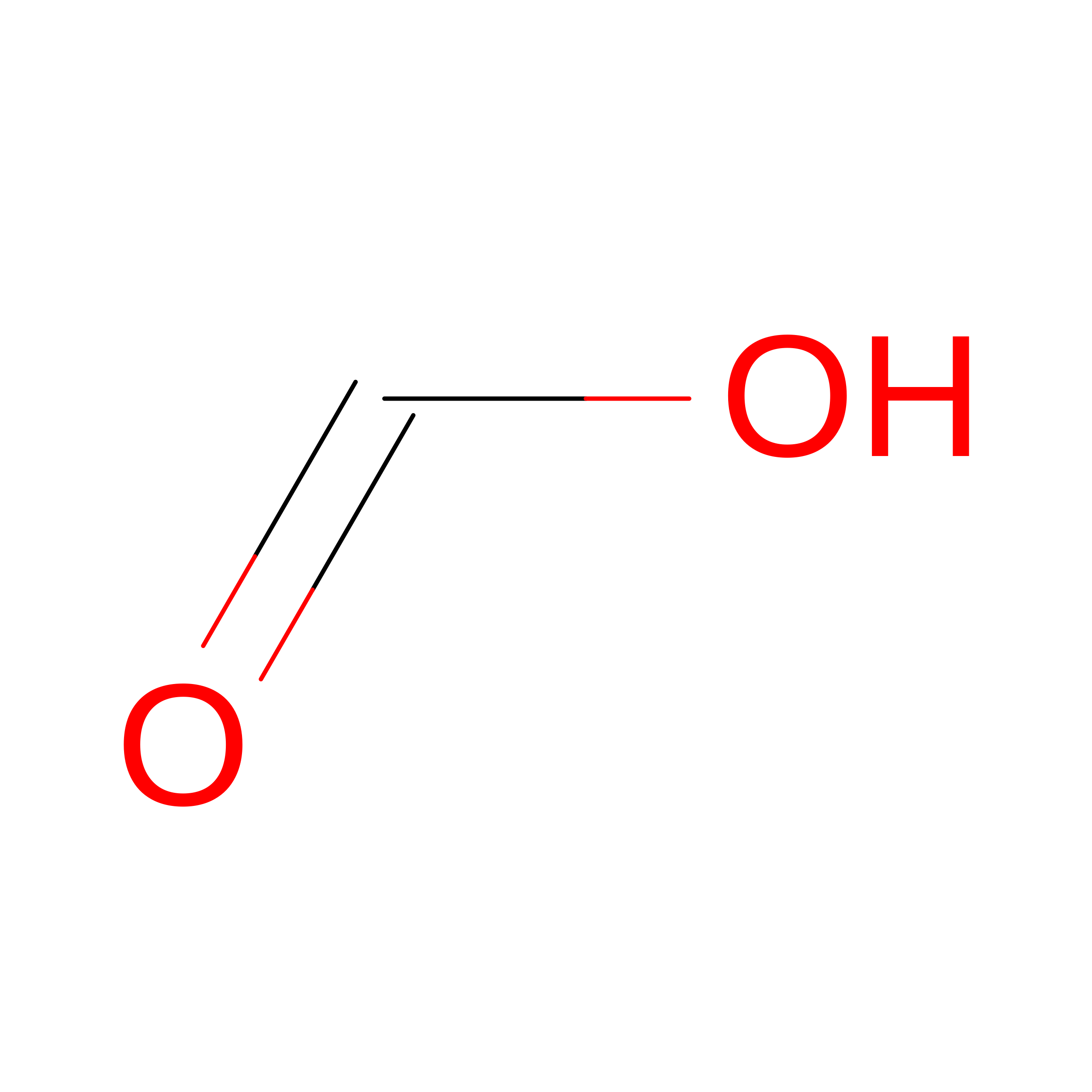
FORMIC ACID
C H2 O2
BDAGIHXWWSANSR-UHFFFAOYSA-N
CL

Query on CL


Download:Ideal Coordinates CCD File
J [auth A]CHLORIDE ION
Cl
VEXZGXHMUGYJMC-UHFFFAOYSA-M

Experimental Data & Validation

Experimental Data

  • Method: X-RAY DIFFRACTION
  • Resolution: 2.20 Å
  • R-Value Free:  0.231 (Depositor), 0.233 (DCC) 
  • R-Value Work:  0.195 (Depositor), 0.205 (DCC) 
  • R-Value Observed: 0.197 (Depositor) 
Space Group: P 43 21 2
Unit Cell:
Length ( Å )Angle ( ˚ )
a = 87.563α = 90
b = 87.563β = 90
c = 157.745γ = 90
Software Package:
Software NamePurpose
JBluIce-EPICSdata collection
PHASERphasing
PHENIXrefinement
HKL-2000data reduction
HKL-2000data scaling

Structure Validation

View Full Validation Report


Entry History 

Deposition Data

Revision History  (Full details and data files)

  • Version 1.0: 2010-07-28
    Type: Initial release
  • Version 1.1: 2011-07-13
    Changes: Version format compliance
  • Version 1.2: 2017-11-08
    Changes: Refinement description
  • Version 1.3: 2023-12-27
    Changes: Data collection, Database references, Derived calculations
  • Version 1.4: 2024-04-03
    Changes: Refinement description