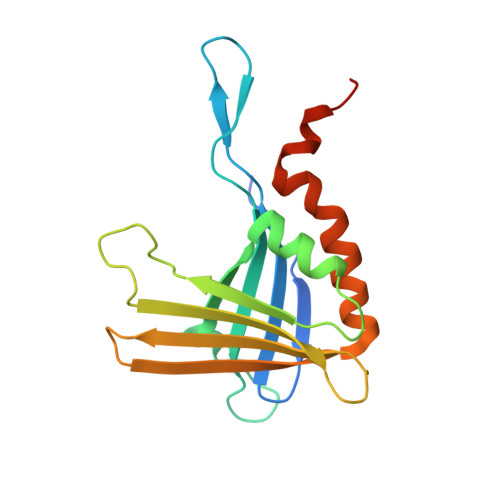
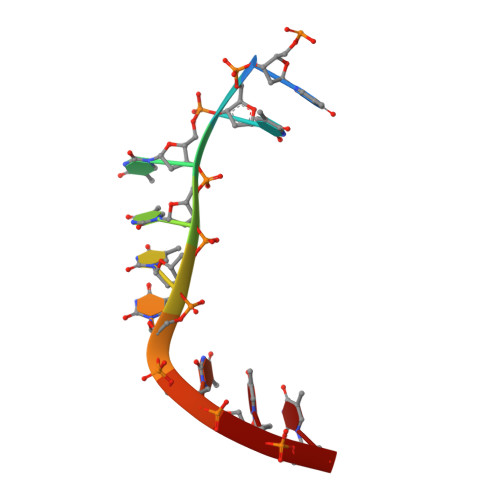
3N1J | pdb_00003n1j

Crystal structure of a StWhy2-dT32 complex


Experimental Data Snapshot

  • Method: X-RAY DIFFRACTION
  • Resolution: 2.65 Å
  • R-Value Free: 
    0.258 (Depositor), 0.253 (DCC) 
  • R-Value Work: 
    0.211 (Depositor), 0.211 (DCC) 
  • R-Value Observed: 
    0.216 (Depositor) 

Starting Model: experimental
View more details

wwPDB Validation 3D Report Full Report

Validation slider image for 3N1J

This is version 1.3 of the entry. See complete history

Literature

Crystal Structures of DNA-Whirly Complexes and Their Role in Arabidopsis Organelle Genome Repair.

Cappadocia, L.Marechal, A.Parent, J.S.Lepage, E.Sygusch, J.Brisson, N.

(2010) Plant Cell 22: 1849-1867

  • DOI: https://doi.org/10.1105/tpc.109.071399
  • Primary Citation Related Structures: 
    3N1H, 3N1I, 3N1J, 3N1K, 3N1L

  • PubMed Abstract: 

    DNA double-strand breaks are highly detrimental to all organisms and need to be quickly and accurately repaired. Although several proteins are known to maintain plastid and mitochondrial genome stability in plants, little is known about the mechanisms of DNA repair in these organelles and the roles of specific proteins. Here, using ciprofloxacin as a DNA damaging agent specific to the organelles, we show that plastids and mitochondria can repair DNA double-strand breaks through an error-prone pathway similar to the microhomology-mediated break-induced replication observed in humans, yeast, and bacteria. This pathway is negatively regulated by the single-stranded DNA (ssDNA) binding proteins from the Whirly family, thus indicating that these proteins could contribute to the accurate repair of plant organelle genomes. To understand the role of Whirly proteins in this process, we solved the crystal structures of several Whirly-DNA complexes. These reveal a nonsequence-specific ssDNA binding mechanism in which DNA is stabilized between domains of adjacent subunits and rendered unavailable for duplex formation and/or protein interactions. Our results suggest a model in which the binding of Whirly proteins to ssDNA would favor accurate repair of DNA double-strand breaks over an error-prone microhomology-mediated break-induced replication repair pathway.


  • Organizational Affiliation
    • Department of Biochemistry, Université de Montréal, Montreal, Canada H3C 3J7.

Macromolecule Content 

  • Total Structure Weight: 22.69 kDa 
  • Atom Count: 1,506 
  • Modeled Residue Count: 170 
  • Deposited Residue Count: 187 
  • Unique protein chains: 1
  • Unique nucleic acid chains: 1

Macromolecules


Find similar proteins by:|  3D Structure
Entity ID: 1
MoleculeChains  Sequence LengthOrganismDetailsImage
Protein StWhy2178Solanum tuberosumMutation(s): 0 
Gene Names: StWhy2
UniProt
Find proteins for D9J034 (Solanum tuberosum)
Explore D9J034 
Go to UniProtKB:  D9J034
Entity Groups
Sequence Clusters30% Identity50% Identity70% Identity90% Identity95% Identity100% Identity
UniProt GroupD9J034
Sequence Annotations
Expand
Reference Sequence
Find similar nucleic acids by:  Sequence
Entity ID: 2
MoleculeChains LengthOrganismImage
DNA 32-mer dT329N/A
Sequence Annotations
Expand
Reference Sequence

Experimental Data & Validation

Experimental Data

  • Method: X-RAY DIFFRACTION
  • Resolution: 2.65 Å
  • R-Value Free:  0.258 (Depositor), 0.253 (DCC) 
  • R-Value Work:  0.211 (Depositor), 0.211 (DCC) 
  • R-Value Observed: 0.216 (Depositor) 
Space Group: F 4 3 2
Unit Cell:
Length ( Å )Angle ( ˚ )
a = 166.495α = 90
b = 166.495β = 90
c = 166.495γ = 90
Software Package:
Software NamePurpose
PHENIXrefinement
PHENIXmodel building
CNSrefinement
CBASSdata collection
HKL-2000data reduction
HKL-2000data scaling
PHENIXphasing
CNSphasing

Structure Validation

View Full Validation Report


Entry History 

Deposition Data

Revision History  (Full details and data files)

  • Version 1.0: 2010-08-11
    Type: Initial release
  • Version 1.1: 2011-07-13
    Changes: Version format compliance
  • Version 1.2: 2019-07-17
    Changes: Data collection, Refinement description
  • Version 1.3: 2023-09-06
    Changes: Data collection, Database references, Refinement description