Download Mendeley
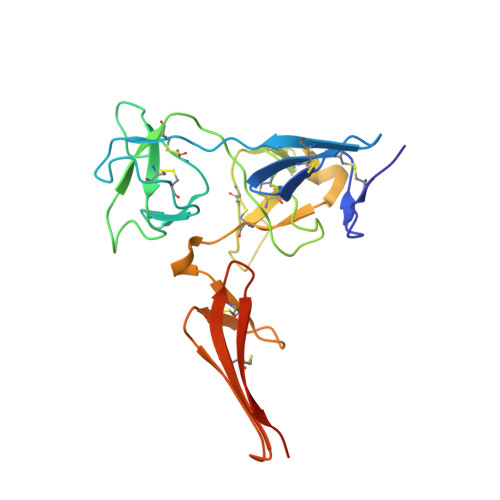
Implications for collagen binding from the crystallographic structure of fibronectin 6FnI1-2FnII7FnI
Erat, M.C., Schwarz-Linek, U., Pickford, A.R., Farndale, R.W., Campbell, I.D., Vakonakis, I.(2010) J Biol Chem 285: 33764-33770
- PubMed: 20739283 Search on PubMedSearch on PubMed Central
- DOI: https://doi.org/10.1074/jbc.M110.139394
- Primary Citation Related Structures:
3MQL - PubMed Abstract:
Collagen and fibronectin (FN) are two abundant and essential components of the vertebrate extracellular matrix; they interact directly with cellular receptors and affect cell adhesion and migration. Past studies identified a FN fragment comprising six modules, (6)FnI(1-2)FnII(7-9)FnI, and termed the gelatin binding domain (GBD) as responsible for collagen interaction. Recently, we showed that the GBD binds tightly to a specific site within type I collagen and determined the structure of domains (8-9)FnI in complex with a peptide from that site. Here, we present the crystallographic structure of domains (6)FnI(1-2)FnII(7)FnI, which form a compact, globular unit through interdomain interactions. Analysis of NMR titrations with single-stranded collagen peptides reveals a dominant collagen interaction surface on domains (2)FnII and (7)FnI; a similar surface appears involved in interactions with triple-helical peptides. Models of the complete GBD, based on the new structure and the (8-9)FnI·collagen complex show a continuous putative collagen binding surface. We explore the implications of this model using long collagen peptides and discuss our findings in the context of FN interactions with collagen fibrils.
- Department of Biochemistry, University of Oxford, Oxford OX1 3QU, United Kingdom.
Organizational Affiliation: