3LEZ | pdb_00003lez

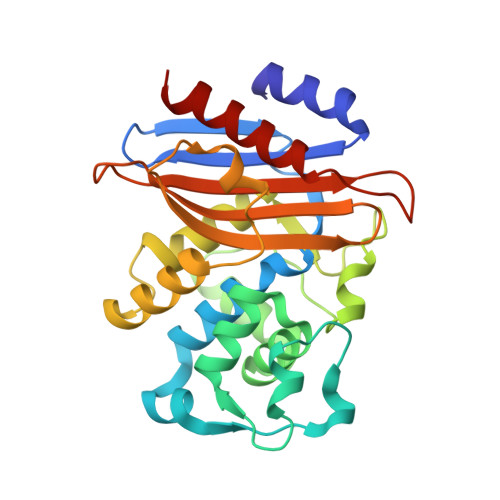
Crystal structure of a halotolerant bacterial beta-lactamase


Experimental Data Snapshot

  • Method: X-RAY DIFFRACTION
  • Resolution: 1.25 Å
  • R-Value Free: 
    0.174 (Depositor) 
  • R-Value Work: 
    0.154 (Depositor) 
  • R-Value Observed: 
    0.155 (Depositor) 

wwPDB Validation 3D Report Full Report

Validation slider image for 3LEZ

This is version 1.2 of the entry. See complete history

Literature

An antibiotic-resistance enzyme from a deep-sea bacterium

Toth, M.Smith, C.Frase, H.Mobashery, S.Vakulenko, S.

(2010) J Am Chem Soc 132: 816-823

  • DOI: https://doi.org/10.1021/ja908850p
  • Primary Citation Related Structures: 
    3LEZ

  • PubMed Abstract: 

    We describe herein a highly proficient class A beta-lactamase OIH-1 from the bacterium Oceanobacillus iheyensis, whose habitat is the sediment at a depth of 1050 m in the Pacific Ocean. The OIH-1 structure was solved by molecular replacement and refined at 1.25 A resolution. OIH-1 has evolved to be an extremely halotolerant beta-lactamase capable of hydrolyzing its substrates in the presence of NaCl at saturating concentration. Not only is this the most highly halotolerant bacterial enzyme structure known to date, it is also the highest resolution halophilic protein structure yet determined. Evolution of OIH-1 in the salinity of the ocean has resulted in a molecular surface that is coated with acidic residues, a marked difference from beta-lactamases of terrestrial sources. OIH-1 is the first example of an antibiotic-resistance enzyme that has evolved in the depths of the ocean in isolation from clinical selection and gives us an extraordinary glimpse into protein evolution under extreme conditions. It represents evidence for the existence of a reservoir of antibiotic-resistance enzymes in nature among microbial populations from deep oceanic sources.


  • Organizational Affiliation
    • Department of Chemistry and Biochemistry, University of Notre Dame, Notre Dame, Indiana 46556, USA.

Macromolecule Content 

  • Total Structure Weight: 29.46 kDa 
  • Atom Count: 2,677 
  • Modeled Residue Count: 260 
  • Deposited Residue Count: 260 
  • Unique protein chains: 1

Macromolecules

Find similar proteins by:|  3D Structure
Entity ID: 1
MoleculeChains  Sequence LengthOrganismDetailsImage
Beta-lactamase260Oceanobacillus iheyensisMutation(s): 0 
Gene Names: OB2793oih-1
EC: 3.5.2.6
UniProt
Find proteins for Q8EMP8 (Oceanobacillus iheyensis (strain DSM 14371 / CIP 107618 / JCM 11309 / KCTC 3954 / HTE831))
Explore Q8EMP8 
Go to UniProtKB:  Q8EMP8
Entity Groups
Sequence Clusters30% Identity50% Identity70% Identity90% Identity95% Identity100% Identity
UniProt GroupQ8EMP8
Sequence Annotations
Expand
Reference Sequence

Small Molecules

Ligands 3 Unique
IDChains Name / Formula / InChI Key2D Diagram3D Interactions
EPE

Query on EPE


Download:Ideal Coordinates CCD File
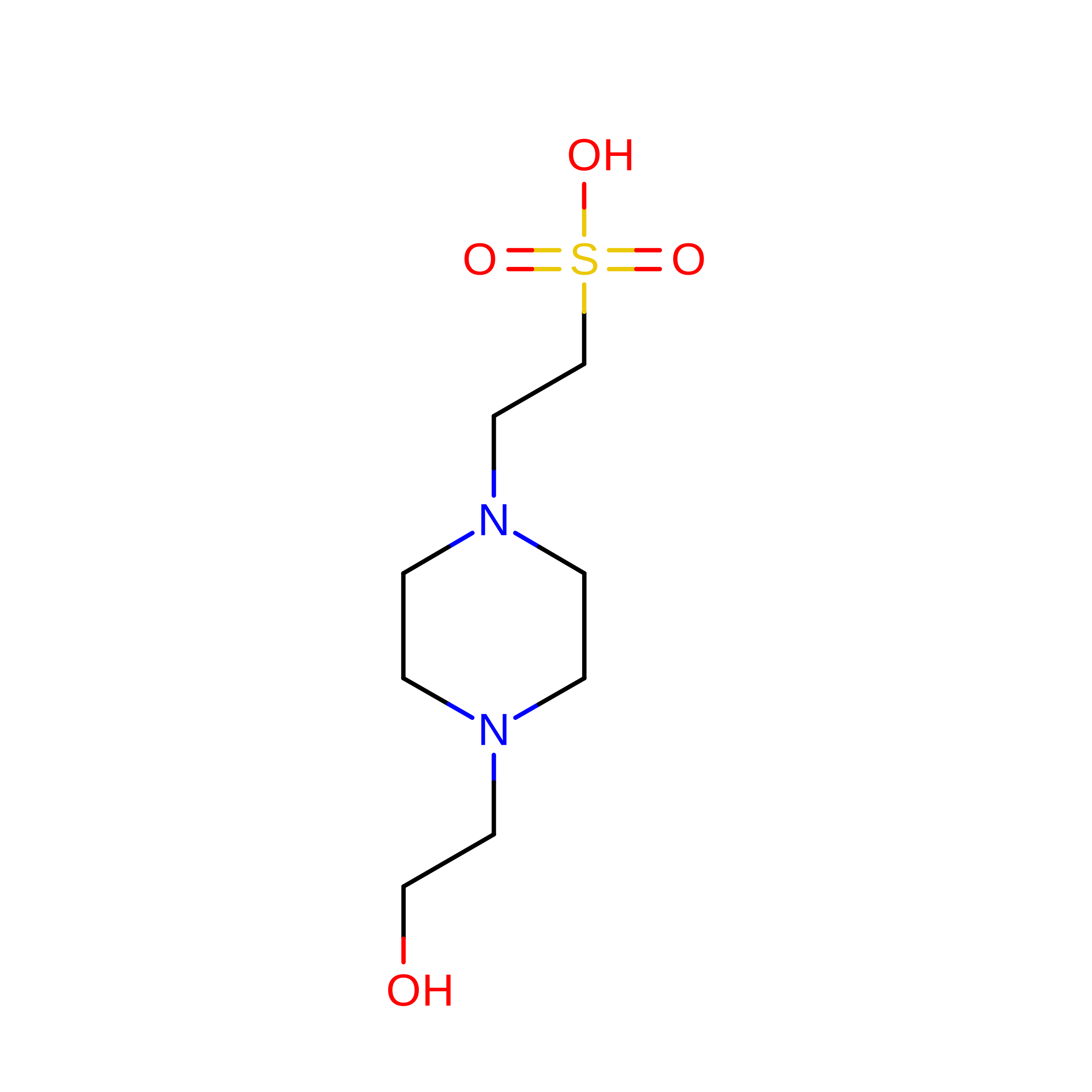
K [auth A]4-(2-HYDROXYETHYL)-1-PIPERAZINE ETHANESULFONIC ACID
C8 H18 N2 O4 S
JKMHFZQWWAIEOD-UHFFFAOYSA-N
CA

Query on CA


Download:Ideal Coordinates CCD File
B [auth A]
C [auth A]
D [auth A]
E [auth A]
F [auth A]
B [auth A],
C [auth A],
D [auth A],
E [auth A],
F [auth A],
G [auth A],
H [auth A],
I [auth A]
CALCIUM ION
Ca
BHPQYMZQTOCNFJ-UHFFFAOYSA-N
CL

Query on CL


Download:Ideal Coordinates CCD File
J [auth A]CHLORIDE ION
Cl
VEXZGXHMUGYJMC-UHFFFAOYSA-M

Experimental Data & Validation

Experimental Data

  • Method: X-RAY DIFFRACTION
  • Resolution: 1.25 Å
  • R-Value Free:  0.174 (Depositor) 
  • R-Value Work:  0.154 (Depositor) 
  • R-Value Observed: 0.155 (Depositor) 
Space Group: P 31 2 1
Unit Cell:
Length ( Å )Angle ( ˚ )
a = 55.98α = 90
b = 55.98β = 90
c = 165.89γ = 120
Software Package:
Software NamePurpose
Blu-Icedata collection
MOLREPphasing
PHENIXrefinement
XDSdata reduction
XSCALEdata scaling

Structure Validation

View Full Validation Report


Entry History 

Deposition Data

Revision History  (Full details and data files)

  • Version 1.0: 2010-02-02
    Type: Initial release
  • Version 1.1: 2011-07-13
    Changes: Version format compliance
  • Version 1.2: 2024-02-21
    Changes: Data collection, Database references, Derived calculations