3LEG | pdb_00003leg

Lectin Domain of Lectinolysin complexed with Lewis Y Antigen


Experimental Data Snapshot

  • Method: X-RAY DIFFRACTION
  • Resolution: 2.01 Å
  • R-Value Free: 
    0.234 (Depositor), 0.233 (DCC) 
  • R-Value Work: 
    0.193 (Depositor), 0.192 (DCC) 
  • R-Value Observed: 
    0.195 (Depositor) 

Starting Model: experimental
View more details

wwPDB Validation 3D Report Full Report

Validation slider image for 3LEG

This is version 2.2 of the entry. See complete history

Literature

Structure of the lectin regulatory domain of the cholesterol-dependent cytolysin lectinolysin reveals the basis for its lewis antigen specificity.

Feil, S.C.Lawrence, S.Mulhern, T.D.Holien, J.K.Hotze, E.M.Farrand, S.Tweten, R.K.Parker, M.W.

(2012) Structure 20: 248-258

  • DOI: https://doi.org/10.1016/j.str.2011.11.017
  • Primary Citation Related Structures: 
    3LE0, 3LEG, 3LEI, 3LEK

  • PubMed Abstract: 

    The cholesterol-dependent cytolysins (CDCs) punch holes in target cell membranes through a highly regulated process. Streptococcus mitis lectinolysin (LLY) exhibits another layer of regulation with a lectin domain that enhances the pore-forming activity of the toxin. We have determined the crystal structures of the lectin domain by itself and in complex with various glycans that reveal the molecular basis for the Lewis antigen specificity of LLY. A small-angle X-ray scattering study of intact LLY reveals the molecule is flat and elongated with the lectin domain oriented so that the Lewis antigen-binding site is exposed. We suggest that the lectin domain enhances the pore-forming activity of LLY by concentrating toxin molecules at fucose-rich sites on membranes, thus promoting the formation of prepore oligomers on the surface of susceptible cells.


  • Organizational Affiliation
    • Biota Structural Biology Laboratory, St. Vincent's Institute of Medical Research, Fitzroy, Victoria 3065, Australia.

Macromolecule Content 

  • Total Structure Weight: 17.64 kDa 
  • Atom Count: 1,284 
  • Modeled Residue Count: 142 
  • Deposited Residue Count: 153 
  • Unique protein chains: 1

Macromolecules

Find similar proteins by:|  3D Structure
Entity ID: 1
MoleculeChains  Sequence LengthOrganismDetailsImage
Platelet aggregation factor Sm-hPAF153Streptococcus mitisMutation(s): 1 
Gene Names: samhpaf
UniProt
Find proteins for Q2PHL4 (Streptococcus mitis)
Explore Q2PHL4 
Go to UniProtKB:  Q2PHL4
Entity Groups
Sequence Clusters30% Identity50% Identity70% Identity90% Identity95% Identity100% Identity
UniProt GroupQ2PHL4
Sequence Annotations
Expand
Reference Sequence

Oligosaccharides

Help  
Entity ID: 2
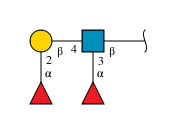
MoleculeChains Length2D Diagram GlycosylationD Interactions
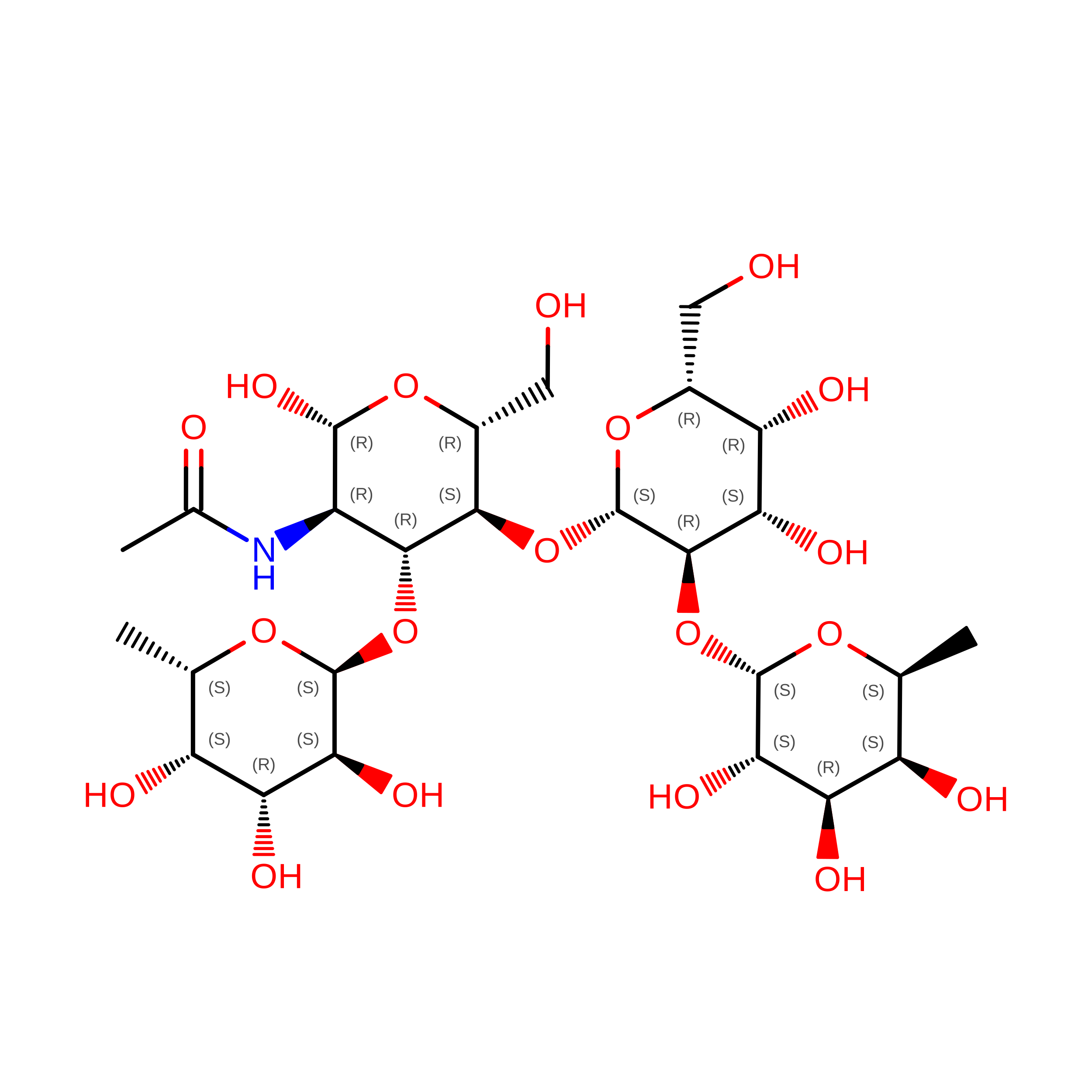
alpha-L-fucopyranose-(1-2)-beta-D-galactopyranose-(1-4)-[alpha-L-fucopyranose-(1-3)]2-acetamido-2-deoxy-beta-D-glucopyranose
B
4N/A
Glycosylation Resources
GlyTouCan: G00052MO
GlyCosmos: G00052MO
GlyGen: G00052MO

Biologically Interesting Molecules (External Reference) 

1 Unique

Experimental Data & Validation

Experimental Data

  • Method: X-RAY DIFFRACTION
  • Resolution: 2.01 Å
  • R-Value Free:  0.234 (Depositor), 0.233 (DCC) 
  • R-Value Work:  0.193 (Depositor), 0.192 (DCC) 
  • R-Value Observed: 0.195 (Depositor) 
Space Group: P 43 21 2
Unit Cell:
Length ( Å )Angle ( ˚ )
a = 67.06α = 90
b = 67.06β = 90
c = 98.67γ = 90
Software Package:
Software NamePurpose
d*TREKdata scaling
PHASERphasing
REFMACrefinement
PDB_EXTRACTdata extraction
CrystalCleardata collection
d*TREKdata reduction

Structure Validation

View Full Validation Report


Entry History 

Deposition Data

  • Released Date: 2010-12-29 
  • Deposition Author(s): Feil, S.C.

Revision History  (Full details and data files)

  • Version 1.0: 2010-12-29
    Type: Initial release
  • Version 1.1: 2011-07-13
    Changes: Version format compliance
  • Version 1.2: 2012-02-29
    Changes: Database references
  • Version 2.0: 2020-07-29
    Type: Remediation
    Reason: Carbohydrate remediation
    Changes: Atomic model, Data collection, Derived calculations, Non-polymer description, Structure summary
  • Version 2.1: 2021-10-13
    Changes: Database references, Structure summary
  • Version 2.2: 2023-09-06
    Changes: Data collection, Refinement description