3LDZ | pdb_00003ldz

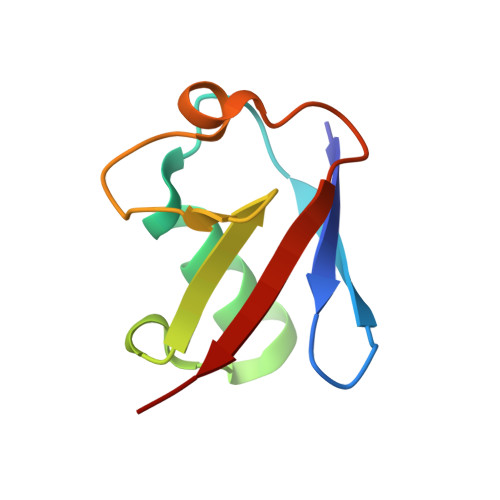
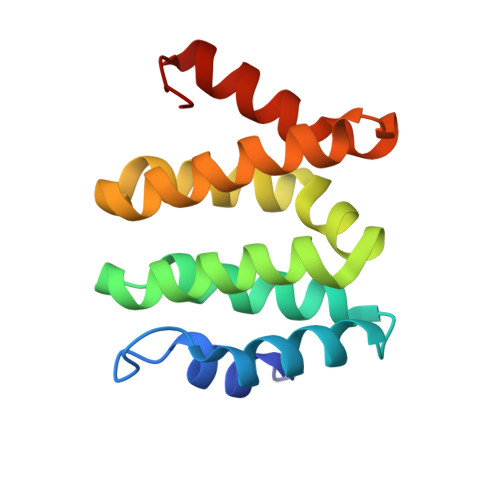
Crystal structure of human STAM1 VHS domain in complex with ubiquitin


Experimental Data Snapshot

  • Method: X-RAY DIFFRACTION
  • Resolution: 2.60 Å
  • R-Value Free: 
    0.234 (Depositor), 0.247 (DCC) 
  • R-Value Work: 
    0.225 (Depositor), 0.236 (DCC) 
  • R-Value Observed: 
    0.226 (Depositor) 

wwPDB Validation 3D Report Full Report

Validation slider image for 3LDZ

This is version 1.4 of the entry. See complete history

Literature

VHS domains of ESCRT-0 cooperate in high-avidity binding to polyubiquitinated cargo.

Ren, X.Hurley, J.H.

(2010) EMBO J 29: 1045-1054

  • DOI: https://doi.org/10.1038/emboj.2010.6
  • Primary Citation Related Structures: 
    3LDZ

  • PubMed Abstract: 

    VHS (Vps27, Hrs, and STAM) domains occur in ESCRT-0 subunits Hrs and STAM, GGA adapters, and other trafficking proteins. The structure of the STAM VHS domain-ubiquitin complex was solved at 2.6 A resolution, revealing that determinants for ubiquitin recognition are conserved in nearly all VHS domains. VHS domains from all classes of VHS-domain containing proteins in yeast and humans, including both subunits of ESCRT-0, bound ubiquitin in vitro. ESCRTs have been implicated in the sorting of Lys63-linked polyubiquitinated cargo. Intact human ESCRT-0 binds Lys63-linked tetraubiquitin 50-fold more tightly than monoubiquitin, though only 2-fold more tightly than Lys48-linked tetraubiquitin. The gain in affinity is attributed to the cooperation of flexibly connected VHS and UIM motifs of ESCRT-0 in avid binding to the polyubiquitin chain. Mutational analysis of all the five ubiquitin-binding sites in yeast ESCRT-0 shows that cooperation between them is required for the sorting of the Lys63-linked polyubiquitinated cargo Cps1 to the vacuole.


  • Organizational Affiliation
    • Laboratory of Molecular Biology, National Institute of Diabetes and Digestive and Kidney Diseases, National Institutes of Health, US Department of Health and Human Services, Bethesda, MD, USA.

Macromolecule Content 

  • Total Structure Weight: 87.54 kDa 
  • Atom Count: 6,112 
  • Modeled Residue Count: 779 
  • Deposited Residue Count: 779 
  • Unique protein chains: 2

Macromolecules

Find similar proteins by:|  3D Structure
Entity ID: 1
MoleculeChains  Sequence LengthOrganismDetailsImage
UbiquitinA [auth F],
F [auth E],
G
73Bos taurusMutation(s): 0 
UniProt & NIH Common Fund Data Resources
Find proteins for P0CG48 (Homo sapiens)
Explore P0CG48 
Go to UniProtKB:  P0CG48
PHAROS:  P0CG48
GTEx:  ENSG00000150991 
Entity Groups
Sequence Clusters30% Identity50% Identity70% Identity90% Identity95% Identity100% Identity
UniProt GroupP0CG48
Sequence Annotations
Expand
Reference Sequence
Find similar proteins by:|  3D Structure
Entity ID: 2
MoleculeChains  Sequence LengthOrganismDetailsImage
Signal transducing adapter molecule 1B [auth A],
C [auth D],
D [auth B],
E [auth C]
140Homo sapiensMutation(s): 0 
UniProt & NIH Common Fund Data Resources
Find proteins for Q92783 (Homo sapiens)
Explore Q92783 
Go to UniProtKB:  Q92783
PHAROS:  Q92783
GTEx:  ENSG00000136738 
Entity Groups
Sequence Clusters30% Identity50% Identity70% Identity90% Identity95% Identity100% Identity
UniProt GroupQ92783
Sequence Annotations
Expand
Reference Sequence

Experimental Data & Validation

Experimental Data

  • Method: X-RAY DIFFRACTION
  • Resolution: 2.60 Å
  • R-Value Free:  0.234 (Depositor), 0.247 (DCC) 
  • R-Value Work:  0.225 (Depositor), 0.236 (DCC) 
  • R-Value Observed: 0.226 (Depositor) 
Space Group: P 1 21 1
Unit Cell:
Length ( Å )Angle ( ˚ )
a = 66.61α = 90
b = 112.13β = 99.43
c = 68.66γ = 90
Software Package:
Software NamePurpose
XSCALEdata scaling
PHASERphasing
TNTrefinement
PDB_EXTRACTdata extraction
HKL-2000data collection
DENZOdata reduction
SCALEPACKdata scaling
BUSTERrefinement

Structure Validation

View Full Validation Report


Entry History 

Deposition Data

Revision History  (Full details and data files)

  • Version 1.0: 2010-03-02
    Type: Initial release
  • Version 1.1: 2011-07-13
    Changes: Version format compliance
  • Version 1.2: 2017-11-01
    Changes: Refinement description
  • Version 1.3: 2018-02-28
    Changes: Data collection
  • Version 1.4: 2024-02-21
    Changes: Data collection, Database references