3L54 | pdb_00003l54

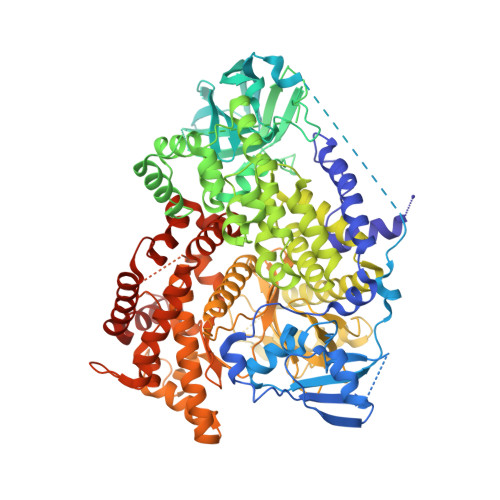
Structure of Pi3K gamma with inhibitor


Experimental Data Snapshot

  • Method: X-RAY DIFFRACTION
  • Resolution: 2.30 Å
  • R-Value Free: 
    0.280 (Depositor), 0.275 (DCC) 
  • R-Value Work: 
    0.216 (Depositor), 0.211 (DCC) 
  • R-Value Observed: 
    0.219 (Depositor) 

wwPDB Validation 3D Report Full Report

Validation slider image for 3L54

Ligand Structure Quality Assessment 


This is version 1.3 of the entry. See complete history

Literature

Discovery of GSK2126458, a Highly Potent Inhibitor of PI3K and the Mammalian Target of Rapamycin.

Knight, S.D.Adams, N.D.Burgess, J.L.Chaudhari, A.M.Darcy, M.G.Donatelli, C.A.Luengo, J.I.Newlander, K.A.Parrish, C.A.Ridgers, L.H.Sarpong, M.A.Schmidt, S.J.Van Aller, G.S.Carson, J.D.Diamond, M.A.Elkins, P.A.Gardiner, C.M.Garver, E.Gilbert, S.A.Gontarek, R.R.Jackson, J.R.Kershner, K.L.Luo, L.Raha, K.Sherk, C.S.Sung, C.M.Sutton, D.Tummino, P.J.Wegrzyn, R.J.Auger, K.R.Dhanak, D.

(2010) ACS Med Chem Lett 1: 39-43

  • DOI: https://doi.org/10.1021/ml900028r
  • Primary Citation Related Structures: 
    3L08, 3L54

  • PubMed Abstract: 

    Phosphoinositide 3-kinase α (PI3Kα) is a critical regulator of cell growth and transformation, and its signaling pathway is the most commonly mutated pathway in human cancers. The mammalian target of rapamycin (mTOR), a class IV PI3K protein kinase, is also a central regulator of cell growth, and mTOR inhibitors are believed to augment the antiproliferative efficacy of PI3K/AKT pathway inhibition. 2,4-Difluoro-N-{2-(methyloxy)-5-[4-(4-pyridazinyl)-6-quinolinyl]-3-pyridinyl}benzenesulfonamide (GSK2126458, 1) has been identified as a highly potent, orally bioavailable inhibitor of PI3Kα and mTOR with in vivo activity in both pharmacodynamic and tumor growth efficacy models. Compound 1 is currently being evaluated in human clinical trials for the treatment of cancer.


  • Organizational Affiliation
    • GlaxoSmithKline, 1250 South Collegeville Road, Collegeville, Pennsylvania 19426.

Macromolecule Content 

  • Total Structure Weight: 111.13 kDa 
  • Atom Count: 6,836 
  • Modeled Residue Count: 837 
  • Deposited Residue Count: 966 
  • Unique protein chains: 1

Macromolecules

Find similar proteins by:|  3D Structure
Entity ID: 1
MoleculeChains  Sequence LengthOrganismDetailsImage
Phosphatidylinositol-4,5-bisphosphate 3-kinase catalytic subunit gamma isoform966Homo sapiensMutation(s): 0 
Gene Names: PIK3CG
EC: 2.7.1.153 (PDB Primary Data), 2.7.1.137 (UniProt), 2.7.1.154 (UniProt), 2.7.11.1 (UniProt)
UniProt & NIH Common Fund Data Resources
Find proteins for P48736 (Homo sapiens)
Explore P48736 
Go to UniProtKB:  P48736
PHAROS:  P48736
GTEx:  ENSG00000105851 
Entity Groups
Sequence Clusters30% Identity50% Identity70% Identity90% Identity95% Identity100% Identity
UniProt GroupP48736
Sequence Annotations
Expand
Reference Sequence

Small Molecules

Ligands 2 Unique
IDChains Name / Formula / InChI Key2D Diagram3D Interactions
LXX

Query on LXX


Download:Ideal Coordinates CCD File
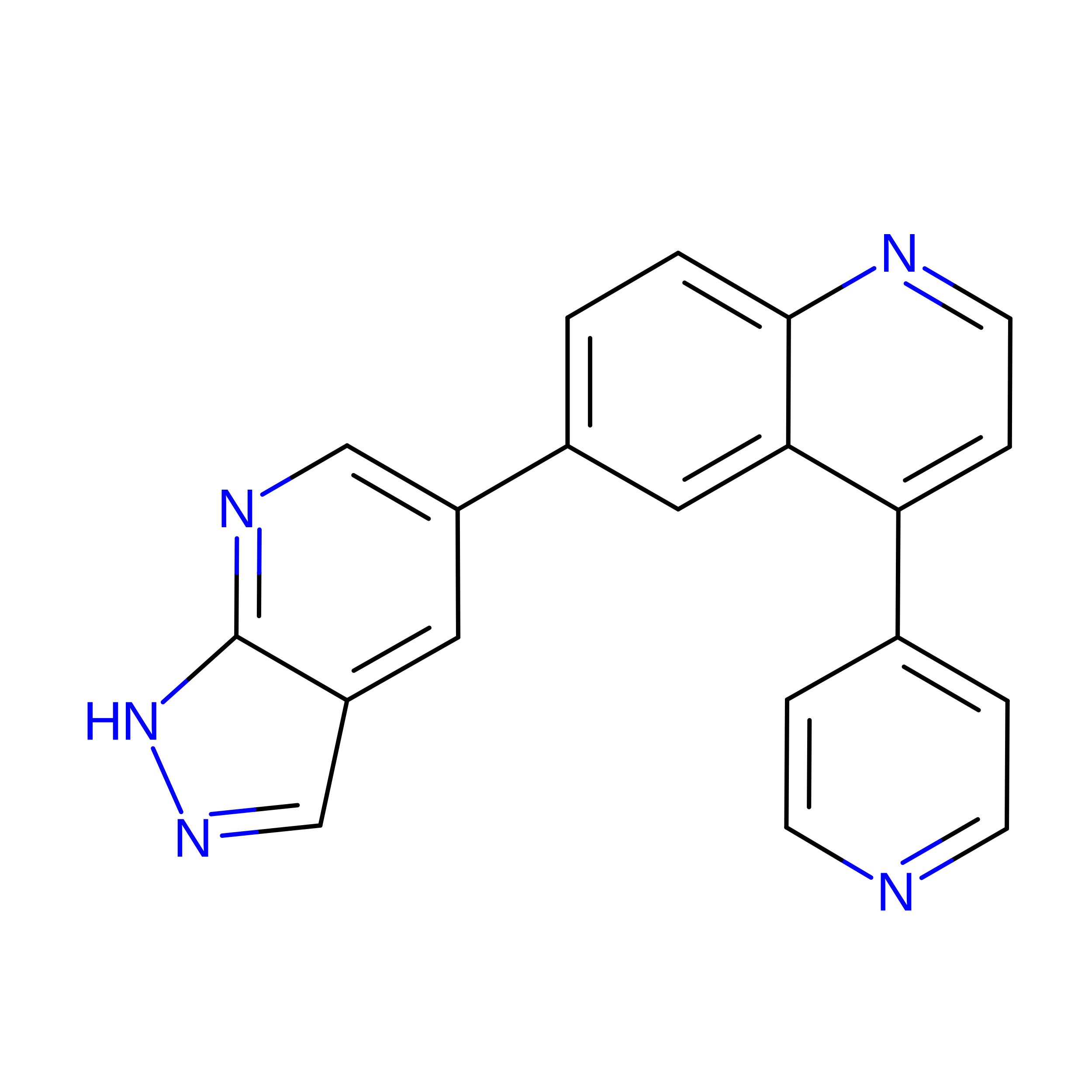
C [auth A]6-(1H-pyrazolo[3,4-b]pyridin-5-yl)-4-pyridin-4-ylquinoline
C20 H13 N5
PYHJWHYHRSDRDJ-UHFFFAOYSA-N
SO4

Query on SO4


Download:Ideal Coordinates CCD File
B [auth A]SULFATE ION
O4 S
QAOWNCQODCNURD-UHFFFAOYSA-L

Experimental Data & Validation

Experimental Data

  • Method: X-RAY DIFFRACTION
  • Resolution: 2.30 Å
  • R-Value Free:  0.280 (Depositor), 0.275 (DCC) 
  • R-Value Work:  0.216 (Depositor), 0.211 (DCC) 
  • R-Value Observed: 0.219 (Depositor) 
Space Group: C 1 2 1
Unit Cell:
Length ( Å )Angle ( ˚ )
a = 145.262α = 90
b = 68.406β = 94.76
c = 106.724γ = 90
Software Package:
Software NamePurpose
DENZOdata reduction
PHENIXmodel building
PHENIXrefinement
HKL-2000data reduction
HKL-2000data scaling
PHENIXphasing

Structure Validation

View Full Validation Report


Ligand Structure Quality Assessment 


Entry History 

Deposition Data

Revision History  (Full details and data files)

  • Version 1.0: 2010-06-30
    Type: Initial release
  • Version 1.1: 2011-07-13
    Changes: Version format compliance
  • Version 1.2: 2014-09-24
    Changes: Database references
  • Version 1.3: 2024-02-21
    Changes: Data collection, Database references, Derived calculations