3KFF | pdb_00003kff

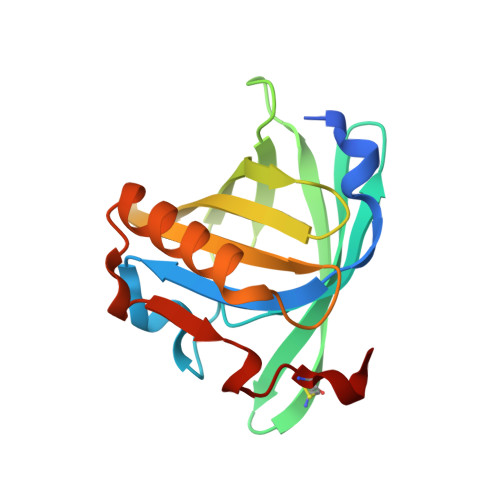
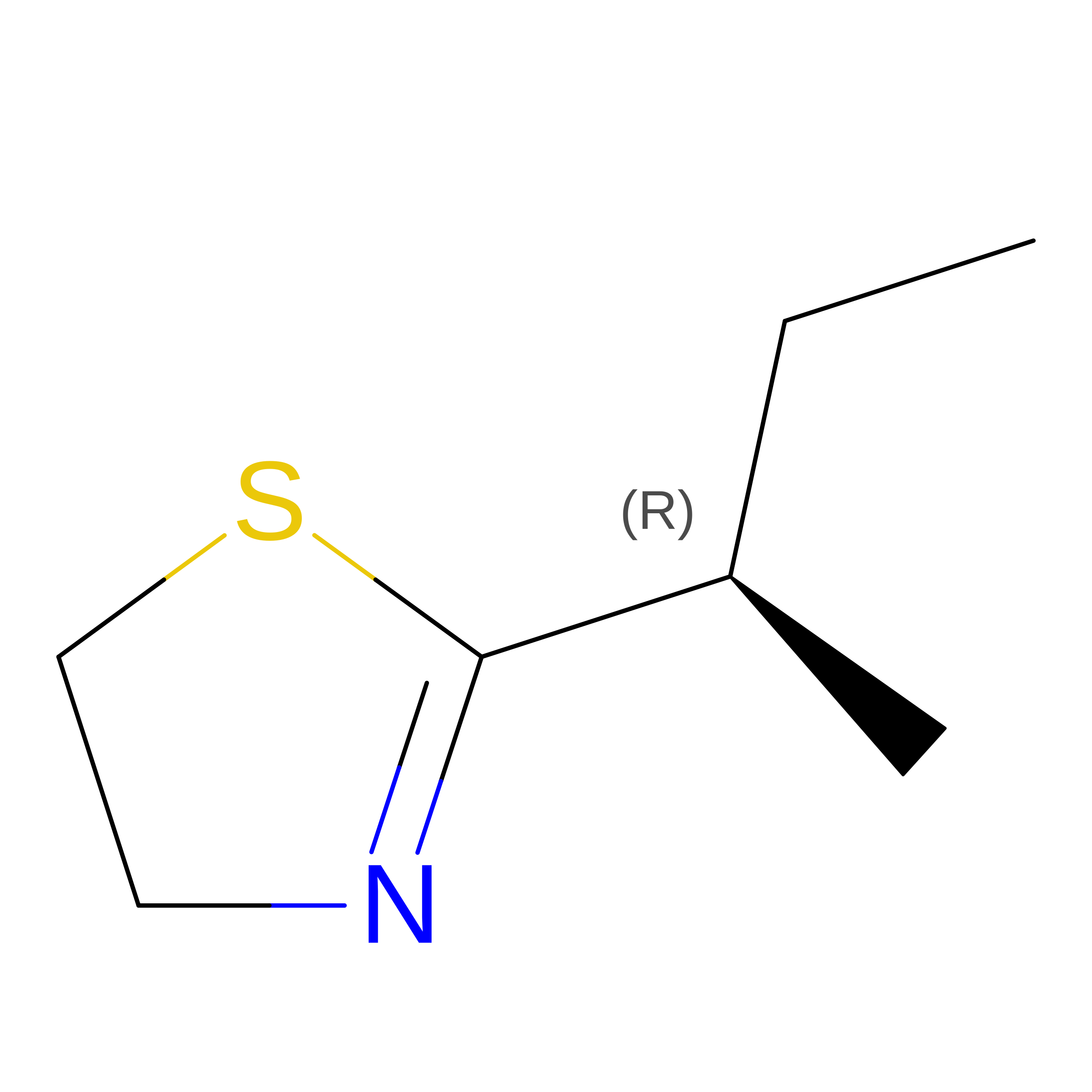
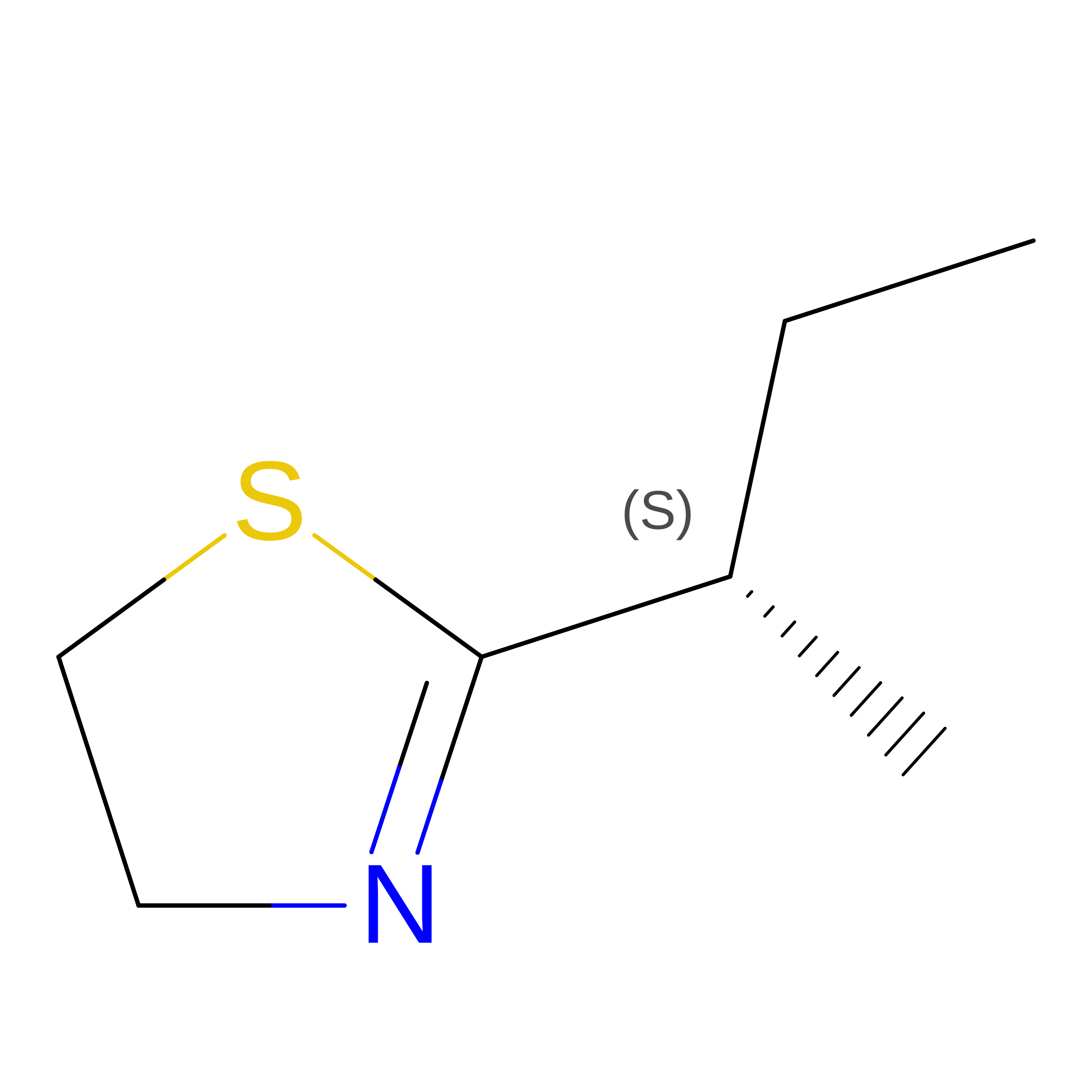
Major mouse urinary protein IV complexed with 2-sec-butyl-4,5-dihydrothiazole


Experimental Data Snapshot

  • Method: X-RAY DIFFRACTION
  • Resolution: 0.96 Å
  • R-Value Free: 
    0.164 (Depositor), 0.148 (DCC) 
  • R-Value Work: 
    0.147 (DCC) 
  • R-Value Observed: 
    0.136 (Depositor) 

Starting Model: experimental
View more details

wwPDB Validation 3D Report Full Report

Validation slider image for 3KFF

This is version 1.4 of the entry. See complete history

Literature

High resolution X-ray structures of mouse major urinary protein nasal isoform in complex with pheromones.

Perez-Miller, S.Zou, Q.Novotny, M.V.Hurley, T.D.

(2010) Protein Sci 19: 1469-1479

  • DOI: https://doi.org/10.1002/pro.426
  • Primary Citation Related Structures: 
    3KFF, 3KFG, 3KFH, 3KFI

  • PubMed Abstract: 

    In mice, the major urinary proteins (MUP) play a key role in pheromonal communication by binding and transporting semiochemicals. MUP-IV is the only isoform known to be expressed in the vomeronasal mucosa. In comparison with the MUP isoforms that are abundantly excreted in the urine, MUP-IV is highly specific for the male mouse pheromone 2-sec-butyl-4,5-dihydrothiazole (SBT). To examine the structural basis of this ligand preference, we determined the X-ray crystal structure of MUP-IV bound to three mouse pheromones: SBT, 2,5-dimethylpyrazine, and 2-heptanone. We also obtained the structure of MUP-IV with 2-ethylhexanol bound in the cavity. These four structures show that relative to the major excreted MUP isoforms, three amino acid substitutions within the binding calyx impact ligand coordination. The F103 for A along with F54 for L result in a smaller cavity, potentially creating a more closely packed environment for the ligand. The E118 for G substitution introduces a charged group into a hydrophobic environment. The sidechain of E118 is observed to hydrogen bond to polar groups on all four ligands with nearly the same geometry as seen for the water-mediated hydrogen bond network in the MUP-I and MUP-II crystal structures. These differences in cavity size and interactions between the protein and ligand are likely to contribute to the observed specificity of MUP-IV.


  • Organizational Affiliation
    • Department of Biochemistry and Molecular Biology, Indiana University School of Medicine, Indianapolis, Indiana 46202, USA.

Macromolecule Content 

  • Total Structure Weight: 19.17 kDa 
  • Atom Count: 1,711 
  • Modeled Residue Count: 152 
  • Deposited Residue Count: 162 
  • Unique protein chains: 1

Macromolecules

Find similar proteins by:|  3D Structure
Entity ID: 1
MoleculeChains  Sequence LengthOrganismDetailsImage
Major urinary protein 4162Mus musculusMutation(s): 0 
Gene Names: Mup4
UniProt
Find proteins for P11590 (Mus musculus)
Explore P11590 
Go to UniProtKB:  P11590
Entity Groups
Sequence Clusters30% Identity50% Identity70% Identity90% Identity95% Identity100% Identity
UniProt GroupP11590
Sequence Annotations
Expand
Reference Sequence

Small Molecules

Experimental Data & Validation

Experimental Data

  • Method: X-RAY DIFFRACTION
  • Resolution: 0.96 Å
  • R-Value Free:  0.164 (Depositor), 0.148 (DCC) 
  • R-Value Work:  0.147 (DCC) 
  • R-Value Observed: 0.136 (Depositor) 
Space Group: P 21 21 21
Unit Cell:
Length ( Å )Angle ( ˚ )
a = 47.617α = 90
b = 53.747β = 90
c = 61.249γ = 90
Software Package:
Software NamePurpose
DENZOdata reduction
SCALEPACKdata scaling
AMoREphasing
SHELXrefinement
PDB_EXTRACTdata extraction
HKL-2000data reduction
HKL-2000data scaling
SHELXL-97refinement

Structure Validation

View Full Validation Report


Entry History 

Deposition Data

Revision History  (Full details and data files)

  • Version 1.0: 2010-06-16
    Type: Initial release
  • Version 1.1: 2011-07-13
    Changes: Version format compliance
  • Version 1.2: 2017-11-01
    Changes: Advisory, Refinement description
  • Version 1.3: 2023-09-06
    Changes: Advisory, Data collection, Database references, Derived calculations, Refinement description
  • Version 1.4: 2024-11-06
    Changes: Structure summary