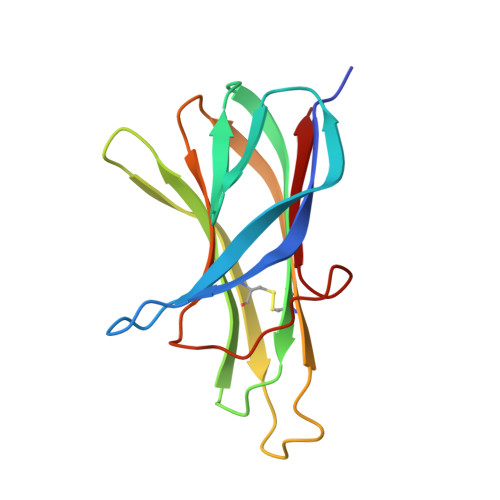
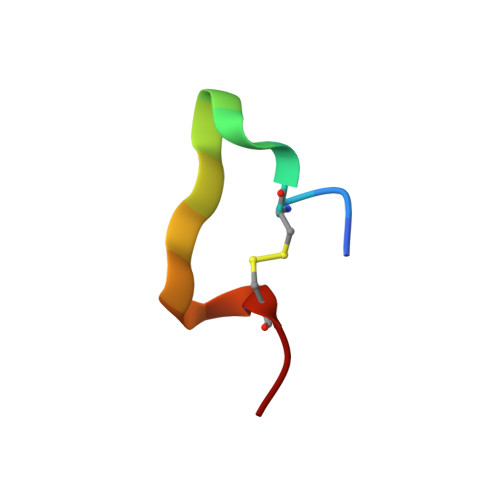
3K48 | pdb_00003k48

Crystal structure of APRIL bound to a peptide


Experimental Data Snapshot

  • Method: X-RAY DIFFRACTION
  • Resolution: 2.80 Å
  • R-Value Free: 
    0.267 (Depositor), 0.270 (DCC) 
  • R-Value Work: 
    0.205 (Depositor), 0.209 (DCC) 
  • R-Value Observed: 
    0.212 (Depositor) 

Starting Model: experimental
View more details

wwPDB Validation 3D Report Full Report

Validation slider image for 3K48

This is version 1.4 of the entry. See complete history

Literature

Multiple novel classes of APRIL-specific receptor-blocking peptides isolated by phage display.

Gordon, N.C.Lien, S.Johnson, J.Wallweber, H.J.Tran, T.Currell, B.Mathieu, M.Quan, C.Starovasnik, M.A.Hymowitz, S.G.Kelley, R.F.

(2010) J Mol Biology 396: 166-177

  • DOI: https://doi.org/10.1016/j.jmb.2009.11.041
  • Primary Citation Related Structures: 
    3K48

  • PubMed Abstract: 

    A proliferation-inducing ligand (APRIL) is a member of the tumor necrosis factor (TNF) ligand superfamily and has a proliferative effect on both normal and tumor cells. The TNF family receptors (B-cell maturation antigen (BCMA), transmembrane activator and CAML-interactor (TACI), and BAFF receptor-3 (BR3)) for APRIL and the closely related ligand, B-cell activating factor of the TNF family (BAFF), bind these ligands through a highly conserved six residue DXL motif ((F/Y/W)-D-X-L-(V/T)-(R/G)). Panning peptide phage display libraries led to the identification of several novel classes of APRIL-binding peptides, which could be grouped by their common sequence motifs. Interestingly, only one of these ten classes consisted of peptides containing the DXL motif. Nevertheless, all classes of peptides prevented APRIL, but not BAFF, from binding BCMA, their shared receptor. Synthetic peptides based on selected sequences inhibited APRIL binding to BCMA with IC(50) values of 0.49-27 microM. An X-ray crystallographic structure of APRIL bound to one of the phage-derived peptides showed that the peptide, lacking the DXL motif, was nevertheless bound in the DXL pocket on APRIL. Our results demonstrate that even though a focused, highly conserved motif is required for APRIL-receptor interaction, remarkably, many novel and distinct classes of peptides are also capable of binding APRIL at the ligand receptor interface.


  • Organizational Affiliation
    • Genentech, Inc., 1 DNA Way, South San Francisco, CA 94080, USA.

Macromolecule Content 

  • Total Structure Weight: 53.21 kDa 
  • Atom Count: 3,613 
  • Modeled Residue Count: 453 
  • Deposited Residue Count: 468 
  • Unique protein chains: 2

Macromolecules

Find similar proteins by:|  3D Structure
Entity ID: 1
MoleculeChains  Sequence LengthOrganismDetailsImage
Tumor necrosis factor ligand superfamily member 13A,
B,
C [auth D]
140Mus musculusMutation(s): 0 
Gene Names: AprilTNFSF 13Tnfsf13
UniProt
Find proteins for Q9D777 (Mus musculus)
Explore Q9D777 
Go to UniProtKB:  Q9D777
Entity Groups
Sequence Clusters30% Identity50% Identity70% Identity90% Identity95% Identity100% Identity
UniProt GroupQ9D777
Sequence Annotations
Expand
Reference Sequence
Find similar proteins by:  Sequence   |   3D Structure  
Entity ID: 2
MoleculeChains  Sequence LengthOrganismDetailsImage
peptideD [auth R],
E [auth S],
F [auth T]
16N/AMutation(s): 0 

Experimental Data & Validation

Experimental Data

  • Method: X-RAY DIFFRACTION
  • Resolution: 2.80 Å
  • R-Value Free:  0.267 (Depositor), 0.270 (DCC) 
  • R-Value Work:  0.205 (Depositor), 0.209 (DCC) 
  • R-Value Observed: 0.212 (Depositor) 
Space Group: C 1 2 1
Unit Cell:
Length ( Å )Angle ( ˚ )
a = 100.811α = 90
b = 84.771β = 99.45
c = 55.562γ = 90
Software Package:
Software NamePurpose
Blu-Icedata collection
AMoREphasing
REFMACrefinement
HKL-2000data reduction
HKL-2000data scaling

Structure Validation

View Full Validation Report


Entry History 

Deposition Data

Revision History  (Full details and data files)

  • Version 1.0: 2009-11-24
    Type: Initial release
  • Version 1.1: 2011-07-13
    Changes: Advisory, Version format compliance
  • Version 1.2: 2011-08-10
    Changes: Database references
  • Version 1.3: 2023-09-06
    Changes: Data collection, Database references, Refinement description
  • Version 1.4: 2024-10-30
    Changes: Structure summary