3JPV | pdb_00003jpv

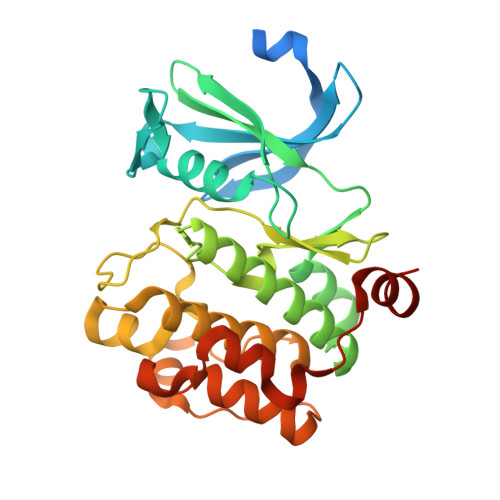
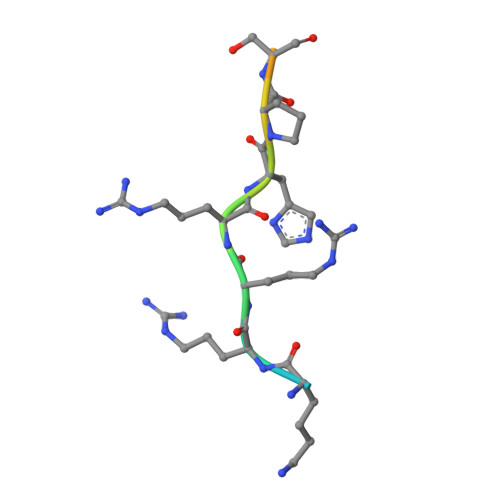
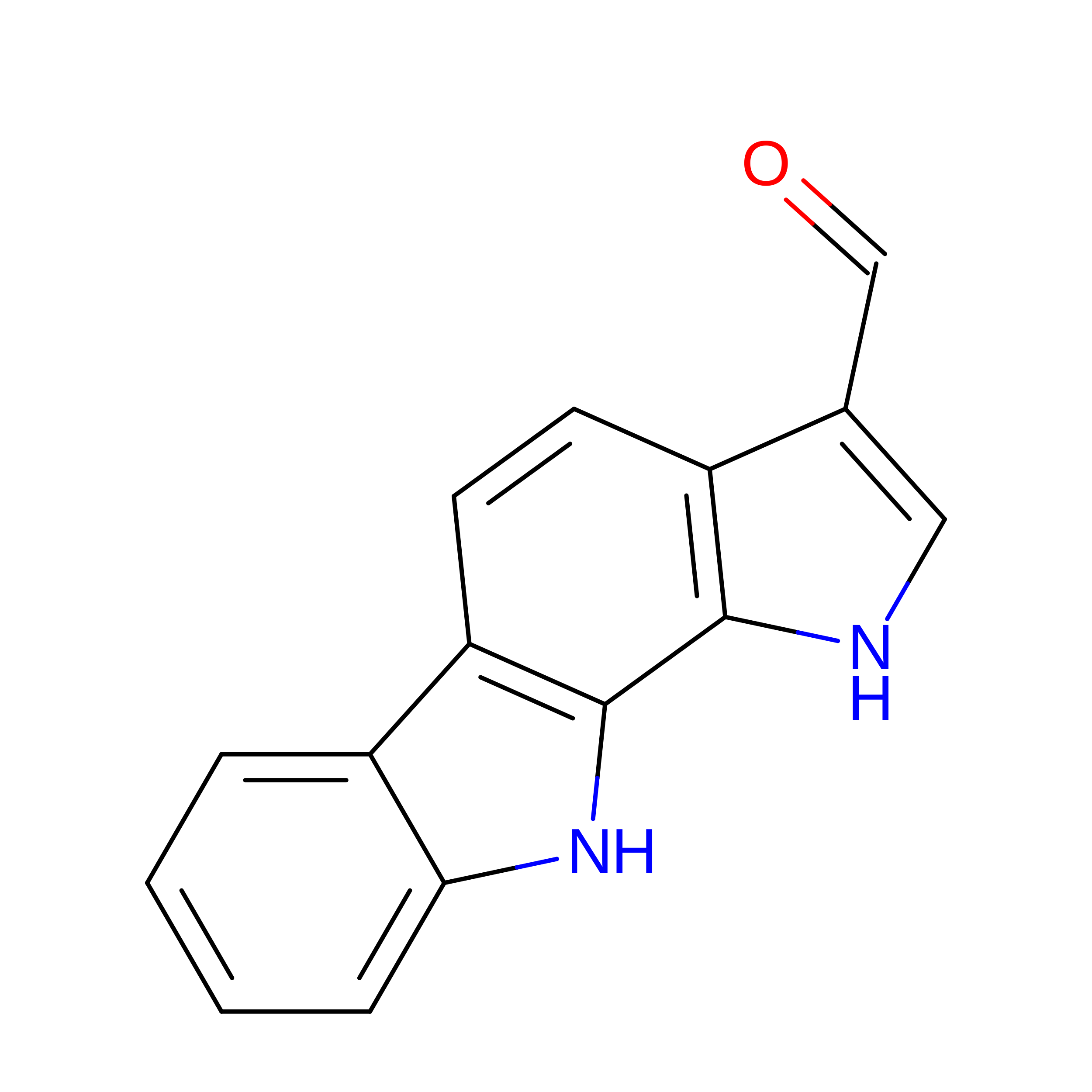
Crystal structure of human proto-oncogene serine threonine kinase (PIM1) in complex with a consensus peptide and a pyrrolo[2,3-a]carbazole ligand


Experimental Data Snapshot

  • Method: X-RAY DIFFRACTION
  • Resolution: 2.35 Å
  • R-Value Free: 
    0.226 (Depositor) 
  • R-Value Work: 
    0.173 (Depositor) 
  • R-Value Observed: 
    0.176 (Depositor) 

Starting Model: experimental
View more details

wwPDB Validation 3D Report Full Report

Validation slider image for 3JPV

Ligand Structure Quality Assessment 


This is version 1.2 of the entry. See complete history

Literature

Synthesis, kinase inhibitory potencies, and in vitro antiproliferative evaluation of new pim kinase inhibitors.

Akue-Gedu, R.Rossignol, E.Azzaro, S.Knapp, S.Filippakopoulos, P.Bullock, A.N.Bain, J.Cohen, P.Prudhomme, M.Anizon, F.Moreau, P.

(2009) J Med Chem 52: 6369-6381

  • DOI: https://doi.org/10.1021/jm901018f
  • Primary Citation Related Structures: 
    3JPV

  • PubMed Abstract: 

    Members of the Pim kinase family have been identified as promising targets for the development of antitumor agents. After a screening of pyrrolo[2,3-a]- and [3,2-a]carbazole derivatives toward 66 protein kinases, we identified pyrrolo[2,3-a]carbazole as a new scaffold to design potent Pim kinase inhibitors. In particular, compound 9 was identified as a low nM selective Pim inhibitor. Additionally, several pyrrolo[2,3-a]carbazole derivatives showed selectivity for Pim-1 and Pim-3 over Pim-2. In vitro antiproliferative activities of 9 and 28, the most potent Pim inhibitors identified, were evaluated toward three human solid cancer cell lines (PA1, PC3, and DU145) and one human fibroblast primary culture, revealing IC50 values in the micromolar range. Finally, the crystal structure of Pim-1 complexed with lead compound 9 was determined. The structure revealed a non-ATP mimetic binding mode with no hydrogen bonds formed with the kinase hinge region and explained the selectivity of pyrrolo[2,3-a]carbazole derivatives for Pim kinases.


  • Organizational Affiliation
    • Clermont Université, Université Blaise Pascal, Laboratoire SEESIB, F-63177 Aubière, France.

Macromolecule Content 

  • Total Structure Weight: 37.42 kDa 
  • Atom Count: 2,446 
  • Modeled Residue Count: 280 
  • Deposited Residue Count: 327 
  • Unique protein chains: 2

Macromolecules

Find similar proteins by:|  3D Structure
Entity ID: 1
MoleculeChains  Sequence LengthOrganismDetailsImage
Proto-oncogene serine/threonine-protein kinase Pim-1313Homo sapiensMutation(s): 0 
Gene Names: PIM1
EC: 2.7.11.1
UniProt & NIH Common Fund Data Resources
Find proteins for P11309 (Homo sapiens)
Explore P11309 
Go to UniProtKB:  P11309
PHAROS:  P11309
GTEx:  ENSG00000137193 
Entity Groups
Sequence Clusters30% Identity50% Identity70% Identity90% Identity95% Identity100% Identity
UniProt GroupP11309
Sequence Annotations
Expand
Reference Sequence
Find similar proteins by:  Sequence   |   3D Structure  
Entity ID: 2
MoleculeChains  Sequence LengthOrganismDetailsImage
Peptide (PIMTIDE) ARKRRRHPSGPPTA14N/AMutation(s): 0 

Small Molecules

Ligands 1 Unique
IDChains Name / Formula / InChI Key2D Diagram3D Interactions
1DR

Query on 1DR


Download:Ideal Coordinates CCD File
C [auth A]1,10-dihydropyrrolo[2,3-a]carbazole-3-carbaldehyde
C15 H10 N2 O
VWNCOFUKBTYAON-UHFFFAOYSA-N

Experimental Data & Validation

Experimental Data

  • Method: X-RAY DIFFRACTION
  • Resolution: 2.35 Å
  • R-Value Free:  0.226 (Depositor) 
  • R-Value Work:  0.173 (Depositor) 
  • R-Value Observed: 0.176 (Depositor) 
Space Group: P 65
Unit Cell:
Length ( Å )Angle ( ˚ )
a = 97.821α = 90
b = 97.821β = 90
c = 80.743γ = 120
Software Package:
Software NamePurpose
SCALAdata scaling
PHASERphasing
REFMACrefinement
PDB_EXTRACTdata extraction
CrystalCleardata collection
MOSFLMdata reduction

Structure Validation

View Full Validation Report


Ligand Structure Quality Assessment 


Entry History 

Revision History  (Full details and data files)

  • Version 1.0: 2009-10-27
    Type: Initial release
  • Version 1.1: 2011-07-13
    Changes: Advisory, Version format compliance
  • Version 1.2: 2023-09-06
    Changes: Data collection, Database references, Derived calculations, Refinement description