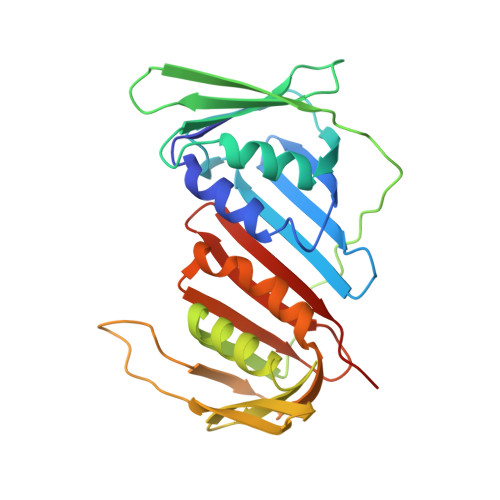
3JA9 | pdb_00003ja9

Structure of native human PCNA


Experimental Data Snapshot

  • Method: ELECTRON MICROSCOPY
  • Resolution: 22.0 Å
  • Aggregation State: PARTICLE 
  • Reconstruction Method: SINGLE PARTICLE 

Starting Model: experimental
View more details

wwPDB Validation 3D Report Full Report

Validation slider image for 3JA9

This is version 1.4 of the entry. See complete history

Literature

Molecular architecture of the Ub-PCNA/Pol eta complex bound to DNA

Lau, W.C.Li, Y.Zhang, Q.Huen, M.S.

(2015) Sci Rep 5: 15759-15759

  • DOI: https://doi.org/10.1038/srep15759
  • Primary Citation Related Structures: 
    3JA9, 3JAA

  • PubMed Abstract: 

    Translesion synthesis (TLS) is the mechanism by which DNA polymerases replicate through unrepaired DNA lesions. TLS is activated by monoubiquitination of the homotrimeric proliferating cell nuclear antigen (PCNA) at lysine-164, followed by the switch from replicative to specialized polymerases at DNA damage sites. Pol η belongs to the Y-Family of specialized polymerases that can efficiently bypass UV-induced lesions. Like other members of the Y-Family polymerases, its recruitment to the damaged sites is mediated by the interaction with monoubiquitinated PCNA (Ub-PCNA) via its ubiquitin-binding domain and non-canonical PCNA-interacting motif in the C-terminal region. The structural determinants underlying the direct recognition of Ub-PCNA by Pol η, or Y-Family polymerases in general, remain largely unknown. Here we report a structure of the Ub-PCNA/Pol η complex bound to DNA determined by single-particle electron microscopy (EM). The overall obtained structure resembles that of the editing PCNA/PolB complex. Analysis of the map revealed the conformation of ubiquitin that binds the C-terminal domain of Pol η. Our present study suggests that the Ub-PCNA/Pol η interaction requires the formation of a structured binding interface, which is dictated by the inherent flexibility of Ub-PCNA.


  • Organizational Affiliation
    • School of Biomedical Sciences, The University of Hong Kong, Hong Kong, China.

Macromolecule Content 

  • Total Structure Weight: 86.39 kDa 
  • Atom Count: 6,033 
  • Modeled Residue Count: 768 
  • Deposited Residue Count: 783 
  • Unique protein chains: 1

Macromolecules

Find similar proteins by:|  3D Structure
Entity ID: 1
MoleculeChains  Sequence LengthOrganismDetailsImage
Proliferating cell nuclear antigen
A, B, C
261Homo sapiensMutation(s): 0 
Gene Names: PCNA
UniProt & NIH Common Fund Data Resources
Find proteins for P12004 (Homo sapiens)
Explore P12004 
Go to UniProtKB:  P12004
PHAROS:  P12004
GTEx:  ENSG00000132646 
Entity Groups
Sequence Clusters30% Identity50% Identity70% Identity90% Identity95% Identity100% Identity
UniProt GroupP12004
Sequence Annotations
Expand
Reference Sequence

Experimental Data & Validation

Experimental Data

  • Method: ELECTRON MICROSCOPY
  • Resolution: 22.0 Å
  • Aggregation State: PARTICLE 
  • Reconstruction Method: SINGLE PARTICLE 
EM Software:
TaskSoftware PackageVersion
RECONSTRUCTIONEMAN2

Structure Validation

View Full Validation Report


Entry History 

Deposition Data

Revision History  (Full details and data files)

  • Version 1.0: 2015-12-09
    Type: Initial release
  • Version 1.1: 2015-12-16
    Changes: Other
  • Version 1.2: 2019-10-23
    Changes: Data collection, Database references, Other
  • Version 1.3: 2019-12-18
    Changes: Data collection
  • Version 1.4: 2024-10-16
    Changes: Data collection, Database references, Refinement description, Structure summary