3J8W | pdb_00003j8w

Cryo-EM reconstruction of quasi-HPV16 complex with H263.A2 Fab


Experimental Data Snapshot

  • Method: ELECTRON MICROSCOPY
  • Resolution: 13.0 Å
  • Aggregation State: PARTICLE 
  • Reconstruction Method: SINGLE PARTICLE 

Starting Model: experimental
View more details

wwPDB Validation 3D Report Full Report

Validation slider image for 3J8W

This is version 1.3 of the entry. See complete history

Literature

Structural comparison of four different antibodies interacting with human papillomavirus 16 and mechanisms of neutralization.

Guan, J.Bywaters, S.M.Brendle, S.A.Lee, H.Ashley, R.E.Makhov, A.M.Conway, J.F.Christensen, N.D.Hafenstein, S.

(2015) Virology 483: 253-263

  • DOI: https://doi.org/10.1016/j.virol.2015.04.016
  • Primary Citation Related Structures: 
    3J8V, 3J8W, 3J8Z

  • PubMed Abstract: 

    Cryo-electron microscopy (cryo-EM) was used to solve the structures of human papillomavirus type 16 (HPV16) complexed with fragments of antibody (Fab) from three different neutralizing monoclonals (mAbs): H16.1A, H16.14J, and H263.A2. The structure-function analysis revealed predominantly monovalent binding of each Fab with capsid interactions that involved multiple loops from symmetry related copies of the major capsid protein. The residues identified in each Fab-virus interface map to a conformational groove on the surface of the capsomer. In addition to the known involvement of the FG and HI loops, the DE loop was also found to constitute the core of each epitope. Surprisingly, the epitope mapping also identified minor contributions by EF and BC loops. Complementary immunological assays included mAb and Fab neutralization. The specific binding characteristics of mAbs correlated with different neutralizing behaviors in pre- and post-attachment neutralization assays.


  • Organizational Affiliation
    • Department of Medicine, The Pennsylvania State University College of Medicine, 500 University Drive, Hershey, PA 17033 USA.

Macromolecule Content 

  • Total Structure Weight: 354.59 kDa 
  • Atom Count: 23,678 
  • Modeled Residue Count: 3,013 
  • Deposited Residue Count: 3,183 
  • Unique protein chains: 3

Macromolecules

Find similar proteins by:|  3D Structure
Entity ID: 1
MoleculeChains  Sequence LengthOrganismDetailsImage
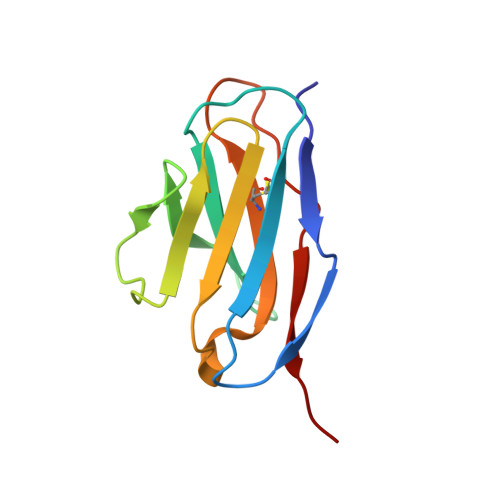
H263.A2 light chainA [auth L],
C [auth J],
E [auth K],
G [auth M]
109Mus musculusMutation(s): 0 
Find similar proteins by:|  3D Structure
Entity ID: 2
MoleculeChains  Sequence LengthOrganismDetailsImage
H263.A2 heavy chainB [auth H],
D [auth F],
F [auth G],
H [auth I]
118Mus musculusMutation(s): 0 
Find similar proteins by:|  3D Structure
Entity ID: 3
MoleculeChains  Sequence LengthOrganismDetailsImage
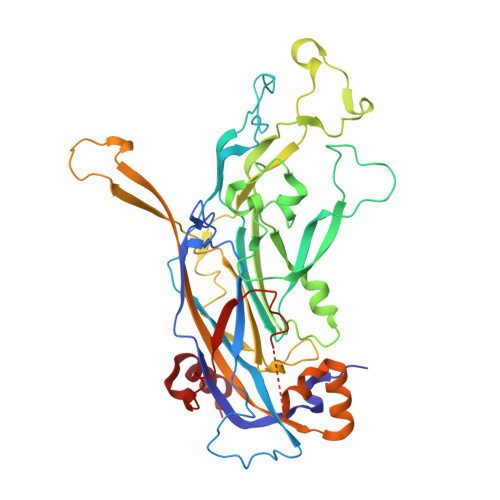
L1I [auth A],
J [auth B],
K [auth C],
L [auth D],
M [auth E]
455Human papillomavirus 16Mutation(s): 0 
UniProt
Find proteins for P03101 (Human papillomavirus type 16)
Explore P03101 
Go to UniProtKB:  P03101
Entity Groups
Sequence Clusters30% Identity50% Identity70% Identity90% Identity95% Identity100% Identity
UniProt GroupP03101
Sequence Annotations
Expand
Reference Sequence

Experimental Data & Validation

Experimental Data

  • Method: ELECTRON MICROSCOPY
  • Resolution: 13.0 Å
  • Aggregation State: PARTICLE 
  • Reconstruction Method: SINGLE PARTICLE 
EM Software:
TaskSoftware PackageVersion
RECONSTRUCTIONAuto3DEM

Structure Validation

View Full Validation Report


Entry History 

Deposition Data

Revision History  (Full details and data files)

  • Version 1.0: 2015-05-06
    Type: Initial release
  • Version 1.1: 2015-06-03
    Changes: Database references
  • Version 1.2: 2018-07-18
    Changes: Data collection
  • Version 1.3: 2024-10-30
    Changes: Data collection, Database references, Derived calculations, Refinement description, Structure summary