3IX3 | pdb_00003ix3

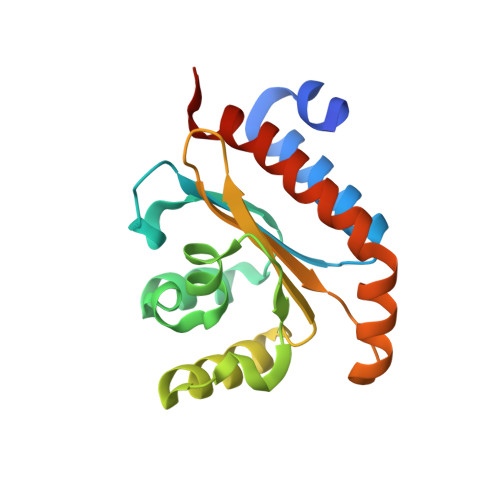
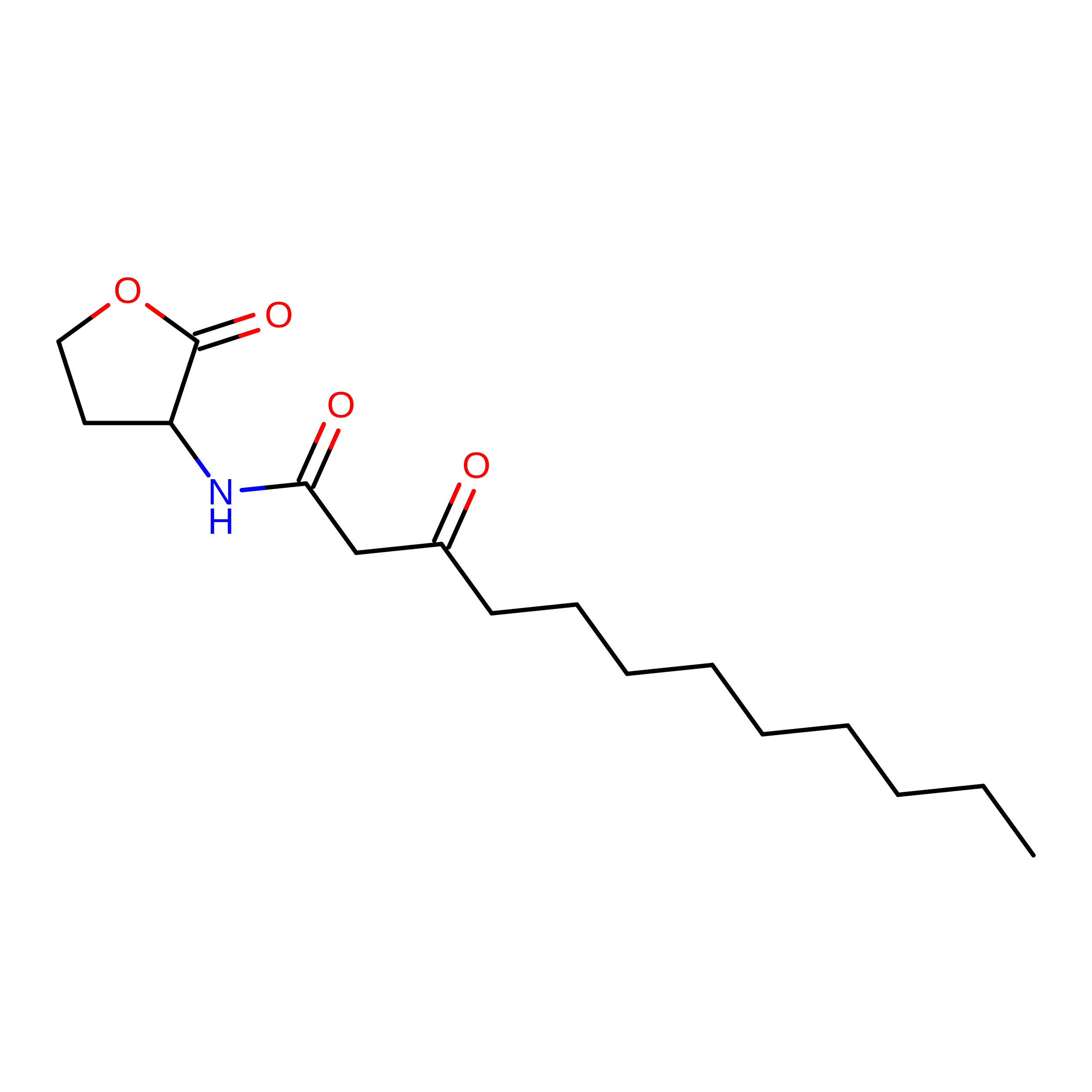
LasR-OC12 HSL complex


Experimental Data Snapshot

  • Method: X-RAY DIFFRACTION
  • Resolution: 1.40 Å
  • R-Value Free: 
    0.207 (Depositor), 0.212 (DCC) 
  • R-Value Work: 
    0.168 (Depositor), 0.173 (DCC) 
  • R-Value Observed: 
    0.170 (Depositor) 

Starting Model: experimental
View more details

wwPDB Validation 3D Report Full Report

Validation slider image for 3IX3

Ligand Structure Quality Assessment 


This is version 1.3 of the entry. See complete history

Literature

Molecular basis for the recognition of structurally distinct autoinducer mimics by the Pseudomonas aeruginosa LasR quorum-sensing signaling receptor.

Zou, Y.Nair, S.K.

(2009) Chem Biol 16: 961-970

  • DOI: https://doi.org/10.1016/j.chembiol.2009.09.001
  • Primary Citation Related Structures: 
    3IX3, 3IX4, 3IX8, 3JPU

  • PubMed Abstract: 

    The human pathogen Pseudomonas aeruginosa coordinates the expression of virulence factors using quorum sensing, a signaling cascade triggered by the activation of signal receptors by small-molecule autoinducers. These homoserine lactone autoinducers stabilize their cognate receptors and activate their functions as transcription factors. Because quorum sensing regulates the progression of infection and host immune resistance, significant efforts have been devoted toward the identification of small molecules that disrupt this process. Screening efforts have identified a class of triphenyl compounds that are structurally distinct from the homoserine lactone autoinducer, yet interact specifically and potently with LasR receptor to modulate quorum sensing (Muh et al., 2006a). Here we present the high-resolution crystal structures of the ligand binding domain of LasR in complex with the autoinducer N-3-oxo-dodecanoyl homoserine lactone (1.4 A resolution), and with the triphenyl mimics TP-1, TP-3, and TP-4 (to between 1.8 A and 2.3 A resolution). These crystal structures provide a molecular rationale for understanding how chemically distinct compounds can be accommodated by a highly selective receptor, and provide the framework for the development of novel quorum-sensing regulators, utilizing the triphenyl scaffold.


  • Organizational Affiliation
    • Department of Biochemistry, University of Illinois at Urbana-Champaign, 600 S. Mathews Avenue, Urbana, IL 61801, USA.

Macromolecule Content 

  • Total Structure Weight: 39.24 kDa 
  • Atom Count: 3,085 
  • Modeled Residue Count: 326 
  • Deposited Residue Count: 346 
  • Unique protein chains: 1

Macromolecules

Find similar proteins by:|  3D Structure
Entity ID: 1
MoleculeChains  Sequence LengthOrganismDetailsImage
Transcriptional activator protein lasR
A, B
173Pseudomonas aeruginosaMutation(s): 0 
Gene Names: lasRPA1430
UniProt
Find proteins for P25084 (Pseudomonas aeruginosa (strain ATCC 15692 / DSM 22644 / CIP 104116 / JCM 14847 / LMG 12228 / 1C / PRS 101 / PAO1))
Explore P25084 
Go to UniProtKB:  P25084
Entity Groups
Sequence Clusters30% Identity50% Identity70% Identity90% Identity95% Identity100% Identity
UniProt GroupP25084
Sequence Annotations
Expand
Reference Sequence

Experimental Data & Validation

Experimental Data

  • Method: X-RAY DIFFRACTION
  • Resolution: 1.40 Å
  • R-Value Free:  0.207 (Depositor), 0.212 (DCC) 
  • R-Value Work:  0.168 (Depositor), 0.173 (DCC) 
  • R-Value Observed: 0.170 (Depositor) 
Space Group: P 1 21 1
Unit Cell:
Length ( Å )Angle ( ˚ )
a = 54.293α = 90
b = 67.616β = 115.04
c = 54.396γ = 90
Software Package:
Software NamePurpose
MAR345dtbdata collection
PHASERphasing
REFMACrefinement
HKL-2000data reduction
HKL-2000data scaling

Structure Validation

View Full Validation Report


Ligand Structure Quality Assessment 


Entry History 

Deposition Data

Revision History  (Full details and data files)

  • Version 1.0: 2009-09-15
    Type: Initial release
  • Version 1.1: 2011-07-13
    Changes: Version format compliance
  • Version 1.2: 2023-09-06
    Changes: Data collection, Database references, Derived calculations, Refinement description
  • Version 1.3: 2026-04-29
    Changes: Database references, Structure summary