3IPC | pdb_00003ipc

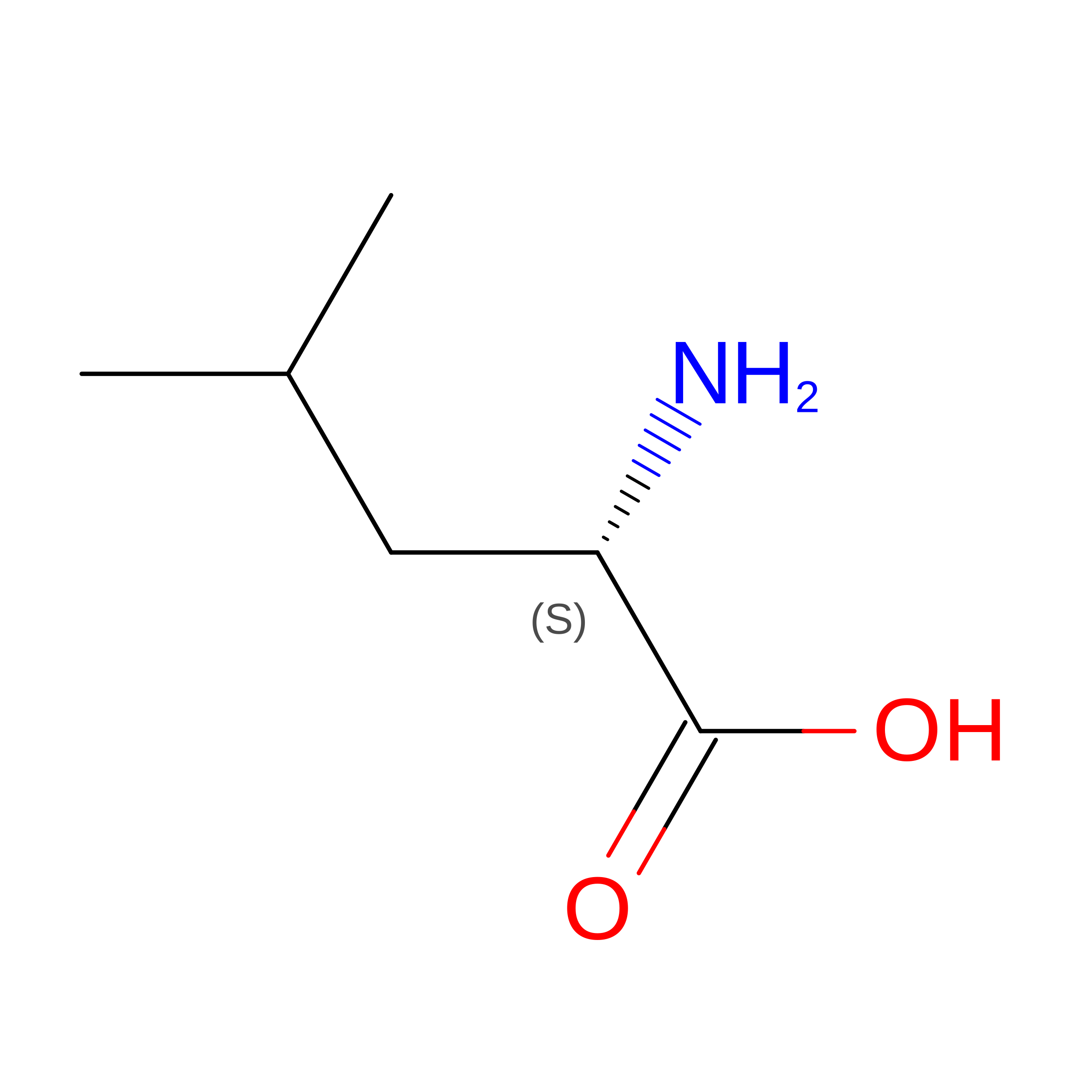
Structure of ATU2422-GABA F77A mutant receptor in complex with leucine


Experimental Data Snapshot

  • Method: X-RAY DIFFRACTION
  • Resolution: 1.30 Å
  • R-Value Free: 
    0.186 (Depositor), 0.183 (DCC) 
  • R-Value Work: 
    0.158 (Depositor), 0.153 (DCC) 
  • R-Value Observed: 
    0.159 (Depositor) 

Starting Models: experimental
View more details

wwPDB Validation 3D Report Full Report

Validation slider image for 3IPC

This is version 1.3 of the entry. See complete history

Literature

A conserved mechanism of GABA binding and antagonism is revealed by structure-function analysis of the periplasmic binding protein Atu2422 in Agrobacterium tumefaciens.

Planamente, S.Vigouroux, A.Mondy, S.Nicaise, M.Faure, D.Morera, S.

(2010) J Biological Chem 285: 30294-30303

  • DOI: https://doi.org/10.1074/jbc.M110.140715
  • Primary Citation Related Structures: 
    3IP5, 3IP6, 3IP7, 3IP9, 3IPA, 3IPC

  • PubMed Abstract: 

    Bacterial periplasmic binding proteins (PBPs) and eukaryotic PBP-like domains (also called as Venus flytrap modules) of G-protein-coupled receptors are involved in extracellular GABA perception. We investigated the structural and functional basis of ligand specificity of the PBP Atu2422, which is implicated in virulence and transport of GABA in the plant pathogen Agrobacterium tumefaciens. Five high-resolution x-ray structures of Atu2422 liganded to GABA, Pro, Ala, and Val and of point mutant Atu2422-F77A liganded to Leu were determined. Structural analysis of the ligand-binding site revealed two essential residues, Phe(77) and Tyr(275), the implication of which in GABA signaling and virulence was confirmed using A. tumefaciens cells expressing corresponding Atu2422 mutants. Phe(77) restricts ligand specificity to α-amino acids with a short lateral chain, which act as antagonists of GABA signaling in A. tumefaciens. Tyr(275) specifically interacts with the GABA γ-amino group. Conservation of these two key residues in proteins phylogenetically related to Atu2422 brought to light a subfamily of PBPs in which all members could bind GABA and short α-amino acids. This work led to the identification of a fingerprint sequence and structural features for defining PBPs that bind GABA and its competitors and revealed their occurrence among host-interacting proteobacteria.


  • Organizational Affiliation
    • Laboratoire d'Enzymologie et Biochimie Structurales, Institut des Sciences du Végétal, CNRS, Avenue de la Terrasse, 91198 Gif-sur-Yvette, France.

Macromolecule Content 

  • Total Structure Weight: 37.67 kDa 
  • Atom Count: 3,065 
  • Modeled Residue Count: 348 
  • Deposited Residue Count: 356 
  • Unique protein chains: 1

Macromolecules

Find similar proteins by:|  3D Structure
Entity ID: 1
MoleculeChains  Sequence LengthOrganismDetailsImage
ABC transporter, substrate binding protein (Amino acid)356Agrobacterium fabrum str. C58Mutation(s): 1 
Gene Names: AGR_C_4394Atu2422
UniProt
Find proteins for Q7CX36 (Agrobacterium fabrum (strain C58 / ATCC 33970))
Explore Q7CX36 
Go to UniProtKB:  Q7CX36
Entity Groups
Sequence Clusters30% Identity50% Identity70% Identity90% Identity95% Identity100% Identity
UniProt GroupQ7CX36
Sequence Annotations
Expand
Reference Sequence

Experimental Data & Validation

Experimental Data

  • Method: X-RAY DIFFRACTION
  • Resolution: 1.30 Å
  • R-Value Free:  0.186 (Depositor), 0.183 (DCC) 
  • R-Value Work:  0.158 (Depositor), 0.153 (DCC) 
  • R-Value Observed: 0.159 (Depositor) 
Space Group: C 1 2 1
Unit Cell:
Length ( Å )Angle ( ˚ )
a = 119.77α = 90
b = 43.03β = 109.76
c = 66.46γ = 90
Software Package:
Software NamePurpose
JDirectordata collection
PHASERphasing
PHENIXrefinement
XDSdata reduction
XDSdata scaling

Structure Validation

View Full Validation Report


Entry History 

Deposition Data

Revision History  (Full details and data files)

  • Version 1.0: 2010-07-14
    Type: Initial release
  • Version 1.1: 2011-07-13
    Changes: Version format compliance
  • Version 1.2: 2021-10-13
    Changes: Database references, Derived calculations
  • Version 1.3: 2023-09-06
    Changes: Data collection, Refinement description