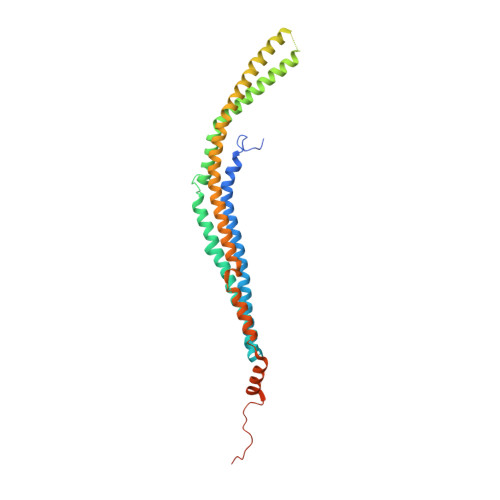
3HAH | pdb_00003hah

Crystal structure of human PACSIN1 F-BAR domain (C2 lattice)


Experimental Data Snapshot

  • Method: X-RAY DIFFRACTION
  • Resolution: 2.77 Å
  • R-Value Free: 
    0.260 (Depositor), 0.266 (DCC) 
  • R-Value Work: 
    0.215 (Depositor), 0.225 (DCC) 
  • R-Value Observed: 
    0.217 (Depositor) 

wwPDB Validation 3D Report Full Report

Validation slider image for 3HAH

This is version 1.2 of the entry. See complete history

Literature

Molecular mechanism of membrane constriction and tubulation mediated by the F-BAR protein Pacsin/Syndapin.

Wang, Q.Navarro, M.V.Peng, G.Molinelli, E.Lin Goh, S.Judson, B.L.Rajashankar, K.R.Sondermann, H.

(2009) Proc Natl Acad Sci U S A 106: 12700-12705

  • DOI: https://doi.org/10.1073/pnas.0902974106
  • Primary Citation Related Structures: 
    3HAH, 3HAI, 3HAJ

  • PubMed Abstract: 

    Peripheral membrane proteins of the Bin/amphiphysin/Rvs (BAR) and Fer-CIP4 homology-BAR (F-BAR) family participate in cellular membrane trafficking and have been shown to generate membrane tubules. The degree of membrane bending appears to be encoded in the structure and immanent curvature of the particular protein domains, with BAR and F-BAR domains inducing high- and low-curvature tubules, respectively. In addition, oligomerization and the formation of ordered arrays influences tubule stabilization. Here, the F-BAR domain-containing protein Pacsin was found to possess a unique activity, creating small tubules and tubule constrictions, in addition to the wide tubules characteristic for this subfamily. Based on crystal structures of the F-BAR domain of Pacsin and mutagenesis studies, vesiculation could be linked to the presence of unique structural features distinguishing it from other F-BAR proteins. Tubulation was suppressed in the context of the full-length protein, suggesting that Pacsin is autoinhibited in solution. The regulated deformation of membranes and promotion of tubule constrictions by Pacsin suggests a more versatile function of these proteins in vesiculation and endocytosis beyond their role as scaffold proteins.


  • Organizational Affiliation
    • Department of Molecular Medicine, College of Veterinary Medicine, Cornell University, Ithaca, NY 14853, USA.

Macromolecule Content 

  • Total Structure Weight: 76.67 kDa 
  • Atom Count: 4,511 
  • Modeled Residue Count: 535 
  • Deposited Residue Count: 650 
  • Unique protein chains: 1

Macromolecules

Find similar proteins by:|  3D Structure
Entity ID: 1
MoleculeChains  Sequence LengthOrganismDetailsImage
human PACSIN1 F-BAR
A, B
325Homo sapiensMutation(s): 0 
Gene Names: KIAA1379PACSIN1
UniProt & NIH Common Fund Data Resources
Find proteins for Q9BY11 (Homo sapiens)
Explore Q9BY11 
Go to UniProtKB:  Q9BY11
PHAROS:  Q9BY11
GTEx:  ENSG00000124507 
Entity Groups
Sequence Clusters30% Identity50% Identity70% Identity90% Identity95% Identity100% Identity
UniProt GroupQ9BY11
Sequence Annotations
Expand
Reference Sequence

Experimental Data & Validation

Experimental Data

  • Method: X-RAY DIFFRACTION
  • Resolution: 2.77 Å
  • R-Value Free:  0.260 (Depositor), 0.266 (DCC) 
  • R-Value Work:  0.215 (Depositor), 0.225 (DCC) 
  • R-Value Observed: 0.217 (Depositor) 
Space Group: C 1 2 1
Unit Cell:
Length ( Å )Angle ( ˚ )
a = 160.009α = 90
b = 85.457β = 117.56
c = 88.392γ = 90
Software Package:
Software NamePurpose
ADSCdata collection
SHELXSphasing
PHENIXrefinement
HKL-2000data reduction
HKL-2000data scaling

Structure Validation

View Full Validation Report


Entry History 

Deposition Data

Revision History  (Full details and data files)

  • Version 1.0: 2009-06-16
    Type: Initial release
  • Version 1.1: 2011-07-13
    Changes: Version format compliance
  • Version 1.2: 2024-02-21
    Changes: Data collection, Database references, Derived calculations