3GD4 | pdb_00003gd4

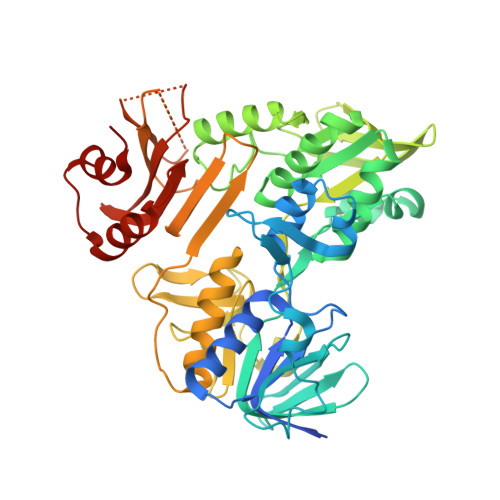
Crystal structure of the reduced, NAD-bound form of murine apoptosis inducing factor


Experimental Data Snapshot

  • Method: X-RAY DIFFRACTION
  • Resolution: 2.24 Å
  • R-Value Free: 
    0.222 (Depositor), 0.221 (DCC) 
  • R-Value Work: 
    0.187 (Depositor) 
  • R-Value Observed: 
    0.189 (Depositor) 

Starting Model: experimental
View more details

wwPDB Validation 3D Report Full Report

Validation slider image for 3GD4

Ligand Structure Quality Assessment 


This is version 1.2 of the entry. See complete history

Literature

Redox-linked conformational dynamics in apoptosis-inducing factor

Sevrioukova, I.F.

(2009) J Mol Biology 390: 924-938

  • DOI: https://doi.org/10.1016/j.jmb.2009.05.013
  • Primary Citation Related Structures: 
    3GD3, 3GD4

  • PubMed Abstract: 

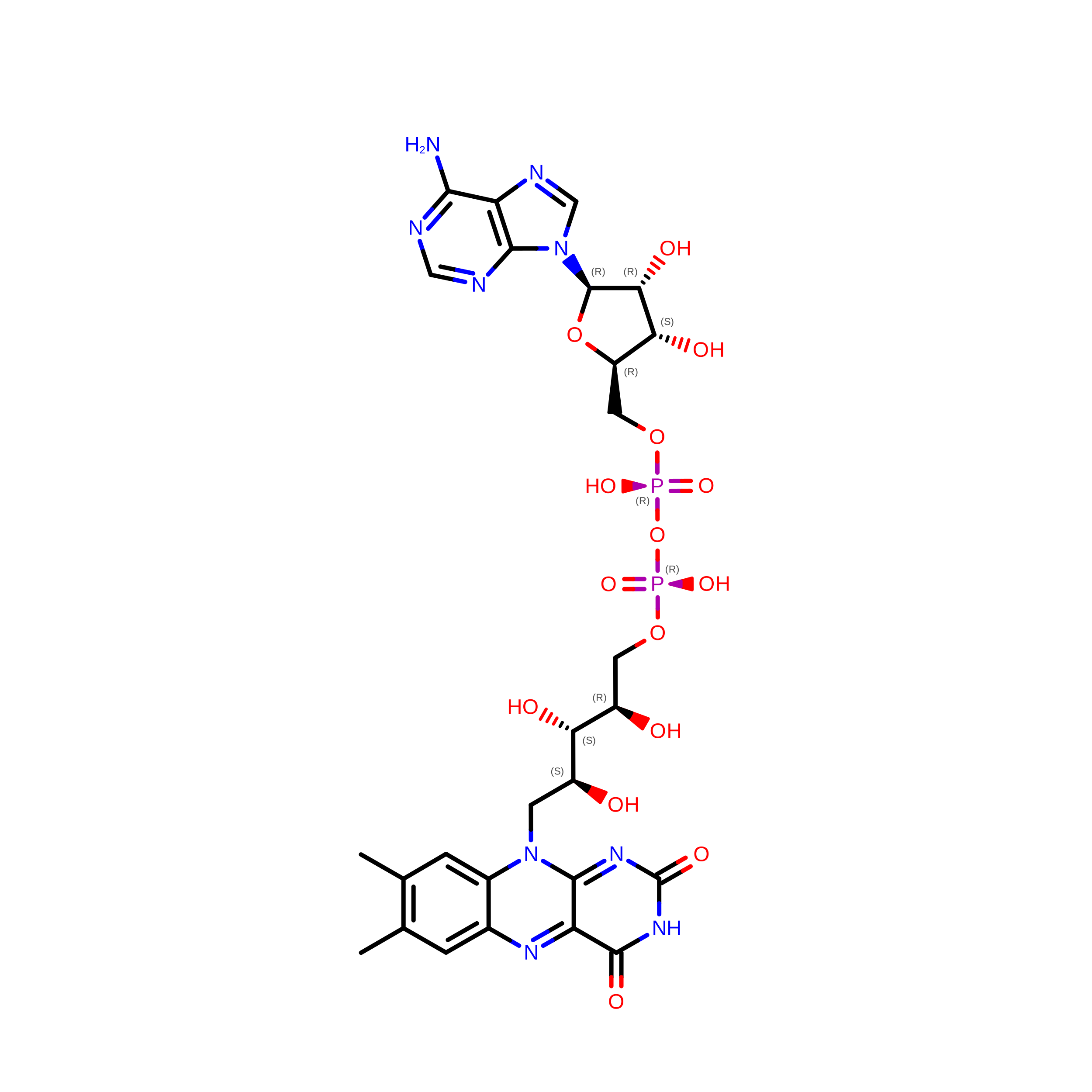
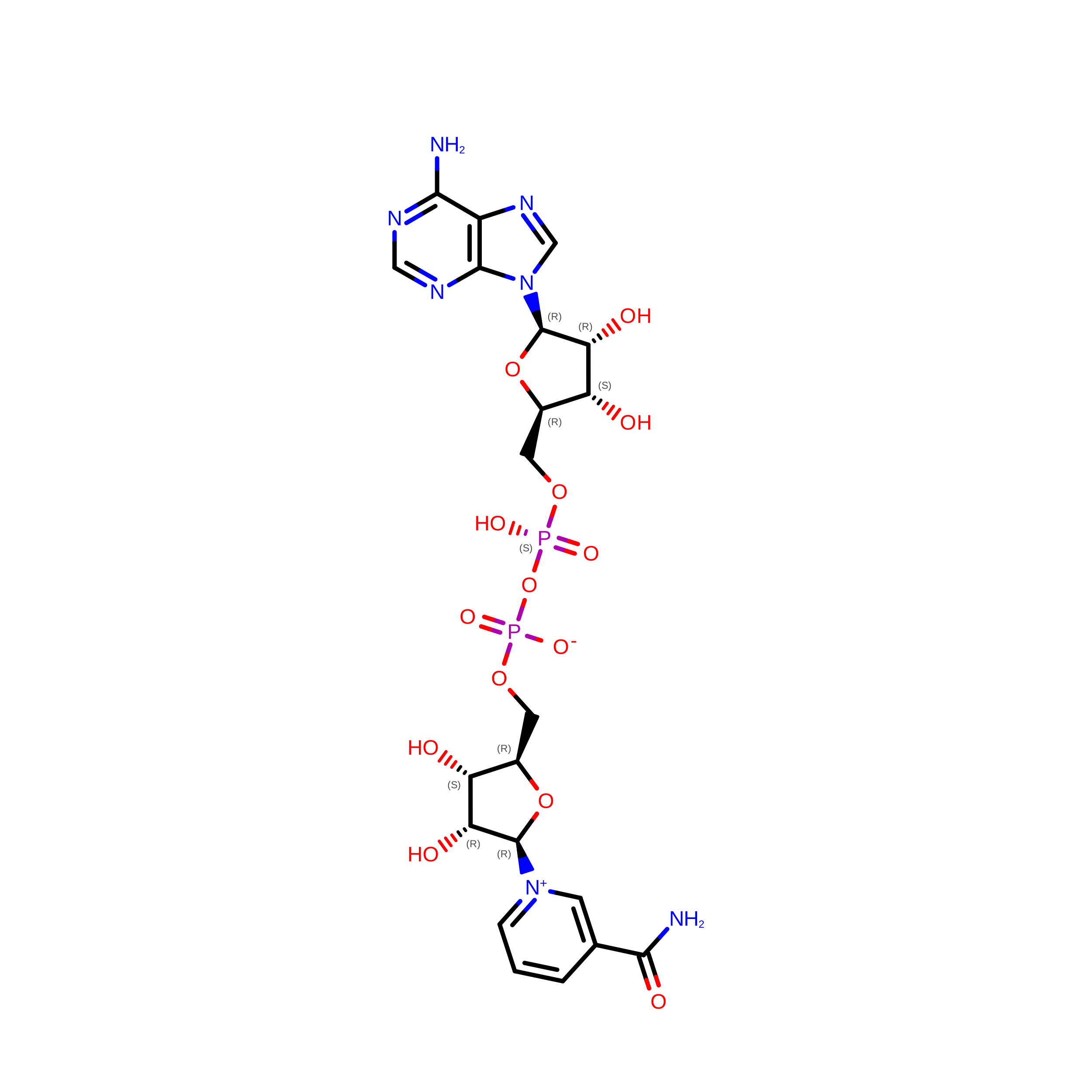
    Apoptosis-inducing factor (AIF) is a bifunctional mitochondrial flavoprotein critical for energy metabolism and induction of caspase-independent apoptosis, whose exact role in normal mitochondria remains unknown. Upon reduction with NADH, AIF undergoes dimerization and forms tight, long-lived FADH(2)-NAD charge-transfer complexes (CTC) that are proposed to be functionally important. To obtain a deeper insight into structure/function relations and redox mechanism of this vitally important protein, we determined the X-ray structures of oxidized and NADH-reduced forms of naturally folded recombinant murine AIF. Our structures reveal that CTC with the pyridine nucleotide is stabilized by (i) pi-stacking interactions between coplanar nicotinamide, isoalloxazine, and Phe309 rings; (ii) rearrangement of multiple aromatic residues in the C-terminal domain, likely serving as an electron delocalization site; and (iii) an extensive hydrogen-bonding network involving His453, a key residue that undergoes a conformational switch to directly interact with and optimally orient the nicotinamide for charge transfer. Via the His453-containing peptide, redox changes in the active site are transmitted to the surface, promoting AIF dimerization and restricting access to a primary nuclear localization signal through which the apoptogenic form is transported to the nucleus. Structural findings agree with biochemical data and support the hypothesis that both normal and apoptogenic functions of AIF are controlled by NADH.


  • Organizational Affiliation
    • Department of Molecular Biology and Biochemistry, University of California, Irvine, 92697-3900, USA. sevrioui@uci.edu

Macromolecule Content 

  • Total Structure Weight: 114.06 kDa 
  • Atom Count: 7,518 
  • Modeled Residue Count: 880 
  • Deposited Residue Count: 1,022 
  • Unique protein chains: 1

Macromolecules

Find similar proteins by:|  3D Structure
Entity ID: 1
MoleculeChains  Sequence LengthOrganismDetailsImage
Apoptosis-inducing factor 1, mitochondrial
A, B
511Mus musculusMutation(s): 0 
Gene Names: AifAifm1Pdcd8
EC: 1.6.99
UniProt
Find proteins for Q9Z0X1 (Mus musculus)
Explore Q9Z0X1 
Go to UniProtKB:  Q9Z0X1
Entity Groups
Sequence Clusters30% Identity50% Identity70% Identity90% Identity95% Identity100% Identity
UniProt GroupQ9Z0X1
Sequence Annotations
Expand
Reference Sequence

Experimental Data & Validation

Experimental Data

  • Method: X-RAY DIFFRACTION
  • Resolution: 2.24 Å
  • R-Value Free:  0.222 (Depositor), 0.221 (DCC) 
  • R-Value Work:  0.187 (Depositor) 
  • R-Value Observed: 0.189 (Depositor) 
Space Group: P 21 21 21
Unit Cell:
Length ( Å )Angle ( ˚ )
a = 60.26α = 90
b = 120.39β = 90
c = 178.19γ = 90
Software Package:
Software NamePurpose
HKL-2000data collection
AMoREphasing
REFMACrefinement
HKL-2000data reduction
HKL-2000data scaling

Structure Validation

View Full Validation Report


Ligand Structure Quality Assessment 


Entry History 

Deposition Data

Revision History  (Full details and data files)

  • Version 1.0: 2009-05-19
    Type: Initial release
  • Version 1.1: 2011-07-13
    Changes: Version format compliance
  • Version 1.2: 2023-09-06
    Changes: Data collection, Database references, Derived calculations, Refinement description