3F6X | pdb_00003f6x

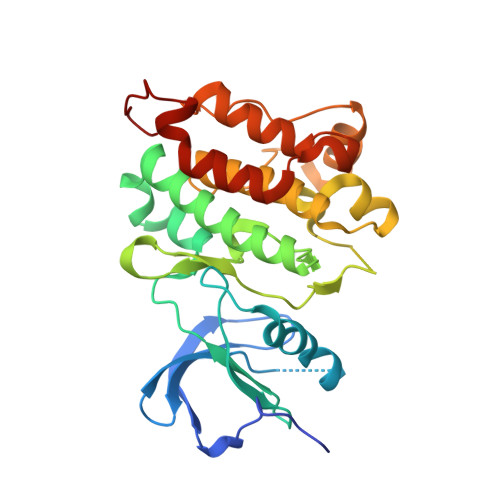
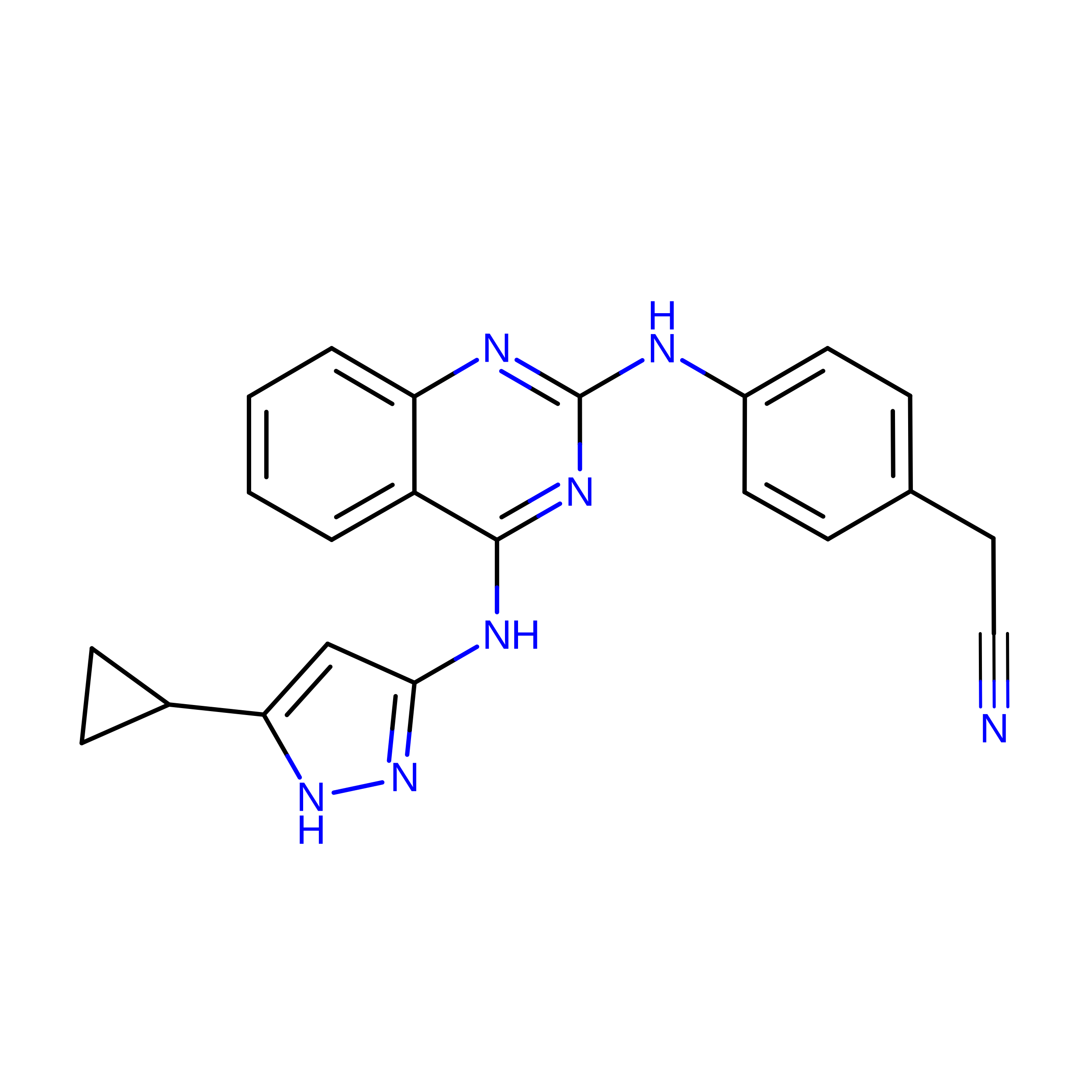
c-Src kinase domain in complex with small molecule inhibitor


Experimental Data Snapshot

  • Method: X-RAY DIFFRACTION
  • Resolution: 2.35 Å
  • R-Value Free: 
    0.266 (Depositor) 
  • R-Value Work: 
    0.234 (Depositor) 

Starting Model: experimental
View more details

wwPDB Validation 3D Report Full Report

Validation slider image for 3F6X

Ligand Structure Quality Assessment 


This is version 1.2 of the entry. See complete history

Literature

Tuning a three-component reaction for trapping kinase substrate complexes.

Statsuk, A.V.Maly, D.J.Seeliger, M.A.Fabian, M.A.Biggs, W.H.Lockhart, D.J.Zarrinkar, P.P.Kuriyan, J.Shokat, K.M.

(2008) J Am Chem Soc 130: 17568-17574

  • DOI: https://doi.org/10.1021/ja807066f
  • Primary Citation Related Structures: 
    3F6X

  • PubMed Abstract: 

    The upstream protein kinases responsible for thousands of phosphorylation events in the phosphoproteome remain to be discovered. We developed a three-component chemical reaction which converts the transient noncovalent substrate-kinase complex into a covalently cross-linked product by utilizing a dialdehyde-based cross-linker, 1. Unfortunately, the reaction of 1 with a lysine in the kinase active site and an engineered cysteine on the substrate to form an isoindole cross-linked product could not be performed in the presence of competing cellular proteins due to nonspecific side reactions. In order to more selectively target the cross-linker to protein kinases in cell lysates, we replaced the weak, kinase-binding adenosine moiety of 1 with a potent protein kinase inhibitor scaffold. In addition, we replaced the o-phthaldialdehyde moiety in 1 with a less-reactive thiophene-2,3-dicarboxaldehyde moiety. The combination of these two structural modifications provides for cross-linking of a cysteine-containing substrate to its corresponding kinase in the presence of competing cellular proteins.


  • Organizational Affiliation
    • Howard Hughes Medical Institute, Department of Cellular and Molecular Pharmacology, University of California, San Francisco, California 94107, USA.

Macromolecule Content 

  • Total Structure Weight: 132.43 kDa 
  • Atom Count: 8,872 
  • Modeled Residue Count: 1,063 
  • Deposited Residue Count: 1,144 
  • Unique protein chains: 1

Macromolecules

Find similar proteins by:|  3D Structure
Entity ID: 1
MoleculeChains  Sequence LengthOrganismDetailsImage
Proto-oncogene tyrosine-protein kinase Src
A, B, C, D
286Gallus gallusMutation(s): 0 
Gene Names: SRC
EC: 2.7.10.2
UniProt
Find proteins for P00523 (Gallus gallus)
Explore P00523 
Go to UniProtKB:  P00523
Entity Groups
Sequence Clusters30% Identity50% Identity70% Identity90% Identity95% Identity100% Identity
UniProt GroupP00523
Sequence Annotations
Expand
Reference Sequence

Experimental Data & Validation

Experimental Data

  • Method: X-RAY DIFFRACTION
  • Resolution: 2.35 Å
  • R-Value Free:  0.266 (Depositor) 
  • R-Value Work:  0.234 (Depositor) 
Space Group: P 1
Unit Cell:
Length ( Å )Angle ( ˚ )
a = 63.697α = 89.06
b = 74.488β = 89.97
c = 84.652γ = 78.43
Software Package:
Software NamePurpose
HKL-2000data collection
PHASERphasing
CNSrefinement
DENZOdata reduction
SCALEPACKdata scaling

Structure Validation

View Full Validation Report


Ligand Structure Quality Assessment 


Entry History 

Deposition Data

Revision History  (Full details and data files)

  • Version 1.0: 2008-12-09
    Type: Initial release
  • Version 1.1: 2011-07-13
    Changes: Version format compliance
  • Version 1.2: 2023-09-06
    Changes: Data collection, Database references, Derived calculations, Refinement description