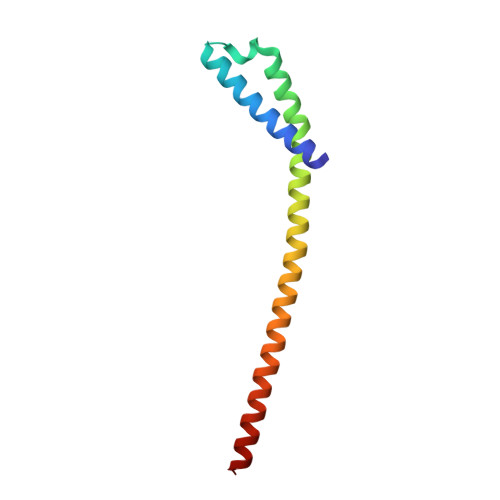
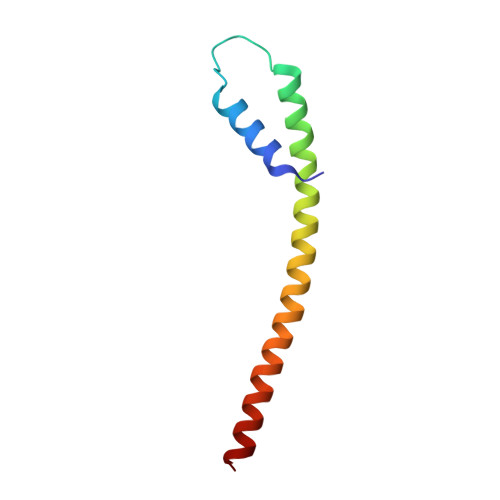
3F1I | pdb_00003f1i

Human ESCRT-0 Core Complex


Experimental Data Snapshot

  • Method: X-RAY DIFFRACTION
  • Resolution: 2.30 Å
  • R-Value Free: 
    0.253 (Depositor), 0.261 (DCC) 
  • R-Value Work: 
    0.239 (Depositor), 0.242 (DCC) 
  • R-Value Observed: 
    0.239 (Depositor) 

wwPDB Validation 3D Report Full Report

Validation slider image for 3F1I

This is version 1.2 of the entry. See complete history

Literature

Hybrid Structural Model of the Complete Human ESCRT-0 Complex.

Ren, X.Kloer, D.P.Kim, Y.C.Ghirlando, R.Saidi, L.F.Hummer, G.Hurley, J.H.

(2009) Structure 17: 406-416

  • DOI: https://doi.org/10.1016/j.str.2009.01.012
  • Primary Citation Related Structures: 
    3F1I

  • PubMed Abstract: 

    The human Hrs and STAM proteins comprise the ESCRT-0 complex, which sorts ubiquitinated cell surface receptors to lysosomes for degradation. Here we report a model for the complete ESCRT-0 complex based on the crystal structure of the Hrs-STAM core complex, previously solved domain structures, hydrodynamic measurements, and Monte Carlo simulations. ESCRT-0 expressed in insect cells has a hydrodynamic radius of RH = 7.9 nm and is a 1:1 heterodimer. The 2.3 Angstroms crystal structure of the ESCRT-0 core complex reveals two domain-swapped GAT domains and an antiparallel two-stranded coiled-coil, similar to yeast ESCRT-0. ESCRT-0 typifies a class of biomolecular assemblies that combine structured and unstructured elements, and have dynamic and open conformations to ensure versatility in target recognition. Coarse-grained Monte Carlo simulations constrained by experimental RH values for ESCRT-0 reveal a dynamic ensemble of conformations well suited for diverse functions.


  • Organizational Affiliation
    • Laboratory of Molecular Biology, National Institute of Diabetes and Digestive and Kidney Diseases, National Institutes of Health, Department of Health and Human Services, Bethesda, MD 20892, USA.

Macromolecule Content 

  • Total Structure Weight: 29.32 kDa 
  • Atom Count: 1,642 
  • Modeled Residue Count: 199 
  • Deposited Residue Count: 252 
  • Unique protein chains: 2

Macromolecules

Find similar proteins by:|  3D Structure
Entity ID: 1
MoleculeChains  Sequence LengthOrganismDetailsImage
Hepatocyte growth factor-regulated tyrosine kinase substrateA [auth H]98Homo sapiensMutation(s): 0 
Gene Names: Hepatocyte growth factor regulated tyrosine kinase substrate (HGS)HGSHRS
UniProt & NIH Common Fund Data Resources
Find proteins for O14964 (Homo sapiens)
Explore O14964 
Go to UniProtKB:  O14964
PHAROS:  O14964
GTEx:  ENSG00000185359 
Entity Groups
Sequence Clusters30% Identity50% Identity70% Identity90% Identity95% Identity100% Identity
UniProt GroupO14964
Sequence Annotations
Expand
Reference Sequence
Find similar proteins by:|  3D Structure
Entity ID: 2
MoleculeChains  Sequence LengthOrganismDetailsImage
Signal transducing adapter molecule 1B [auth S],
C
77Homo sapiensMutation(s): 0 
Gene Names: Signal transducing adaptor molecule (STAM)STAMSTAM1
UniProt & NIH Common Fund Data Resources
Find proteins for Q92783 (Homo sapiens)
Explore Q92783 
Go to UniProtKB:  Q92783
PHAROS:  Q92783
GTEx:  ENSG00000136738 
Entity Groups
Sequence Clusters30% Identity50% Identity70% Identity90% Identity95% Identity100% Identity
UniProt GroupQ92783
Sequence Annotations
Expand
Reference Sequence

Experimental Data & Validation

Experimental Data

  • Method: X-RAY DIFFRACTION
  • Resolution: 2.30 Å
  • R-Value Free:  0.253 (Depositor), 0.261 (DCC) 
  • R-Value Work:  0.239 (Depositor), 0.242 (DCC) 
  • R-Value Observed: 0.239 (Depositor) 
Space Group: I 41
Unit Cell:
Length ( Å )Angle ( ˚ )
a = 78.059α = 90
b = 78.059β = 90
c = 152.849γ = 90
Software Package:
Software NamePurpose
REFMACrefinement
PDB_EXTRACTdata extraction
HKL-2000data collection
XDSdata reduction
XSCALEdata scaling
SHARPphasing

Structure Validation

View Full Validation Report


Entry History 

Deposition Data

Revision History  (Full details and data files)

  • Version 1.0: 2009-03-24
    Type: Initial release
  • Version 1.1: 2011-07-13
    Changes: Advisory, Version format compliance
  • Version 1.2: 2023-12-27
    Changes: Data collection, Database references