3EN6 | pdb_00003en6

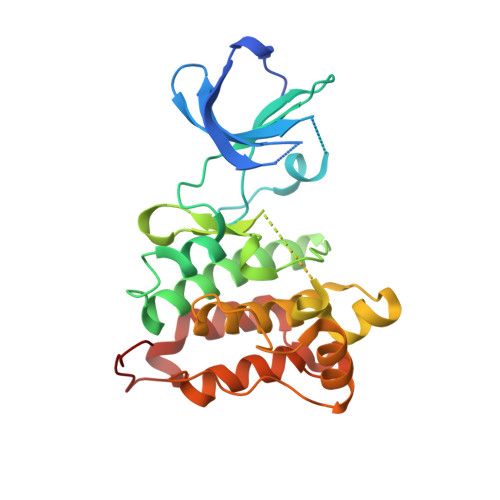
Targeted polypharmacology: crystal structure of the c-Src kinase domain in complex with PP102, a multitargeted kinase inhibitor


Experimental Data Snapshot

  • Method: X-RAY DIFFRACTION
  • Resolution: 2.39 Å
  • R-Value Free: 
    0.259 (Depositor), 0.253 (DCC) 
  • R-Value Work: 
    0.210 (Depositor), 0.206 (DCC) 
  • R-Value Observed: 
    0.213 (Depositor) 

wwPDB Validation 3D Report Full Report

Validation slider image for 3EN6

Ligand Structure Quality Assessment 


This is version 1.3 of the entry. See complete history

Literature

Targeted polypharmacology: discovery of dual inhibitors of tyrosine and phosphoinositide kinases.

Apsel, B.Blair, J.A.Gonzalez, B.Nazif, T.M.Feldman, M.E.Aizenstein, B.Hoffman, R.Williams, R.L.Shokat, K.M.Knight, Z.A.

(2008) Nat Chem Biol 4: 691-699

  • DOI: https://doi.org/10.1038/nchembio.117
  • Primary Citation Related Structures: 
    2V4L, 3EN4, 3EN5, 3EN6, 3EN7, 3ENE

  • PubMed Abstract: 

    The clinical success of multitargeted kinase inhibitors has stimulated efforts to identify promiscuous drugs with optimal selectivity profiles. It remains unclear to what extent such drugs can be rationally designed, particularly for combinations of targets that are structurally divergent. Here we report the systematic discovery of molecules that potently inhibit both tyrosine kinases and phosphatidylinositol-3-OH kinases, two protein families that are among the most intensely pursued cancer drug targets. Through iterative chemical synthesis, X-ray crystallography and kinome-level biochemical profiling, we identified compounds that inhibit a spectrum of new target combinations in these two families. Crystal structures revealed that the dual selectivity of these molecules is controlled by a hydrophobic pocket conserved in both enzyme classes and accessible through a rotatable bond in the drug skeleton. We show that one compound, PP121, blocks the proliferation of tumor cells by direct inhibition of oncogenic tyrosine kinases and phosphatidylinositol-3-OH kinases. These molecules demonstrate the feasibility of accessing a chemical space that intersects two families of oncogenes.


  • Organizational Affiliation
    • Program in Chemistry and Chemical Biology, University of California, San Francisco, 600 16th Street, San Francisco, California 94158, USA.

Macromolecule Content 

  • Total Structure Weight: 65.76 kDa 
  • Atom Count: 3,749 
  • Modeled Residue Count: 475 
  • Deposited Residue Count: 572 
  • Unique protein chains: 1

Macromolecules

Find similar proteins by:|  3D Structure
Entity ID: 1
MoleculeChains  Sequence LengthOrganismDetailsImage
Proto-oncogene tyrosine-protein kinase Src
A, B
286Gallus gallusMutation(s): 0 
Gene Names: SRC
EC: 2.7.10.2
UniProt
Find proteins for P00523 (Gallus gallus)
Explore P00523 
Go to UniProtKB:  P00523
Entity Groups
Sequence Clusters30% Identity50% Identity70% Identity90% Identity95% Identity100% Identity
UniProt GroupP00523
Sequence Annotations
Expand
Reference Sequence

Small Molecules

Ligands 1 Unique
IDChains Name / Formula / InChI Key2D Diagram3D Interactions
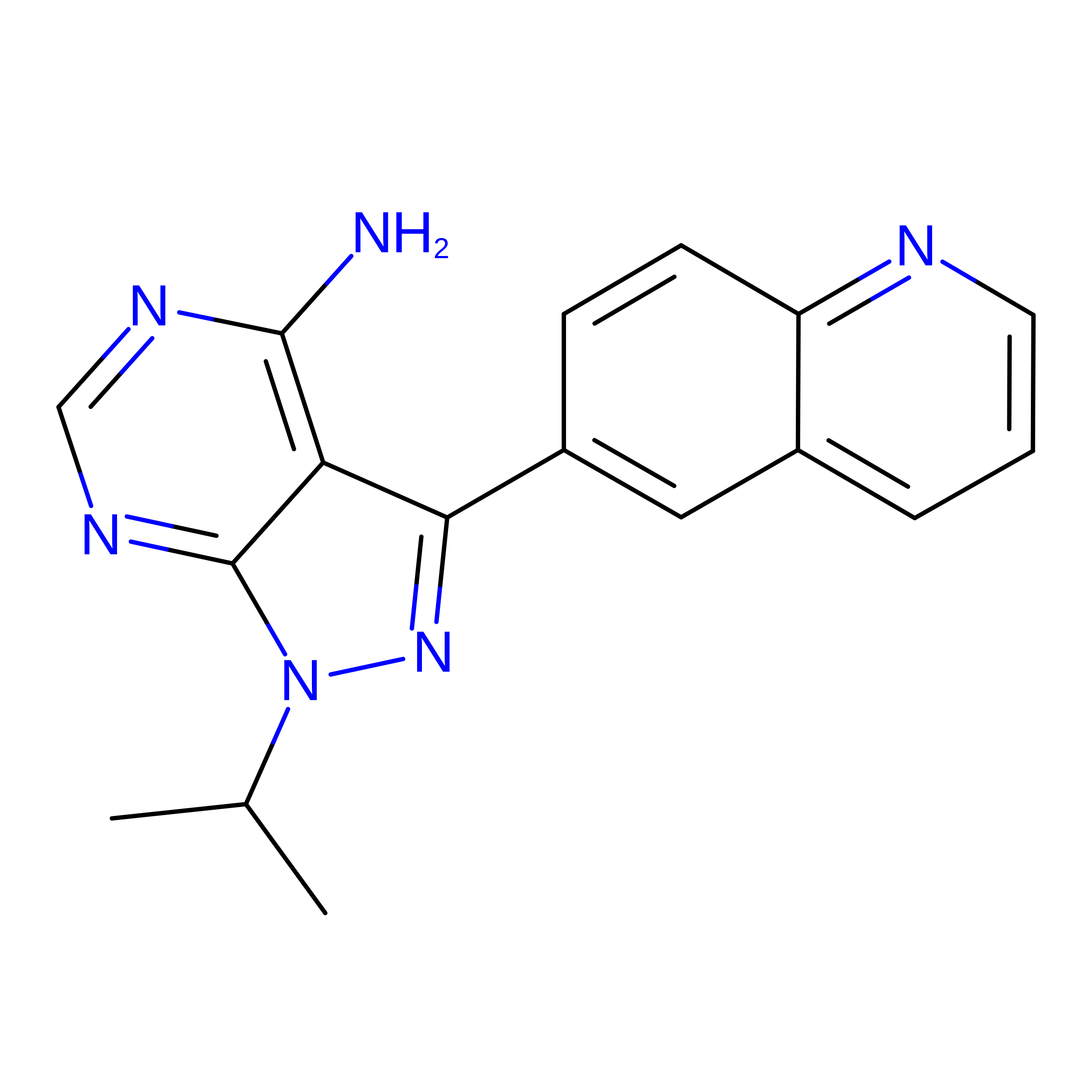
KS5

Query on KS5


Download:Ideal Coordinates CCD File
C [auth B]1-(1-methylethyl)-3-quinolin-6-yl-1H-pyrazolo[3,4-d]pyrimidin-4-amine
C17 H16 N6
GEZALMMCQYDFML-UHFFFAOYSA-N

Experimental Data & Validation

Experimental Data

  • Method: X-RAY DIFFRACTION
  • Resolution: 2.39 Å
  • R-Value Free:  0.259 (Depositor), 0.253 (DCC) 
  • R-Value Work:  0.210 (Depositor), 0.206 (DCC) 
  • R-Value Observed: 0.213 (Depositor) 
Space Group: P 1
Unit Cell:
Length ( Å )Angle ( ˚ )
a = 42.439α = 101.31
b = 63.046β = 91.17
c = 74.579γ = 89.62
Software Package:
Software NamePurpose
DENZOdata reduction
SCALEPACKdata scaling
PHASERphasing
REFMACrefinement
PDB_EXTRACTdata extraction
HKL-2000data collection
HKL-2000data reduction
HKL-2000data scaling

Structure Validation

View Full Validation Report


Ligand Structure Quality Assessment 


Entry History 

Deposition Data

Revision History  (Full details and data files)

  • Version 1.0: 2008-10-14
    Type: Initial release
  • Version 1.1: 2011-07-13
    Changes: Advisory, Version format compliance
  • Version 1.2: 2017-10-25
    Changes: Refinement description
  • Version 1.3: 2024-02-21
    Changes: Data collection, Database references, Derived calculations