3DXR | pdb_00003dxr

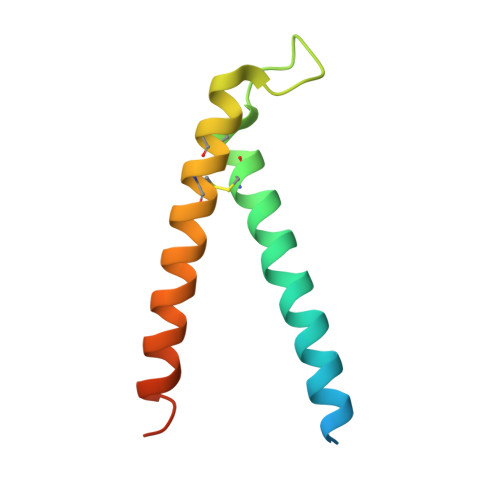
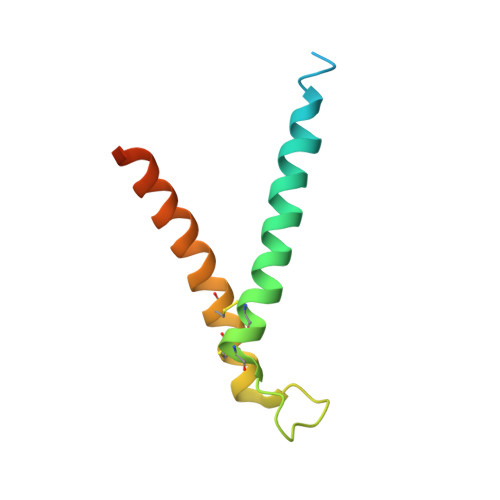
Crystal structure of the yeast inter-membrane space chaperone assembly TIM9.10


Experimental Data Snapshot

  • Method: X-RAY DIFFRACTION
  • Resolution: 2.50 Å
  • R-Value Free: 
    0.275 (Depositor), 0.248 (DCC) 
  • R-Value Work: 
    0.245 (Depositor), 0.247 (DCC) 
  • R-Value Observed: 
    0.247 (Depositor) 

Starting Model: experimental
View more details

wwPDB Validation 3D Report Full Report

Validation slider image for 3DXR

This is version 1.4 of the entry. See complete history

Literature

Structural and functional requirements for activity of the Tim9-Tim10 complex in mitochondrial protein import

Baker, M.J.Webb, C.T.Stroud, D.A.Palmer, C.S.Frazier, A.E.Guiard, B.Chacinska, A.Gulbis, J.M.Ryan, M.T.

(2009) Mol Biol Cell 20: 769-779

  • DOI: https://doi.org/10.1091/mbc.e08-09-0903
  • Primary Citation Related Structures: 
    3DXR

  • PubMed Abstract: 

    The Tim9-Tim10 complex plays an essential role in mitochondrial protein import by chaperoning select hydrophobic precursor proteins across the intermembrane space. How the complex interacts with precursors is not clear, although it has been proposed that Tim10 acts in substrate recognition, whereas Tim9 acts in complex stabilization. In this study, we report the structure of the yeast Tim9-Tim10 hexameric assembly determined to 2.5 A and have performed mutational analysis in yeast to evaluate the specific roles of Tim9 and Tim10. Like the human counterparts, each Tim9 and Tim10 subunit contains a central loop flanked by disulfide bonds that separate two extended N- and C-terminal tentacle-like helices. Buried salt-bridges between highly conserved lysine and glutamate residues connect alternating subunits. Mutation of these residues destabilizes the complex, causes defective import of precursor substrates, and results in yeast growth defects. Truncation analysis revealed that in the absence of the N-terminal region of Tim9, the hexameric complex is no longer able to efficiently trap incoming substrates even though contacts with Tim10 are still made. We conclude that Tim9 plays an important functional role that includes facilitating the initial steps in translocating precursor substrates into the intermembrane space.


  • Organizational Affiliation
    • Department of Biochemistry, La Trobe University, Melbourne 3086, Victoria, Australia.

Macromolecule Content 

  • Total Structure Weight: 20.82 kDa 
  • Atom Count: 1,072 
  • Modeled Residue Count: 138 
  • Deposited Residue Count: 184 
  • Unique protein chains: 2

Macromolecules

Find similar proteins by:|  3D Structure
Entity ID: 1
MoleculeChains  Sequence LengthOrganismDetailsImage
Mitochondrial import inner membrane translocase subunit TIM989Saccharomyces cerevisiaeMutation(s): 0 
Gene Names: TIM9
UniProt
Find proteins for O74700 (Saccharomyces cerevisiae (strain ATCC 204508 / S288c))
Explore O74700 
Go to UniProtKB:  O74700
Entity Groups
Sequence Clusters30% Identity50% Identity70% Identity90% Identity95% Identity100% Identity
UniProt GroupO74700
Sequence Annotations
Expand
Reference Sequence
Find similar proteins by:|  3D Structure
Entity ID: 2
MoleculeChains  Sequence LengthOrganismDetailsImage
Mitochondrial import inner membrane translocase subunit TIM1095Saccharomyces cerevisiaeMutation(s): 0 
Gene Names: MRS11TIM10
UniProt
Find proteins for P87108 (Saccharomyces cerevisiae (strain ATCC 204508 / S288c))
Explore P87108 
Go to UniProtKB:  P87108
Entity Groups
Sequence Clusters30% Identity50% Identity70% Identity90% Identity95% Identity100% Identity
UniProt GroupP87108
Sequence Annotations
Expand
Reference Sequence

Experimental Data & Validation

Experimental Data

  • Method: X-RAY DIFFRACTION
  • Resolution: 2.50 Å
  • R-Value Free:  0.275 (Depositor), 0.248 (DCC) 
  • R-Value Work:  0.245 (Depositor), 0.247 (DCC) 
  • R-Value Observed: 0.247 (Depositor) 
Space Group: H 3 2
Unit Cell:
Length ( Å )Angle ( ˚ )
a = 58.198α = 90
b = 58.198β = 90
c = 243.731γ = 120
Software Package:
Software NamePurpose
DENZOdata reduction
SCALEPACKdata scaling
PHASERphasing
DMphasing
CNSrefinement
PDB_EXTRACTdata extraction
HKL-2000data collection
HKL-2000data reduction
HKL-2000data scaling

Structure Validation

View Full Validation Report


Entry History 

Deposition Data

Revision History  (Full details and data files)

  • Version 1.0: 2008-12-23
    Type: Initial release
  • Version 1.1: 2011-07-13
    Changes: Version format compliance
  • Version 1.2: 2017-10-25
    Changes: Refinement description
  • Version 1.3: 2023-08-30
    Changes: Data collection, Database references, Refinement description
  • Version 1.4: 2024-11-13
    Changes: Structure summary