3D3B | pdb_00003d3b

Structural and functional analysis of the E. coli NusB-S10 transcription antitermination complex.


Experimental Data Snapshot

  • Method: X-RAY DIFFRACTION
  • Resolution: 1.30 Å
  • R-Value Free: 
    0.204 (Depositor), 0.203 (DCC) 
  • R-Value Work: 
    0.173 (Depositor), 0.172 (DCC) 
  • R-Value Observed: 
    0.175 (Depositor) 

Starting Models: experimental
View more details

wwPDB Validation 3D Report Full Report

Validation slider image for 3D3B

This is version 1.4 of the entry. See complete history

Literature

Structural and functional analysis of the E. coli NusB-S10 transcription antitermination complex.

Luo, X.Hsiao, H.H.Bubunenko, M.Weber, G.Court, D.L.Gottesman, M.E.Urlaub, H.Wahl, M.C.

(2008) Mol Cell 32: 791-802

  • DOI: https://doi.org/10.1016/j.molcel.2008.10.028
  • Primary Citation Related Structures: 
    3D3B, 3D3C

  • PubMed Abstract: 

    Protein S10 is a component of the 30S ribosomal subunit and participates together with NusB protein in processive transcription antitermination. The molecular mechanisms by which S10 can act as a translation or a transcription factor are not understood. We used complementation assays and recombineering to delineate regions of S10 dispensable for antitermination, and determined the crystal structure of a transcriptionally active NusB-S10 complex. In this complex, S10 adopts the same fold as in the 30S subunit and is blocked from simultaneous association with the ribosome. Mass spectrometric mapping of UV-induced crosslinks revealed that the NusB-S10 complex presents an intermolecular, composite, and contiguous binding surface for RNAs containing BoxA antitermination signals. Furthermore, S10 overproduction complemented a nusB null phenotype. These data demonstrate that S10 and NusB together form a BoxA-binding module, that NusB facilitates entry of S10 into the transcription machinery, and that S10 represents a central hub in processive antitermination.


  • Organizational Affiliation
    • Research Group X-Ray Crystallography, Max-Planck-Institute for Biophysical Chemistry, D-37077 Göttingen, Germany.

Macromolecule Content 

  • Total Structure Weight: 26.07 kDa 
  • Atom Count: 2,382 
  • Modeled Residue Count: 226 
  • Deposited Residue Count: 228 
  • Unique protein chains: 2

Macromolecules

Find similar proteins by:|  3D Structure
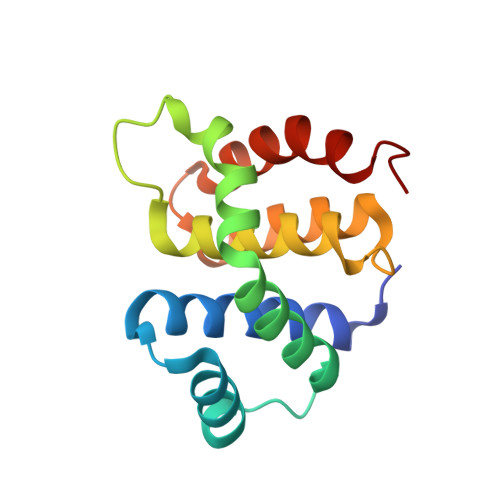
Entity ID: 1
MoleculeChains  Sequence LengthOrganismDetailsImage
N utilization substance protein B141Escherichia coli K-12Mutation(s): 1 
Gene Names: nusBssyBb0416JW0406
UniProt
Find proteins for P0A780 (Escherichia coli (strain K12))
Explore P0A780 
Go to UniProtKB:  P0A780
Entity Groups
Sequence Clusters30% Identity50% Identity70% Identity90% Identity95% Identity100% Identity
UniProt GroupP0A780
Sequence Annotations
Expand
Reference Sequence
Find similar proteins by:|  3D Structure
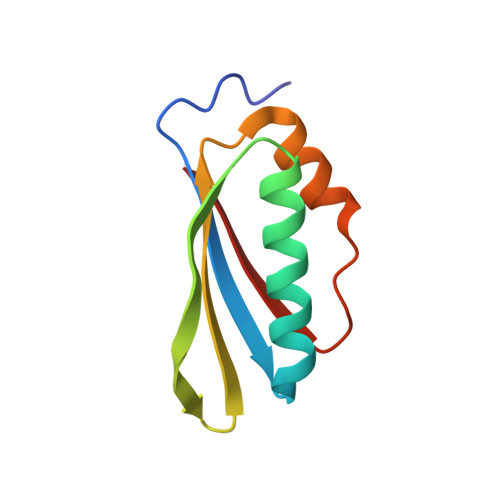
Entity ID: 2
MoleculeChains  Sequence LengthOrganismDetailsImage
30S ribosomal protein S10B [auth J]87Escherichia coli K-12Mutation(s): 0 
Gene Names: rpsJnusEb3321JW3283
UniProt
Find proteins for P0A7R5 (Escherichia coli (strain K12))
Explore P0A7R5 
Go to UniProtKB:  P0A7R5
Entity Groups
Sequence Clusters30% Identity50% Identity70% Identity90% Identity95% Identity100% Identity
UniProt GroupP0A7R5
Sequence Annotations
Expand
Reference Sequence

Experimental Data & Validation

Experimental Data

  • Method: X-RAY DIFFRACTION
  • Resolution: 1.30 Å
  • R-Value Free:  0.204 (Depositor), 0.203 (DCC) 
  • R-Value Work:  0.173 (Depositor), 0.172 (DCC) 
  • R-Value Observed: 0.175 (Depositor) 
Space Group: P 21 21 21
Unit Cell:
Length ( Å )Angle ( ˚ )
a = 40.74α = 90
b = 48.99β = 90
c = 112.77γ = 90
Software Package:
Software NamePurpose
REFMACrefinement
MAR345dtbdata collection
XDSdata reduction
XDSdata scaling
MOLREPphasing

Structure Validation

View Full Validation Report


Entry History 

Deposition Data

Revision History  (Full details and data files)

  • Version 1.0: 2009-01-13
    Type: Initial release
  • Version 1.1: 2011-07-13
    Changes: Advisory, Source and taxonomy, Version format compliance
  • Version 1.2: 2017-08-02
    Changes: Source and taxonomy
  • Version 1.3: 2021-10-20
    Changes: Database references, Derived calculations
  • Version 1.4: 2023-08-30
    Changes: Data collection, Refinement description