3BY9 | pdb_00003by9

Crystal structure of the V. cholerae Histidine Kinase DctB Sensor Domain


Experimental Data Snapshot

  • Method: X-RAY DIFFRACTION
  • Resolution: 1.70 Å
  • R-Value Free: 
    0.199 (Depositor), 0.207 (DCC) 
  • R-Value Work: 
    0.162 (Depositor), 0.175 (DCC) 

wwPDB Validation 3D Report Full Report

Validation slider image for 3BY9

This is version 1.3 of the entry. See complete history

Literature

Crystal Structures of C4-Dicarboxylate Ligand Complexes with Sensor Domains of Histidine Kinases DcuS and DctB.

Cheung, J.Hendrickson, W.A.

(2008) J Biological Chem 283: 30256-30265

  • DOI: https://doi.org/10.1074/jbc.M805253200
  • Primary Citation Related Structures: 
    3BY8, 3BY9

  • PubMed Abstract: 

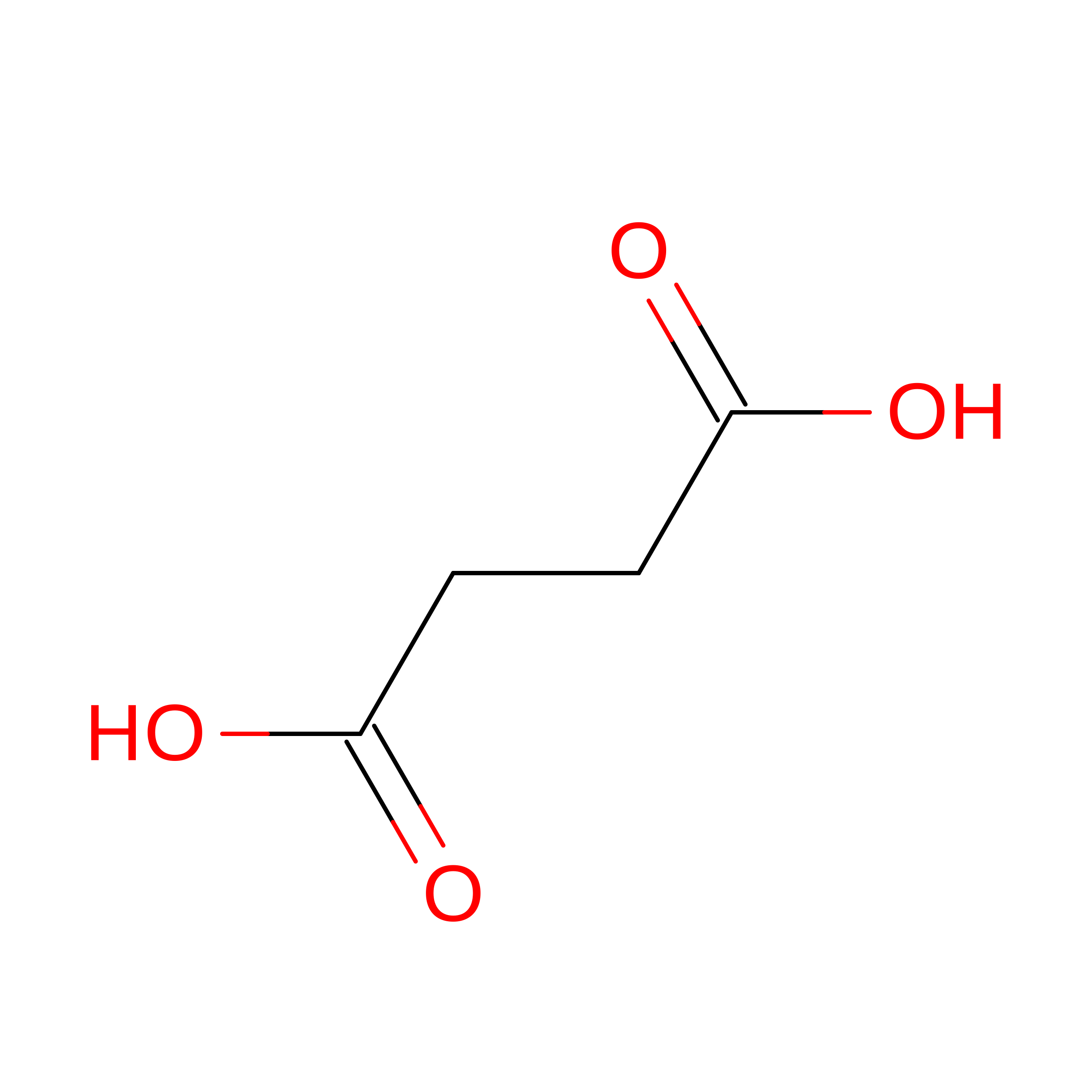
    Two-component signaling systems allow bacteria to adapt to changing environments. Typically, a chemical or other stimulus is detected by the periplasmic sensor domain of a transmembrane histidine kinase sensor, which in turn relays a signal through a phosphotransfer cascade to the cognate cytoplasmic response regulator. Such systems lead ultimately to changes in gene expression or cell motility. Mechanisms of ligand binding and signal transduction through the cell membrane in histidine kinases are not fully understood. In an effort to further understand such processes, we have solved the crystal structures of the periplasmic sensor domains of Escherichia coli DcuS and of Vibrio cholerae DctB in complex with the respective cognate ligands, malate and succinate. Both proteins are involved in the regulation of the transport and metabolism of C(4)-dicarboxylates, but they are not highly related by sequence similarity. Our work reveals that despite disparate sizes, both structures contain a similar characteristic alpha/beta PDC (PhoQ-DcuS-CitA) sensor-domain fold and display similar modes of ligand binding, suggesting similar mechanisms of function.


  • Organizational Affiliation
    • Department of Biochemistry and Molecular Biophysics, Columbia University, New York, New York 10032, USA.

Macromolecule Content 

  • Total Structure Weight: 60.31 kDa 
  • Atom Count: 5,138 
  • Modeled Residue Count: 517 
  • Deposited Residue Count: 520 
  • Unique protein chains: 1

Macromolecules

Find similar proteins by:|  3D Structure
Entity ID: 1
MoleculeChains  Sequence LengthOrganismDetailsImage
Sensor protein
A, B
260Vibrio choleraeMutation(s): 0 
Gene Names: VC1925
EC: 2.7.13.3
UniProt
Find proteins for Q9KQS3 (Vibrio cholerae serotype O1 (strain ATCC 39315 / El Tor Inaba N16961))
Explore Q9KQS3 
Go to UniProtKB:  Q9KQS3
Entity Groups
Sequence Clusters30% Identity50% Identity70% Identity90% Identity95% Identity100% Identity
UniProt GroupQ9KQS3
Sequence Annotations
Expand
Reference Sequence

Experimental Data & Validation

Experimental Data

  • Method: X-RAY DIFFRACTION
  • Resolution: 1.70 Å
  • R-Value Free:  0.199 (Depositor), 0.207 (DCC) 
  • R-Value Work:  0.162 (Depositor), 0.175 (DCC) 
Space Group: P 21 21 21
Unit Cell:
Length ( Å )Angle ( ˚ )
a = 56.311α = 90
b = 90.982β = 90
c = 114.196γ = 90
Software Package:
Software NamePurpose
DENZOdata reduction
SCALEPACKdata scaling
SOLVEphasing
DMphasing
CNSrefinement
PDB_EXTRACTdata extraction

Structure Validation

View Full Validation Report


Entry History 

Deposition Data

Revision History  (Full details and data files)

  • Version 1.0: 2008-08-12
    Type: Initial release
  • Version 1.1: 2011-07-13
    Changes: Version format compliance
  • Version 1.2: 2017-10-25
    Changes: Refinement description
  • Version 1.3: 2024-10-30
    Changes: Data collection, Database references, Derived calculations, Structure summary