3BOV | pdb_00003bov

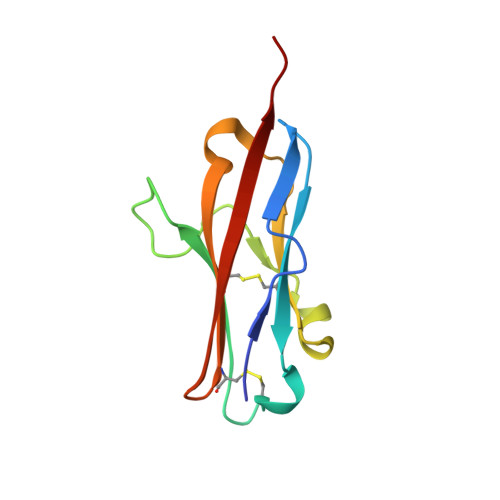
Crystal structure of the receptor binding domain of mouse PD-L2


Experimental Data Snapshot

  • Method: X-RAY DIFFRACTION
  • Resolution: 1.77 Å
  • R-Value Free: 
    0.223 (Depositor), 0.222 (DCC) 
  • R-Value Work: 
    0.190 (Depositor), 0.185 (DCC) 
  • R-Value Observed: 
    0.192 (Depositor) 

Starting Model: experimental
View more details

wwPDB Validation 3D Report Full Report

Validation slider image for 3BOV

This is version 1.4 of the entry. See complete history

Literature

Crystal structure of the complex between programmed death-1 (PD-1) and its ligand PD-L2.

Lazar-Molnar, E.Yan, Q.Cao, E.Ramagopal, U.Nathenson, S.G.Almo, S.C.

(2008) Proc Natl Acad Sci U S A 105: 10483-10488

  • DOI: https://doi.org/10.1073/pnas.0804453105
  • Primary Citation Related Structures: 
    3BOV, 3BP5

  • PubMed Abstract: 

    Programmed death-1 (PD-1) is a member of the CD28/B7 superfamily that delivers negative signals upon interaction with its two ligands, PD-L1 or PD-L2. The high-resolution crystal structure of the complex formed by the complete ectodomains of murine PD-1 and PD-L2 revealed a 1:1 receptor:ligand stoichiometry and displayed a binding interface and overall molecular organization distinct from that observed in the CTLA-4/B7 inhibitory complexes. Furthermore, our structure also provides insights into the association between PD-1 and PD-L1 and highlights differences in the interfaces formed by the two PD-1 ligands (PD-Ls) Mutagenesis studies confirmed the details of the proposed PD-1/PD-L binding interfaces and allowed for the design of a mutant PD-1 receptor with enhanced affinity. These studies define spatial and organizational constraints that control the localization and signaling of PD-1/PD-L complexes within the immunological synapse and provide a basis for manipulating the PD-1 pathways for immunotherapy.


  • Organizational Affiliation
    • Department of Microbiology and Immunology, Albert Einstein College of Medicine, 1300 Morris Park Avenue, Bronx, NY 10461, USA.

Macromolecule Content 

  • Total Structure Weight: 11.89 kDa 
  • Atom Count: 944 
  • Modeled Residue Count: 104 
  • Deposited Residue Count: 105 
  • Unique protein chains: 1

Macromolecules

Find similar proteins by:|  3D Structure
Entity ID: 1
MoleculeChains  Sequence LengthOrganismDetailsImage
Programmed cell death 1 ligand 2105Mus musculusMutation(s): 0 
Gene Names: Pdcd1lg2B7dcBtdcCd273Pdl2
UniProt
Find proteins for Q9WUL5 (Mus musculus)
Explore Q9WUL5 
Go to UniProtKB:  Q9WUL5
Entity Groups
Sequence Clusters30% Identity50% Identity70% Identity90% Identity95% Identity100% Identity
UniProt GroupQ9WUL5
Sequence Annotations
Expand
Reference Sequence

Experimental Data & Validation

Experimental Data

  • Method: X-RAY DIFFRACTION
  • Resolution: 1.77 Å
  • R-Value Free:  0.223 (Depositor), 0.222 (DCC) 
  • R-Value Work:  0.190 (Depositor), 0.185 (DCC) 
  • R-Value Observed: 0.192 (Depositor) 
Space Group: C 2 2 2
Unit Cell:
Length ( Å )Angle ( ˚ )
a = 45.173α = 90
b = 116.637β = 90
c = 45.108γ = 90
Software Package:
Software NamePurpose
DENZOdata reduction
SCALEPACKdata scaling
REFMACrefinement
PDB_EXTRACTdata extraction
CBASSdata collection
HKL-2000data reduction
MOLREPphasing

Structure Validation

View Full Validation Report


Entry History 

Deposition Data

Revision History  (Full details and data files)

  • Version 1.0: 2008-07-15
    Type: Initial release
  • Version 1.1: 2011-07-13
    Changes: Version format compliance
  • Version 1.2: 2017-10-25
    Changes: Refinement description
  • Version 1.3: 2024-04-03
    Changes: Data collection, Database references, Derived calculations, Refinement description
  • Version 1.4: 2024-11-13
    Changes: Structure summary