3B70 | pdb_00003b70

Crystal structure of Aspergillus terreus trans-acting lovastatin polyketide enoyl reductase (LovC) with bound NADP


Experimental Data Snapshot

  • Method: X-RAY DIFFRACTION
  • Resolution: 1.89 Å
  • R-Value Free: 
    0.228 (Depositor), 0.228 (DCC) 
  • R-Value Work: 
    0.184 (Depositor), 0.182 (DCC) 

Starting Model: experimental
View more details

wwPDB Validation 3D Report Full Report

Validation slider image for 3B70

Ligand Structure Quality Assessment 


This is version 1.4 of the entry. See complete history

Literature

Crystal structure and biochemical studies of the trans-acting polyketide enoyl reductase LovC from lovastatin biosynthesis.

Ames, B.D.Nguyen, C.Bruegger, J.Smith, P.Xu, W.Ma, S.Wong, E.Wong, S.Xie, X.Li, J.W.Vederas, J.C.Tang, Y.Tsai, S.C.

(2012) Proc Natl Acad Sci U S A 109: 11144-11149

  • DOI: https://doi.org/10.1073/pnas.1113029109
  • Primary Citation Related Structures: 
    3B6Z, 3B70

  • PubMed Abstract: 

    Lovastatin is an important statin prescribed for the treatment and prevention of cardiovascular diseases. Biosynthesis of lovastatin uses an iterative type I polyketide synthase (PKS). LovC is a trans-acting enoyl reductase (ER) that specifically reduces three out of eight possible polyketide intermediates during lovastatin biosynthesis. Such trans-acting ERs have been reported across a variety of other fungal PKS enzymes as a strategy in nature to diversify polyketides. How LovC achieves such specificity is unknown. The 1.9-Å structure of LovC reveals that LovC possesses a medium-chain dehydrogenase/reductase (MDR) fold with a unique monomeric assembly. Two LovC cocrystal structures and enzymological studies help elucidate the molecular basis of LovC specificity, define stereochemistry, and identify active-site residues. Sequence alignment indicates a general applicability to trans-acting ERs of fungal PKSs, as well as their potential application to directing biosynthesis.


  • Organizational Affiliation
    • Department of Molecular Biology and Biochemistry, University of California, Irvine, CA 92697, USA.

Macromolecule Content 

  • Total Structure Weight: 41.46 kDa 
  • Atom Count: 2,922 
  • Modeled Residue Count: 357 
  • Deposited Residue Count: 371 
  • Unique protein chains: 1

Macromolecules

Find similar proteins by:|  3D Structure
Entity ID: 1
MoleculeChains  Sequence LengthOrganismDetailsImage
Enoyl reductase371Aspergillus terreusMutation(s): 0 
Gene Names: lovC
EC: 2.3.1.161
UniProt
Find proteins for Q9Y7D0 (Aspergillus terreus)
Explore Q9Y7D0 
Go to UniProtKB:  Q9Y7D0
Entity Groups
Sequence Clusters30% Identity50% Identity70% Identity90% Identity95% Identity100% Identity
UniProt GroupQ9Y7D0
Sequence Annotations
Expand
Reference Sequence

Small Molecules

Ligands 2 Unique
IDChains Name / Formula / InChI Key2D Diagram3D Interactions
NAP

Query on NAP


Download:Ideal Coordinates CCD File
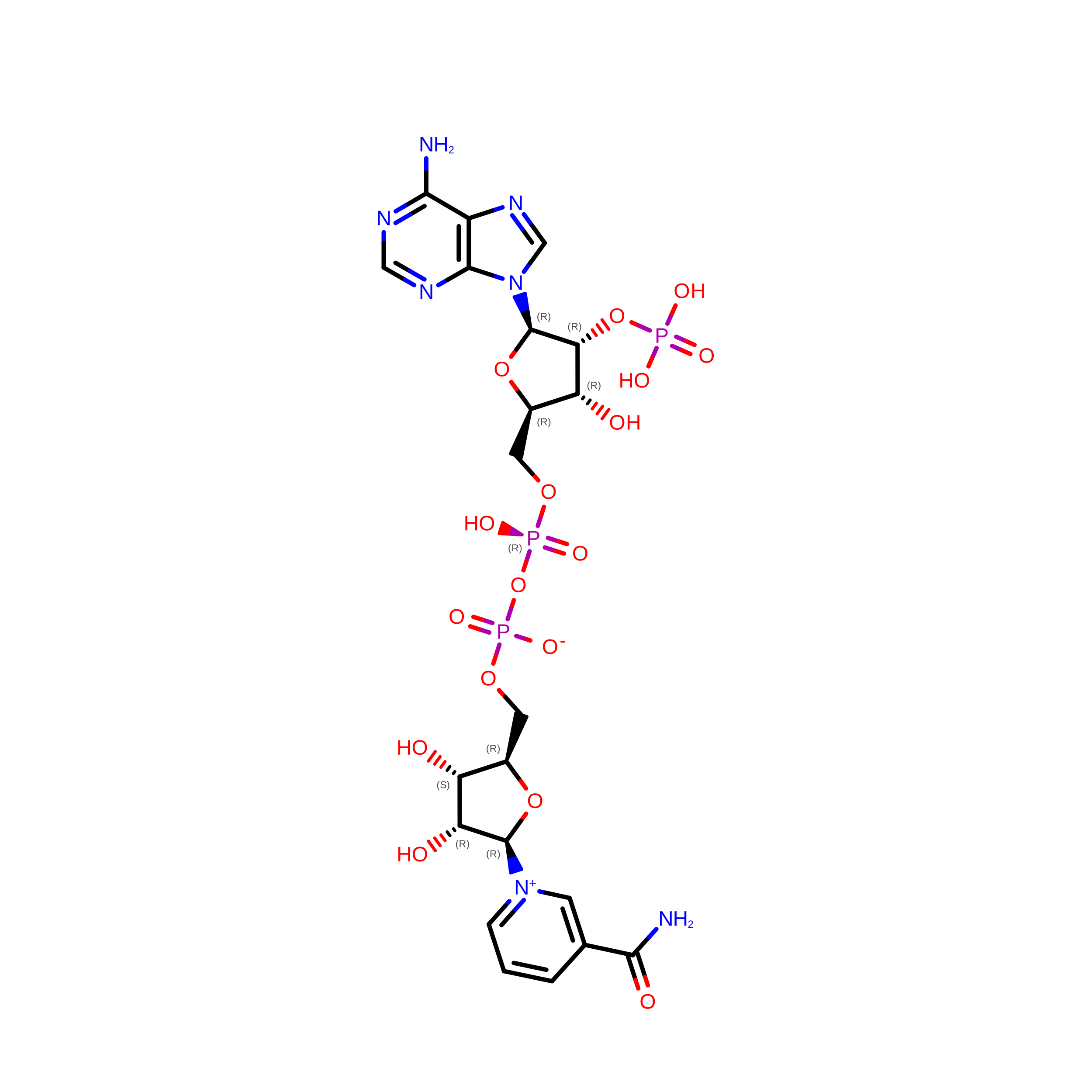
B [auth A]NADP NICOTINAMIDE-ADENINE-DINUCLEOTIDE PHOSPHATE
C21 H28 N7 O17 P3
XJLXINKUBYWONI-NNYOXOHSSA-N
GOL

Query on GOL


Download:Ideal Coordinates CCD File
C [auth A]GLYCEROL
C3 H8 O3
PEDCQBHIVMGVHV-UHFFFAOYSA-N

Experimental Data & Validation

Experimental Data

  • Method: X-RAY DIFFRACTION
  • Resolution: 1.89 Å
  • R-Value Free:  0.228 (Depositor), 0.228 (DCC) 
  • R-Value Work:  0.184 (Depositor), 0.182 (DCC) 
Space Group: P 1 21 1
Unit Cell:
Length ( Å )Angle ( ˚ )
a = 42.379α = 90
b = 44.578β = 102.13
c = 92.927γ = 90
Software Package:
Software NamePurpose
REFMACrefinement
HKL-2000data reduction
HKL-2000data scaling
CNSphasing

Structure Validation

View Full Validation Report


Ligand Structure Quality Assessment 


Entry History 

Deposition Data

Revision History  (Full details and data files)

  • Version 1.0: 2008-09-16
    Type: Initial release
  • Version 1.1: 2011-07-13
    Changes: Non-polymer description, Version format compliance
  • Version 1.2: 2012-07-11
    Changes: Database references
  • Version 1.3: 2013-01-09
    Changes: Database references
  • Version 1.4: 2023-08-30
    Changes: Data collection, Database references, Derived calculations, Refinement description