3AZV | pdb_00003azv

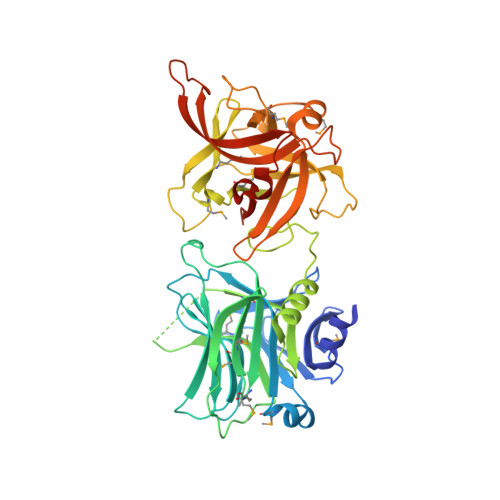
Crystal structure of the receptor binding domain


Experimental Data Snapshot

  • Method: X-RAY DIFFRACTION
  • Resolution: 3.10 Å
  • R-Value Free: 
    0.286 (Depositor), 0.260 (DCC) 
  • R-Value Work: 
    0.250 (Depositor), 0.233 (DCC) 
  • R-Value Observed: 
    0.252 (Depositor) 

wwPDB Validation 3D Report Full Report

Validation slider image for 3AZV

This is version 1.2 of the entry. See complete history

Literature

Structural and mutational analyses of the receptor binding domain of botulinum D/C mosaic neurotoxin: insight into the ganglioside binding mechanism

Nuemket, N.Tanaka, Y.Tsukamoto, K.Tsuji, T.Nakamura, K.Kozaki, S.Yao, M.Tanaka, I.

(2011) Biochem Biophys Res Commun 411: 433-439

  • DOI: https://doi.org/10.1016/j.bbrc.2011.06.173
  • Primary Citation Related Structures: 
    3AZV, 3AZW

  • PubMed Abstract: 

    Clostridium botulinum type D strain OFD05, which produces the D/C mosaic neurotoxin, was isolated from cattle killed by the recent botulism outbreak in Japan. The D/C mosaic neurotoxin is the most toxic of the botulinum neurotoxins (BoNT) characterized to date. Here, we determined the crystal structure of the receptor binding domain of BoNT from strain OFD05 in complex with 3'-sialyllactose at a resolution of 3.0Å. In the structure, an electron density derived from the 3'-sialyllactose was confirmed at the cleft in the C-terminal subdomain. Alanine site-directed mutagenesis showed the significant contribution of the residues surrounding the cleft to ganglioside recognition. In addition, a loop adjoining the cleft also plays an important role in ganglioside recognition. In contrast, little effect was observed when the residues located around the surface previously identified as the protein receptor binding site in other BoNTs were substituted. The results of cell binding analysis of the mutants were significantly correlated with the ganglioside binding properties. Based on these observations, a cell binding mechanism of BoNT from strain OFD05 is proposed, which involves cooperative contribution of two ganglioside binding sites.


  • Organizational Affiliation
    • Graduate School of Life Sciences, Hokkaido University, Sapporo 060-0810, Japan.

Macromolecule Content 

  • Total Structure Weight: 104.65 kDa 
  • Atom Count: 6,889 
  • Modeled Residue Count: 836 
  • Deposited Residue Count: 886 
  • Unique protein chains: 1

Macromolecules

Find similar proteins by:|  3D Structure
Entity ID: 1
MoleculeChains  Sequence LengthOrganismDetailsImage
D/C mosaic neurotoxin
A, B
443Clostridium botulinumMutation(s): 0 
Gene Names: bont
UniProt
Find proteins for Q9LBR1 (Clostridium botulinum)
Explore Q9LBR1 
Go to UniProtKB:  Q9LBR1
Entity Groups
Sequence Clusters30% Identity50% Identity70% Identity90% Identity95% Identity100% Identity
UniProt GroupQ9LBR1
Sequence Annotations
Expand
Reference Sequence

Small Molecules

Modified Residues  1 Unique
IDChains TypeFormula2D DiagramParent
MSE
Query on MSE
A, B
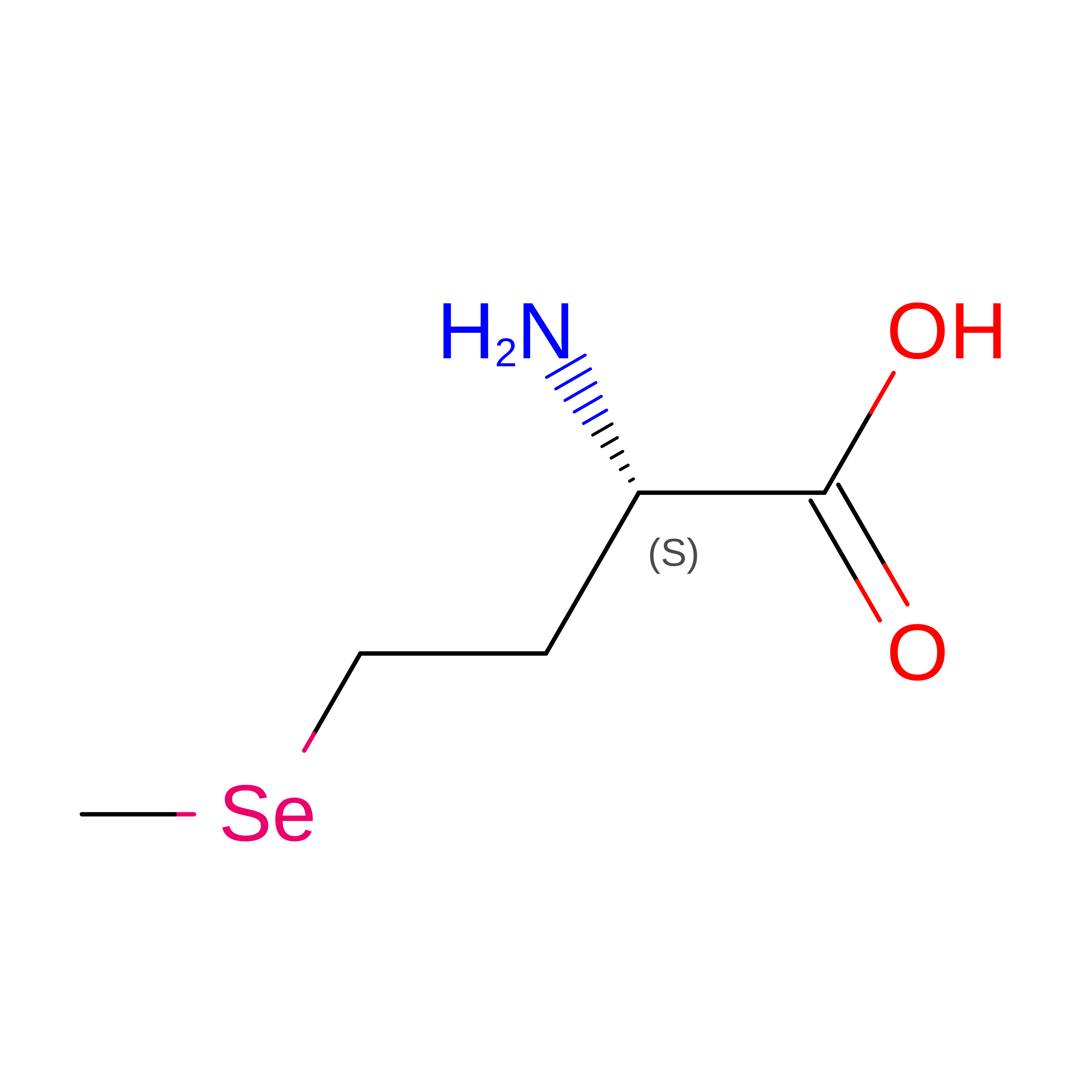
L-PEPTIDE LINKINGC5 H11 N O2 SeMET

Experimental Data & Validation

Experimental Data

  • Method: X-RAY DIFFRACTION
  • Resolution: 3.10 Å
  • R-Value Free:  0.286 (Depositor), 0.260 (DCC) 
  • R-Value Work:  0.250 (Depositor), 0.233 (DCC) 
  • R-Value Observed: 0.252 (Depositor) 
Space Group: P 21 21 21
Unit Cell:
Length ( Å )Angle ( ˚ )
a = 57.96α = 90
b = 138.57β = 90
c = 162.62γ = 90
Software Package:
Software NamePurpose
BSSdata collection
PHENIXmodel building
REFMACrefinement
XDSdata reduction
XDSdata scaling
PHENIXphasing

Structure Validation

View Full Validation Report


Entry History 

Deposition Data

Revision History  (Full details and data files)

  • Version 1.0: 2011-12-28
    Type: Initial release
  • Version 1.1: 2017-10-11
    Changes: Refinement description
  • Version 1.2: 2024-10-30
    Changes: Data collection, Database references, Derived calculations, Structure summary