3A18 | pdb_00003a18

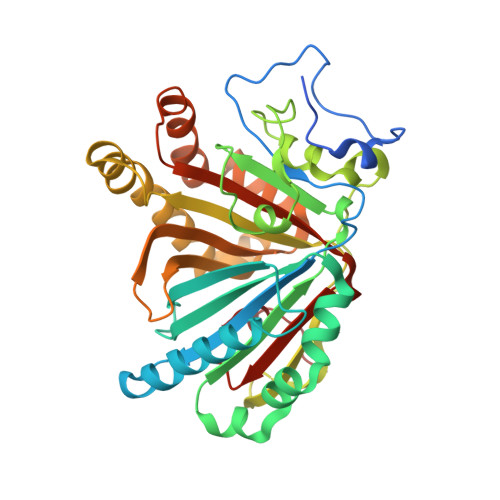
Crystal Structure of Aldoxime Dehydratase (OxdRE) in Complex with Butyraldoxime (soaked crystal)


Experimental Data Snapshot

  • Method: X-RAY DIFFRACTION
  • Resolution: 1.80 Å
  • R-Value Free: 
    0.280 (Depositor), 0.279 (DCC) 
  • R-Value Work: 
    0.247 (Depositor), 0.247 (DCC) 
  • R-Value Observed: 
    0.249 (Depositor) 

Starting Model: experimental
View more details

wwPDB Validation 3D Report Full Report

Validation slider image for 3A18

Ligand Structure Quality Assessment 


This is version 1.3 of the entry. See complete history

Literature

X-ray crystal structure of michaelis complex of aldoxime dehydratase

Sawai, H.Sugimoto, H.Kato, Y.Asano, Y.Shiro, Y.Aono, S.

(2009) J Biological Chem 284: 32089-32096

  • DOI: https://doi.org/10.1074/jbc.M109.018762
  • Primary Citation Related Structures: 
    3A15, 3A16, 3A17, 3A18

  • PubMed Abstract: 

    Aldoxime dehydratase (Oxd) catalyzes the dehydration of aldoximes (R-CH=N-OH) to their corresponding nitrile (R-C triple bond N). Oxd is a heme-containing enzyme that catalyzes the dehydration reaction as its physiological function. We have determined the first two structures of Oxd: the substrate-free OxdRE at 1.8 A resolution and the n-butyraldoxime- and propionaldoxime-bound OxdREs at 1.8 and 1.6 A resolutions, respectively. Unlike other heme enzymes, the organic substrate is directly bound to the heme iron in OxdRE. We determined the structure of the Michaelis complex of OxdRE by using the unique substrate binding and activity regulation properties of Oxd. The Michaelis complex was prepared by x-ray cryoradiolytic reduction of the ferric dead-end complex in which Oxd contains a Fe(3+) heme form. The crystal structures reveal the mechanism of substrate recognition and the catalysis of OxdRE.


  • Organizational Affiliation
    • From the Okazaki Institute for Integrative Bioscience, National Institutes of Natural Sciences, 5-1 Higashiyama, Myodaiji, Okazaki 444-8787, Japan.

Macromolecule Content 

  • Total Structure Weight: 171.14 kDa 
  • Atom Count: 12,589 
  • Modeled Residue Count: 1,411 
  • Deposited Residue Count: 1,492 
  • Unique protein chains: 1

Macromolecules

Find similar proteins by:|  3D Structure
Entity ID: 1
MoleculeChains  Sequence LengthOrganismDetailsImage
Aldoxime dehydratase
A, B, C, D
373Rhodococcus erythropolisMutation(s): 0 
Gene Names: oxd
EC: 4.99.1.5 (PDB Primary Data), 4.8.1.2 (UniProt)
UniProt
Find proteins for Q76K71 (Rhodococcus erythropolis)
Explore Q76K71 
Go to UniProtKB:  Q76K71
Entity Groups
Sequence Clusters30% Identity50% Identity70% Identity90% Identity95% Identity100% Identity
UniProt GroupQ76K71
Sequence Annotations
Expand
Reference Sequence

Small Molecules

Ligands 2 Unique
IDChains Name / Formula / InChI Key2D Diagram3D Interactions
HEM

Query on HEM


Download:Ideal Coordinates CCD File
E [auth A],
G [auth B],
I [auth C],
K [auth D]
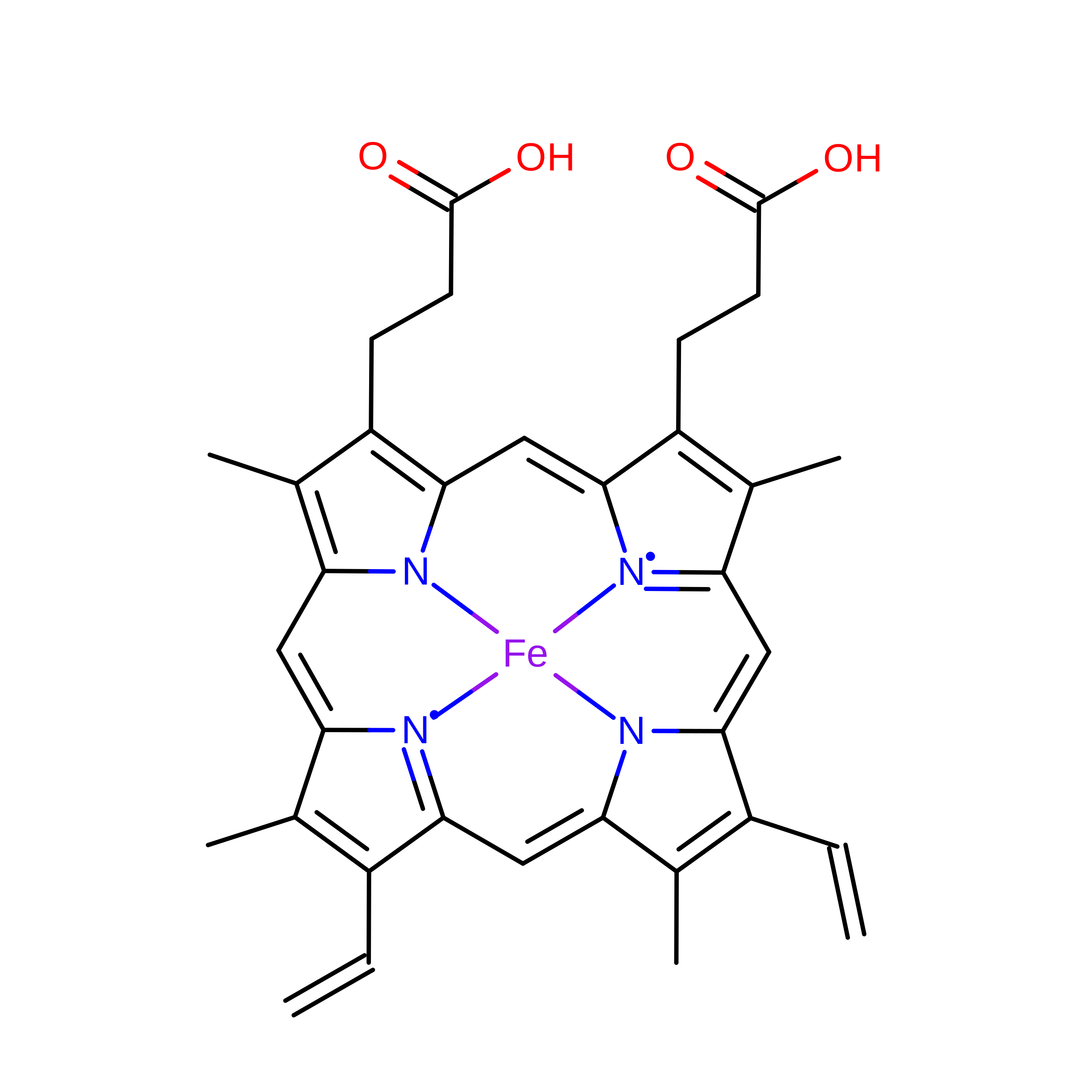
PROTOPORPHYRIN IX CONTAINING FE
C34 H32 Fe N4 O4
KABFMIBPWCXCRK-RGGAHWMASA-L
BXO

Query on BXO


Download:Ideal Coordinates CCD File
F [auth A],
H [auth B],
J [auth C],
L [auth D]
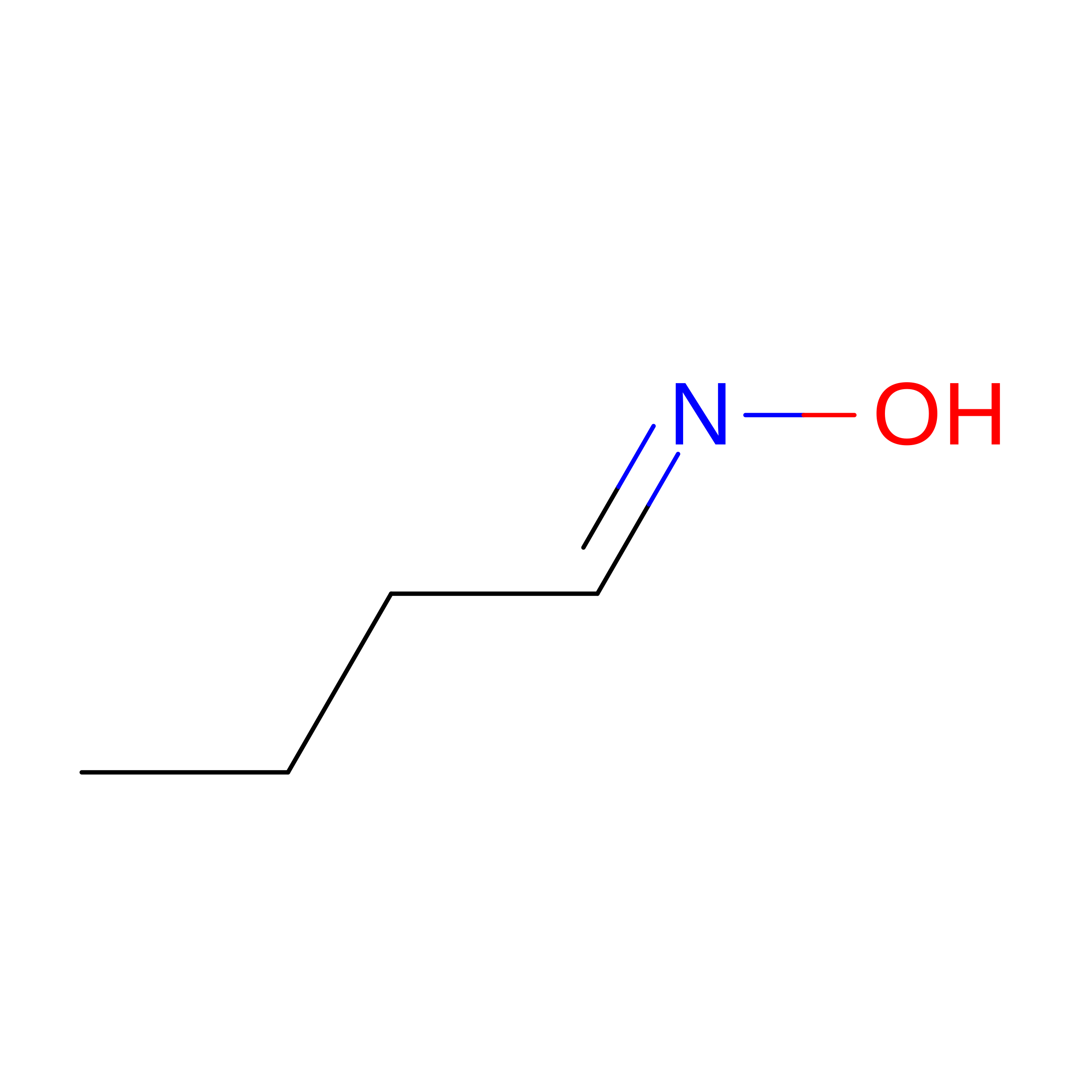
(1Z)-butanal oxime
C4 H9 N O
KGGVGTQEGGOZRN-PLNGDYQASA-N

Experimental Data & Validation

Experimental Data

  • Method: X-RAY DIFFRACTION
  • Resolution: 1.80 Å
  • R-Value Free:  0.280 (Depositor), 0.279 (DCC) 
  • R-Value Work:  0.247 (Depositor), 0.247 (DCC) 
  • R-Value Observed: 0.249 (Depositor) 
Space Group: P 1 21 1
Unit Cell:
Length ( Å )Angle ( ˚ )
a = 63.118α = 90
b = 148.569β = 90.3
c = 79.113γ = 90
Software Package:
Software NamePurpose
DENZOdata reduction
SCALEPACKdata scaling
MOLREPphasing
REFMACrefinement
PDB_EXTRACTdata extraction
SPACEdata collection
HKL-2000data reduction
HKL-2000data scaling

Structure Validation

View Full Validation Report


Ligand Structure Quality Assessment 


Entry History 

Deposition Data

Revision History  (Full details and data files)

  • Version 1.0: 2009-09-08
    Type: Initial release
  • Version 1.1: 2011-07-13
    Changes: Advisory, Refinement description, Version format compliance
  • Version 1.2: 2017-10-11
    Changes: Refinement description
  • Version 1.3: 2023-11-01
    Changes: Data collection, Database references, Derived calculations, Refinement description