2WMO | pdb_00002wmo

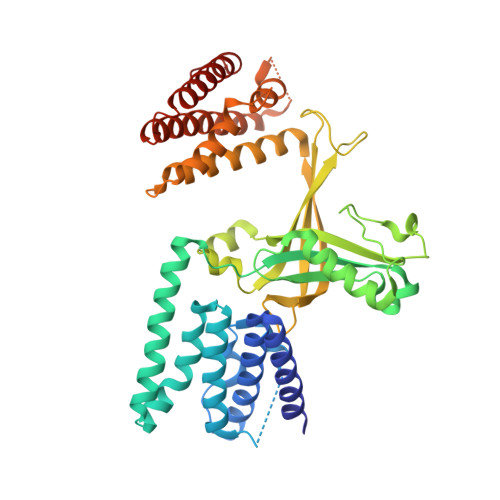
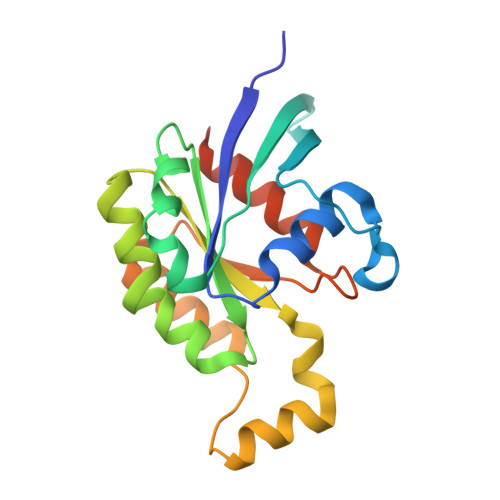
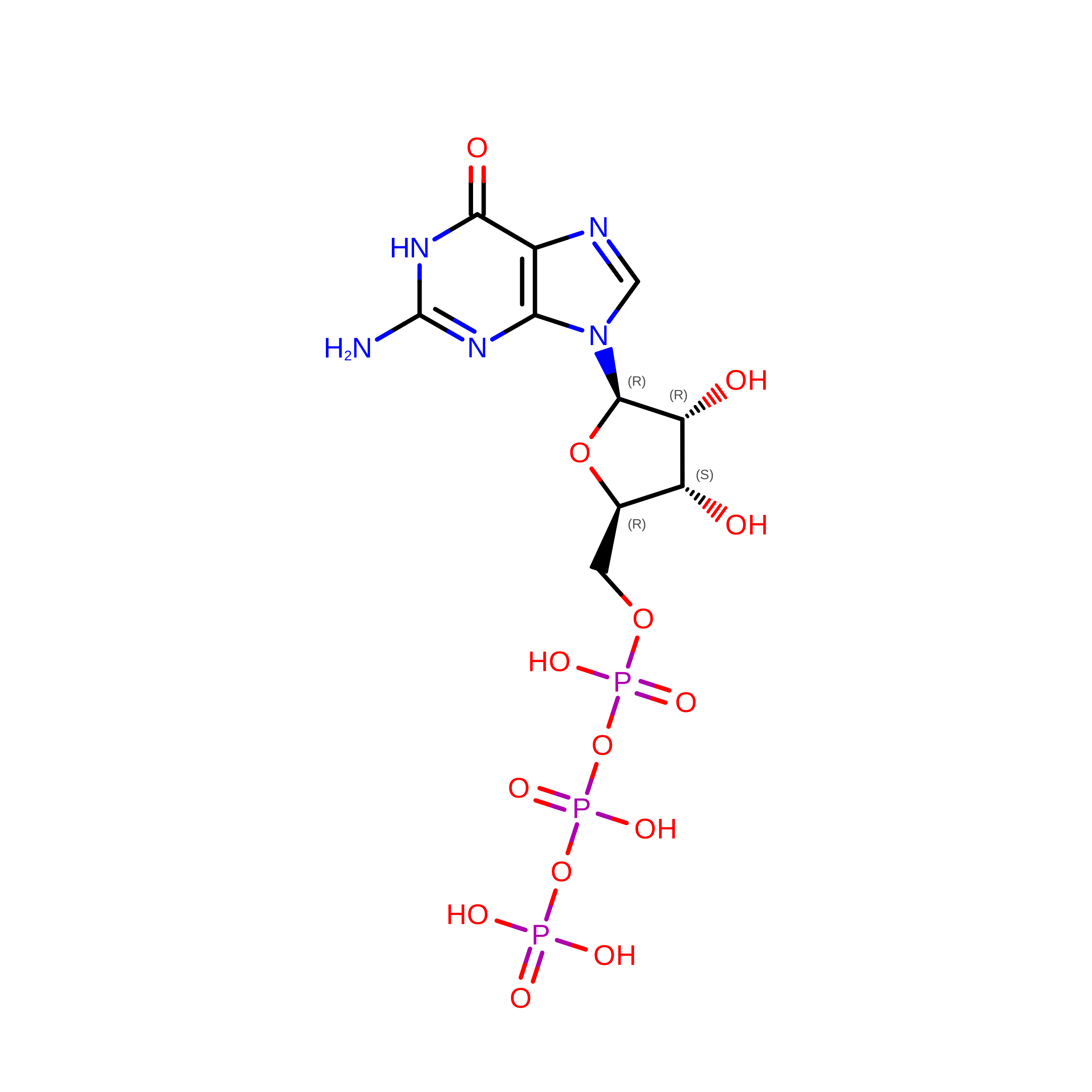
Structure of the complex between DOCK9 and Cdc42.


Experimental Data Snapshot

  • Method: X-RAY DIFFRACTION
  • Resolution: 2.20 Å
  • R-Value Free: 
    0.272 (Depositor), 0.274 (DCC) 
  • R-Value Work: 
    0.216 (Depositor), 0.215 (DCC) 
  • R-Value Observed: 
    0.219 (Depositor) 

Starting Model: experimental
View more details

wwPDB Validation 3D Report Full Report

Validation slider image for 2WMO

Ligand Structure Quality Assessment 


This is version 1.3 of the entry. See complete history

Literature

Activation of Rho Gtpases by Dock Exchange Factors is Mediated by a Nucleotide Sensor.

Yang, J.Zhang, Z.Roe, S.M.Marshall, C.J.Barford, D.

(2009) Science 325: 1398

  • DOI: https://doi.org/10.1126/science.1174468
  • Primary Citation Related Structures: 
    2WM9, 2WMN, 2WMO

  • PubMed Abstract: 

    Activation of Rho guanosine triphosphatases (GTPases) to the guanine triphosphate (GTP)-bound state is a critical event in their regulation of the cytoskeleton and cell signaling. Members of the DOCK family of guanine nucleotide exchange factors (GEFs) are important activators of Rho GTPases, but the mechanism of activation by their catalytic DHR2 domain is unknown. Through structural analysis of DOCK9-Cdc42 complexes, we identify a nucleotide sensor within the alpha10 helix of the DHR2 domain that contributes to release of guanine diphosphate (GDP) and then to discharge of the activated GTP-bound Cdc42. Magnesium exclusion, a critical factor in promoting GDP release, is mediated by a conserved valine residue within this sensor, whereas binding of GTP-Mg2+ to the nucleotide-free complex results in magnesium-inducing displacement of the sensor to stimulate discharge of Cdc42-GTP. These studies identify an unusual mechanism of GDP release and define the complete GEF catalytic cycle from GDP dissociation followed by GTP binding and discharge of the activated GTPase.


  • Organizational Affiliation
    • Section of Structural Biology, Institute of Cancer Research, Chester Beatty Laboratories, 237 Fulham Road, London SW3 6JB, UK.

Macromolecule Content 

  • Total Structure Weight: 71.75 kDa 
  • Atom Count: 4,865 
  • Modeled Residue Count: 581 
  • Deposited Residue Count: 618 
  • Unique protein chains: 2

Macromolecules

Find similar proteins by:|  3D Structure
Entity ID: 1
MoleculeChains  Sequence LengthOrganismDetailsImage
DEDICATOR OF CYTOKINESIS PROTEIN 9428Homo sapiensMutation(s): 0 
UniProt & NIH Common Fund Data Resources
Find proteins for Q9BZ29 (Homo sapiens)
Explore Q9BZ29 
Go to UniProtKB:  Q9BZ29
PHAROS:  Q9BZ29
GTEx:  ENSG00000088387 
Entity Groups
Sequence Clusters30% Identity50% Identity70% Identity90% Identity95% Identity100% Identity
UniProt GroupQ9BZ29
Sequence Annotations
Expand
Reference Sequence
Find similar proteins by:|  3D Structure
Entity ID: 2
MoleculeChains  Sequence LengthOrganismDetailsImage
CELL DIVISION CONTROL PROTEIN 42 HOMOLOG190Homo sapiensMutation(s): 0 
EC: 3.6.5.2
UniProt & NIH Common Fund Data Resources
Find proteins for P60953 (Homo sapiens)
Explore P60953 
Go to UniProtKB:  P60953
PHAROS:  P60953
GTEx:  ENSG00000070831 
Entity Groups
Sequence Clusters30% Identity50% Identity70% Identity90% Identity95% Identity100% Identity
UniProt GroupP60953
Sequence Annotations
Expand
Reference Sequence

Small Molecules

Experimental Data & Validation

Experimental Data

  • Method: X-RAY DIFFRACTION
  • Resolution: 2.20 Å
  • R-Value Free:  0.272 (Depositor), 0.274 (DCC) 
  • R-Value Work:  0.216 (Depositor), 0.215 (DCC) 
  • R-Value Observed: 0.219 (Depositor) 
Space Group: P 21 21 2
Unit Cell:
Length ( Å )Angle ( ˚ )
a = 93.06α = 90
b = 88.59β = 90
c = 89.98γ = 90
Software Package:
Software NamePurpose
PHENIXrefinement
iMOSFLMdata reduction
SCALAdata scaling
PHASERphasing

Structure Validation

View Full Validation Report


Ligand Structure Quality Assessment 


Entry History 

Deposition Data

Revision History  (Full details and data files)

  • Version 1.0: 2009-09-22
    Type: Initial release
  • Version 1.1: 2011-05-08
    Changes: Version format compliance
  • Version 1.2: 2011-07-13
    Changes: Version format compliance
  • Version 1.3: 2023-12-13
    Changes: Data collection, Database references, Derived calculations, Other, Refinement description