2OXG | pdb_00002oxg

The SoxYZ Complex of Paracoccus pantotrophus


Experimental Data Snapshot

  • Method: X-RAY DIFFRACTION
  • Resolution: 1.40 Å
  • R-Value Free: 
    0.194 (Depositor), 0.193 (DCC) 
  • R-Value Work: 
    0.168 (Depositor), 0.166 (DCC) 
  • R-Value Observed: 
    0.170 (Depositor) 

Starting Model: experimental
View more details

wwPDB Validation 3D Report Full Report

Validation slider image for 2OXG

This is version 1.3 of the entry. See complete history

Literature

The SoxYZ Complex Carries Sulfur Cycle Intermediates on a Peptide Swinging Arm.

Sauve, V.Bruno, S.Berks, B.C.Hemmings, A.M.

(2007) J Biological Chem 282: 23194-23204

  • DOI: https://doi.org/10.1074/jbc.M701602200
  • Primary Citation Related Structures: 
    2OX5, 2OXG, 2OXH

  • PubMed Abstract: 

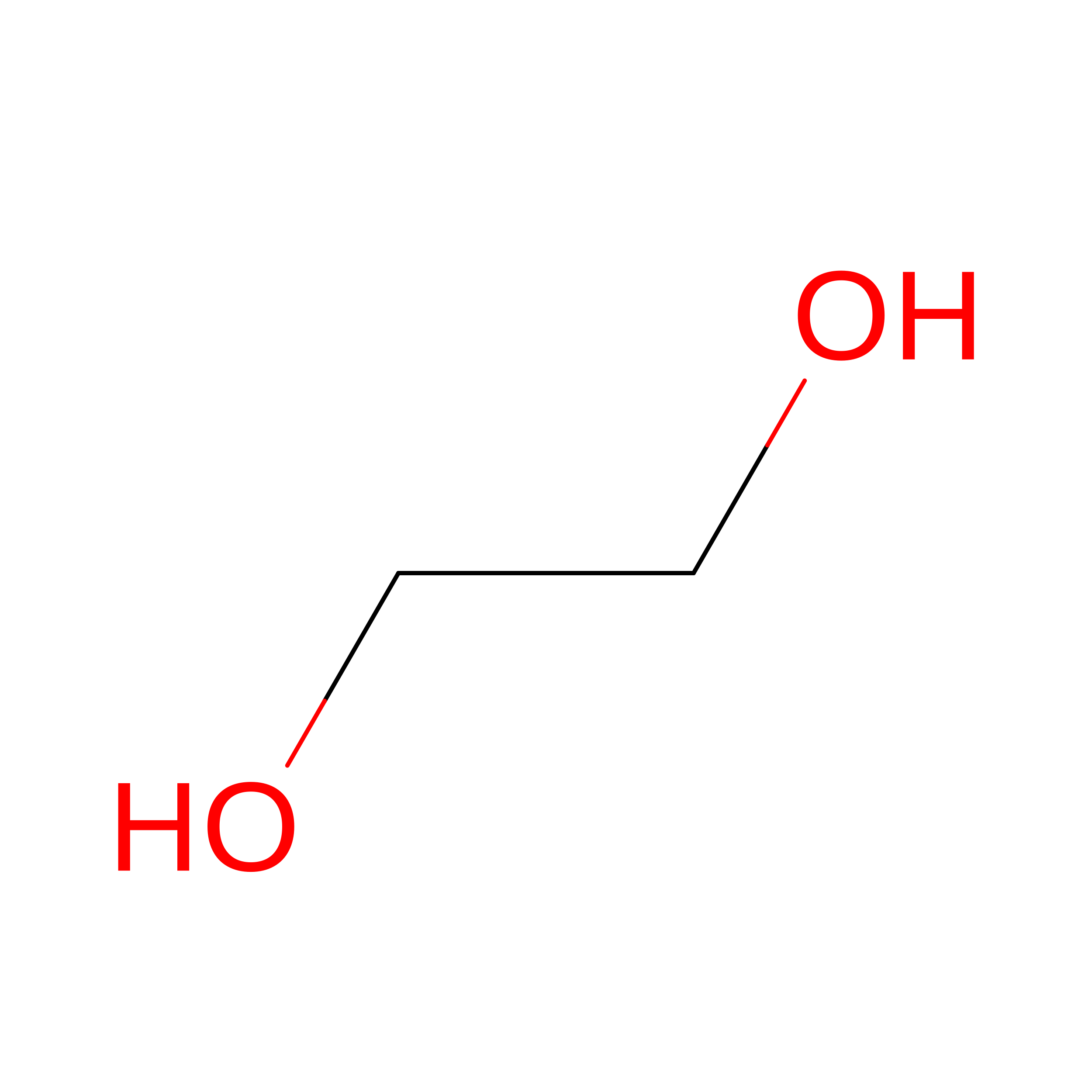
    The bacterial Sox (sulfur oxidizing) system allows the utilization of inorganic sulfur compounds in energy metabolism. Central to this process is the SoxYZ complex that carries the pathway intermediates on a cysteine residue near the C terminus of SoxY. Crystal structures have been determined for Paracoccus pantotrophus SoxYZ with the carrier cysteine in the underivatized state, conjugated to the polysulfide mimic beta-mercaptoethanol, and as the sulfonate adduct pathway intermediate. The carrier cysteine is located on a peptide swinging arm and is bracketed on either side by diglycine dipeptides acting as molecular universal joints. This structure provides a novel solution to the requirement that the cysteine-bound intermediates be able to access and orient themselves within the active sites of multiple partner enzymes. Adjacent to the swinging arm there is a conserved, deep, apolar pocket into which the beta-mercaptoethanol adduct extends. This pocket would be well suited to a role in protecting labile pathway intermediates from adventitious reactions.


  • Organizational Affiliation
    • Department of Biochemistry, University of Oxford, Oxford OX1 3QU, United Kingdom.

Macromolecule Content 

  • Total Structure Weight: 97.03 kDa 
  • Atom Count: 7,094 
  • Modeled Residue Count: 861 
  • Deposited Residue Count: 928 
  • Unique protein chains: 2

Macromolecules

Find similar proteins by:|  3D Structure
Entity ID: 1
MoleculeChains  Sequence LengthOrganismDetailsImage
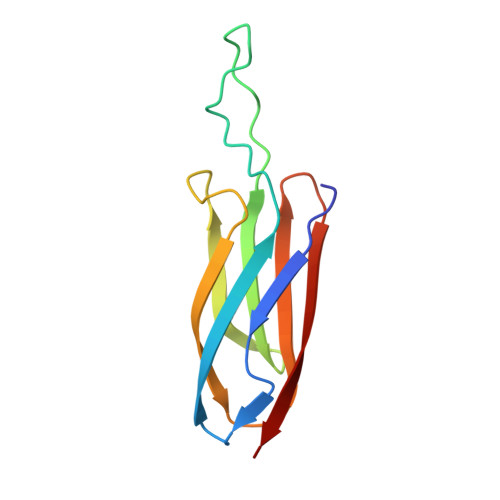
SoxZ proteinA [auth Z],
C [auth A],
E [auth C],
G [auth E]
108Paracoccus denitrificansMutation(s): 0 
Gene Names: soxZ
UniProt
Find proteins for Q9LCU8 (Paracoccus denitrificans)
Explore Q9LCU8 
Go to UniProtKB:  Q9LCU8
Entity Groups
Sequence Clusters30% Identity50% Identity70% Identity90% Identity95% Identity100% Identity
UniProt GroupQ9LCU8
Sequence Annotations
Expand
Reference Sequence
Find similar proteins by:|  3D Structure
Entity ID: 2
MoleculeChains  Sequence LengthOrganismDetailsImage
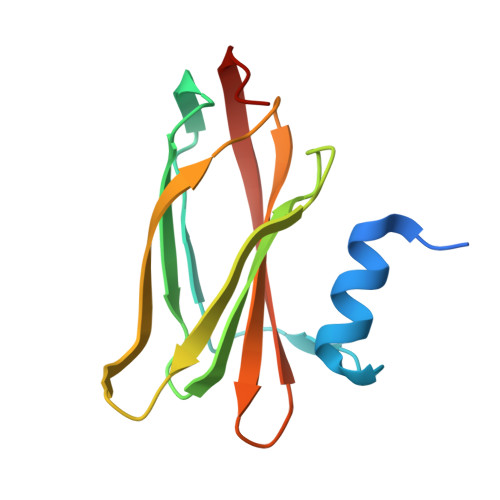
SoxY proteinB [auth Y],
D [auth B],
F [auth D],
H [auth F]
124Paracoccus denitrificansMutation(s): 0 
Gene Names: soxY
UniProt
Find proteins for Q9LCU9 (Paracoccus denitrificans)
Explore Q9LCU9 
Go to UniProtKB:  Q9LCU9
Entity Groups
Sequence Clusters30% Identity50% Identity70% Identity90% Identity95% Identity100% Identity
UniProt GroupQ9LCU9
Sequence Annotations
Expand
Reference Sequence

Experimental Data & Validation

Experimental Data

  • Method: X-RAY DIFFRACTION
  • Resolution: 1.40 Å
  • R-Value Free:  0.194 (Depositor), 0.193 (DCC) 
  • R-Value Work:  0.168 (Depositor), 0.166 (DCC) 
  • R-Value Observed: 0.170 (Depositor) 
Space Group: C 1 2 1
Unit Cell:
Length ( Å )Angle ( ˚ )
a = 206.828α = 90
b = 54.717β = 98.68
c = 77.677γ = 90
Software Package:
Software NamePurpose
SCALAdata scaling
REFMACrefinement
PDB_EXTRACTdata extraction
ADSCdata collection
MOSFLMdata reduction
MOLREPphasing

Structure Validation

View Full Validation Report


Entry History 

Deposition Data

Revision History  (Full details and data files)

  • Version 1.0: 2007-05-22
    Type: Initial release
  • Version 1.1: 2008-05-01
    Changes: Version format compliance
  • Version 1.2: 2011-07-13
    Changes: Version format compliance
  • Version 1.3: 2023-08-30
    Changes: Data collection, Database references, Derived calculations, Refinement description