Download Mendeley
beta-Strand Flipping and Slipping Triggered by Turn Replacement Reveal the Opportunistic Nature of beta-Strand Pairing
Makabe, K., Yan, S., Tereshko, V., Gawlak, G., Koide, S.(2007) J Am Chem Soc 129: 14661-14669
- PubMed: 17985889 Search on PubMedSearch on PubMed Central
- DOI: https://doi.org/10.1021/ja074252c
- Primary Citation Related Structures:
2OL6, 2OL7, 2OL8, 2OY1 - PubMed Abstract:
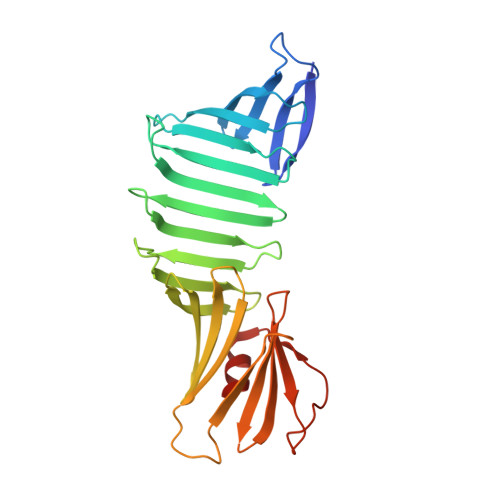
We investigated how the register between adjacent beta-strands is specified using a series of mutants of the single-layer beta-sheet (SLB) in Borrelia OspA. The single-layer architecture of this system eliminates structural restraints imposed by a hydrophobic core, enabling us to address this question. A critical turn (turn 9/10) in the SLB was replaced with a segment with an intentional structural mismatch. Its crystal structure revealed a one-residue insertion into the central beta-strand (strand 9) of the SLB. This insertion triggered a surprisingly large-scale structural rearrangement: (i) the central strand (strand 9) was shifted by one residue, causing the strand to flip with respect to the adjacent beta-strands and thus completely disrupting the native side-chain contacts; (ii) the three-residue turn located on the opposite end of the beta-strand (turn 8/9) was pushed into its preceding beta-strand (strand 8); (iii) the register between strands 8 and 9 was shifted by three residues. Replacing the original sequence for turn 8/9 with a stronger turn motif restored the original strand register but still with a flipped beta-strand 9. The stability differences of these distinct structures were surprisingly small, consistent with an energy landscape where multiple low-energy states with different beta-sheet configurations exist. The observed conformations can be rationalized in terms of maximizing the number of backbone H-bonds. These results suggest that adjacent beta-strands "stick" through the use of factors that are not highly sequence specific and that beta-strands could slide back and forth relatively easily in the absence of external elements such as turns and tertiary packing.
- Department of Biochemistry and Molecular Biology, The University of Chicago, Chicago, Illinois 60637, USA.
Organizational Affiliation: