2NTB | pdb_00002ntb

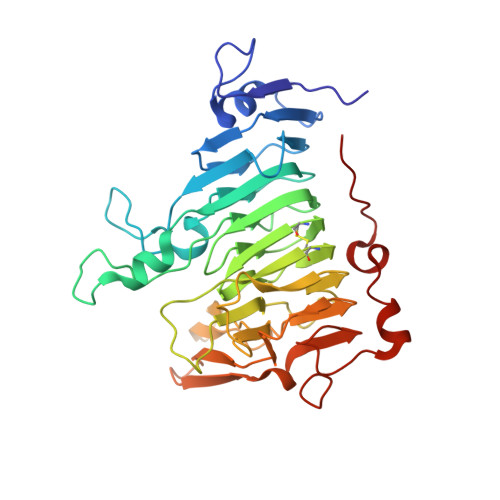
Crystal structure of pectin methylesterase in complex with hexasaccharide V


Experimental Data Snapshot

  • Method: X-RAY DIFFRACTION
  • Resolution: 1.80 Å
  • R-Value Free: 
    0.244 (Depositor), 0.243 (DCC) 
  • R-Value Work: 
    0.205 (Depositor), 0.205 (DCC) 
  • R-Value Observed: 
    0.207 (Depositor) 

Starting Model: experimental
View more details

wwPDB Validation 3D Report Full Report

Validation slider image for 2NTB

This is version 3.2 of the entry. See complete history

Literature

Molecular basis of the activity of the phytopathogen pectin methylesterase.

Fries, M.Ihrig, J.Brocklehurst, K.Shevchik, V.E.Pickersgill, R.W.

(2007) EMBO J 26: 3879-3887

  • DOI: https://doi.org/10.1038/sj.emboj.7601816
  • Primary Citation Related Structures: 
    2NSP, 2NST, 2NT6, 2NT9, 2NTB, 2NTP, 2NTQ

  • PubMed Abstract: 

    We provide a mechanism for the activity of pectin methylesterase (PME), the enzyme that catalyses the essential first step in bacterial invasion of plant tissues. The complexes formed in the crystal using specifically methylated pectins, together with kinetic measurements of directed mutants, provide clear insights at atomic resolution into the specificity and the processive action of the Erwinia chrysanthemi enzyme. Product complexes provide additional snapshots along the reaction coordinate. We previously revealed that PME is a novel aspartic-esterase possessing parallel beta-helix architecture and now show that the two conserved aspartates are the nucleophile and general acid-base in the mechanism, respectively. Other conserved residues at the catalytic centre are shown to be essential for substrate binding or transition state stabilisation. The preferential binding of methylated sugar residues upstream of the catalytic site, and demethylated residues downstream, drives the enzyme along the pectin molecule and accounts for the sequential pattern of demethylation produced by both bacterial and plant PMEs.


  • Organizational Affiliation
    • School of Biological and Chemical Sciences, Queen Mary, University of London, London, UK.

Macromolecule Content 

  • Total Structure Weight: 76.14 kDa 
  • Atom Count: 6,350 
  • Modeled Residue Count: 684 
  • Deposited Residue Count: 684 
  • Unique protein chains: 1

Macromolecules

Find similar proteins by:|  3D Structure
Entity ID: 1
MoleculeChains  Sequence LengthOrganismDetailsImage
Pectinesterase A
A, B
342Dickeya dadantii 3937Mutation(s): 0 
Gene Names: pemApem
EC: 3.1.1.11
UniProt
Find proteins for P0C1A9 (Dickeya dadantii (strain 3937))
Explore P0C1A9 
Go to UniProtKB:  P0C1A9
Entity Groups
Sequence Clusters30% Identity50% Identity70% Identity90% Identity95% Identity100% Identity
UniProt GroupP0C1A9
Sequence Annotations
Expand
Reference Sequence

Oligosaccharides

Help  
Entity ID: 2
MoleculeChains Length2D Diagram GlycosylationD Interactions
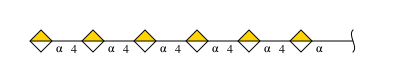
alpha-D-galactopyranuronic acid-(1-4)-alpha-D-galactopyranuronic acid-(1-4)-alpha-D-galactopyranuronic acid-(1-4)-alpha-D-galactopyranuronic acid-(1-4)-alpha-D-galactopyranuronic acid-(1-4)-alpha-D-galactopyranuronic acid
C, D
6N/A
Glycosylation Resources
GlyTouCan: G02254EM
GlyCosmos: G02254EM

Experimental Data & Validation

Experimental Data

  • Method: X-RAY DIFFRACTION
  • Resolution: 1.80 Å
  • R-Value Free:  0.244 (Depositor), 0.243 (DCC) 
  • R-Value Work:  0.205 (Depositor), 0.205 (DCC) 
  • R-Value Observed: 0.207 (Depositor) 
Space Group: P 1 21 1
Unit Cell:
Length ( Å )Angle ( ˚ )
a = 51.094α = 90
b = 85.33β = 93.55
c = 97.803γ = 90
Software Package:
Software NamePurpose
REFMACrefinement
ADSCdata collection
MOSFLMdata reduction
SCALAdata scaling
REFMACphasing

Structure Validation

View Full Validation Report


Entry History 

Deposition Data

Revision History  (Full details and data files)

  • Version 1.0: 2007-09-18
    Type: Initial release
  • Version 1.1: 2011-07-13
    Changes: Source and taxonomy, Version format compliance
  • Version 2.0: 2020-05-13
    Changes: Advisory, Atomic model, Data collection, Derived calculations
  • Version 3.0: 2020-07-29
    Type: Remediation
    Reason: Carbohydrate remediation
    Changes: Atomic model, Data collection, Derived calculations, Structure summary
  • Version 3.1: 2023-08-30
    Changes: Data collection, Database references, Refinement description, Structure summary
  • Version 3.2: 2024-10-16
    Changes: Structure summary