2I2D | pdb_00002i2d

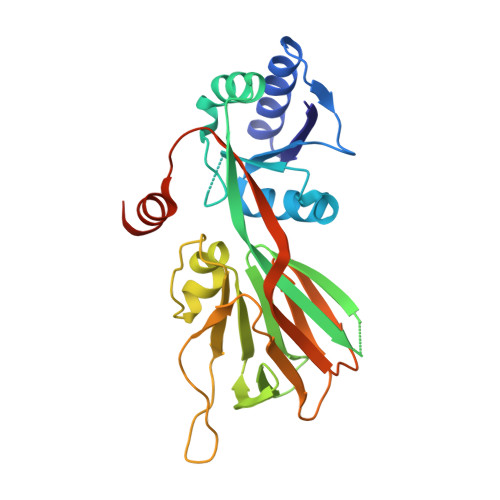
Crystal structure of LmNADK1


Experimental Data Snapshot

  • Method: X-RAY DIFFRACTION
  • Resolution: 2.22 Å
  • R-Value Free: 
    0.252 (Depositor), 0.254 (DCC) 
  • R-Value Work: 
    0.207 (Depositor) 
  • R-Value Observed: 
    0.208 (Depositor) 

Starting Model: experimental
View more details

wwPDB Validation 3D Report Full Report

Validation slider image for 2I2D

Ligand Structure Quality Assessment 


This is version 1.3 of the entry. See complete history

Literature

NAD kinases use substrate-assisted catalysis for specific recognition of NAD.

Poncet-Montange, G.Assairi, L.Arold, S.Pochet, S.Labesse, G.

(2007) J Biological Chem 282: 33925-33934

  • DOI: https://doi.org/10.1074/jbc.M701394200
  • Primary Citation Related Structures: 
    2I1W, 2I29, 2I2A, 2I2B, 2I2C, 2I2D, 2I2F, 2Q5F, 4DY6

  • PubMed Abstract: 

    Here we describe the crystal structures of the NAD kinase (LmNADK1) from Listeria monocytogenes in complex with its substrate NAD, its product NADP, or two synthesized NAD mimics. We identified one of the NAD mimics, di-adenosine diphosphate, as a new substrate for LmNADK1, whereas we showed that the closely related compound di-5'-thioadenosine is a novel non-natural inhibitor for this enzyme. These structures suggest a mechanism involving substrate-assisted catalysis. Indeed, sequence/structure comparison and directed mutagenesis have previously shown that NAD kinases (NADKs) and the distantly related 6-phosphofructokinases share the same catalytically important GGDGT motif. However, in this study we have shown that these enzymes use the central aspartate of this motif differently. Although this acidic residue chelates the catalytic Mg(2+) ion in 6-phosphofructokinases, it activates the phospho-acceptor (NAD) in NADKs. Sequence/structure comparisons suggest that the role of this aspartate would be conserved in NADKs and the related sphingosine and diacylglycerol kinases.


  • Organizational Affiliation
    • Atelier de Bio- et Chimie Informatique Structurale, Centre de Biochimie Structurale, UMR 5048/CNRS, Universités Montpellier 1 et 2, 29 rue de Navacelles, Montpellier, France.

Macromolecule Content 

  • Total Structure Weight: 31.91 kDa 
  • Atom Count: 2,106 
  • Modeled Residue Count: 255 
  • Deposited Residue Count: 272 
  • Unique protein chains: 1

Macromolecules

Find similar proteins by:|  3D Structure
Entity ID: 1
MoleculeChains  Sequence LengthOrganismDetailsImage
Probable inorganic polyphosphate/ATP-NAD kinase 1272Listeria monocytogenesMutation(s): 0 
Gene Names: ppnK1
EC: 2.7.1.23
UniProt
Find proteins for Q8Y8D7 (Listeria monocytogenes serovar 1/2a (strain ATCC BAA-679 / EGD-e))
Explore Q8Y8D7 
Go to UniProtKB:  Q8Y8D7
Entity Groups
Sequence Clusters30% Identity50% Identity70% Identity90% Identity95% Identity100% Identity
UniProt GroupQ8Y8D7
Sequence Annotations
Expand
Reference Sequence

Small Molecules

Ligands 2 Unique
IDChains Name / Formula / InChI Key2D Diagram3D Interactions
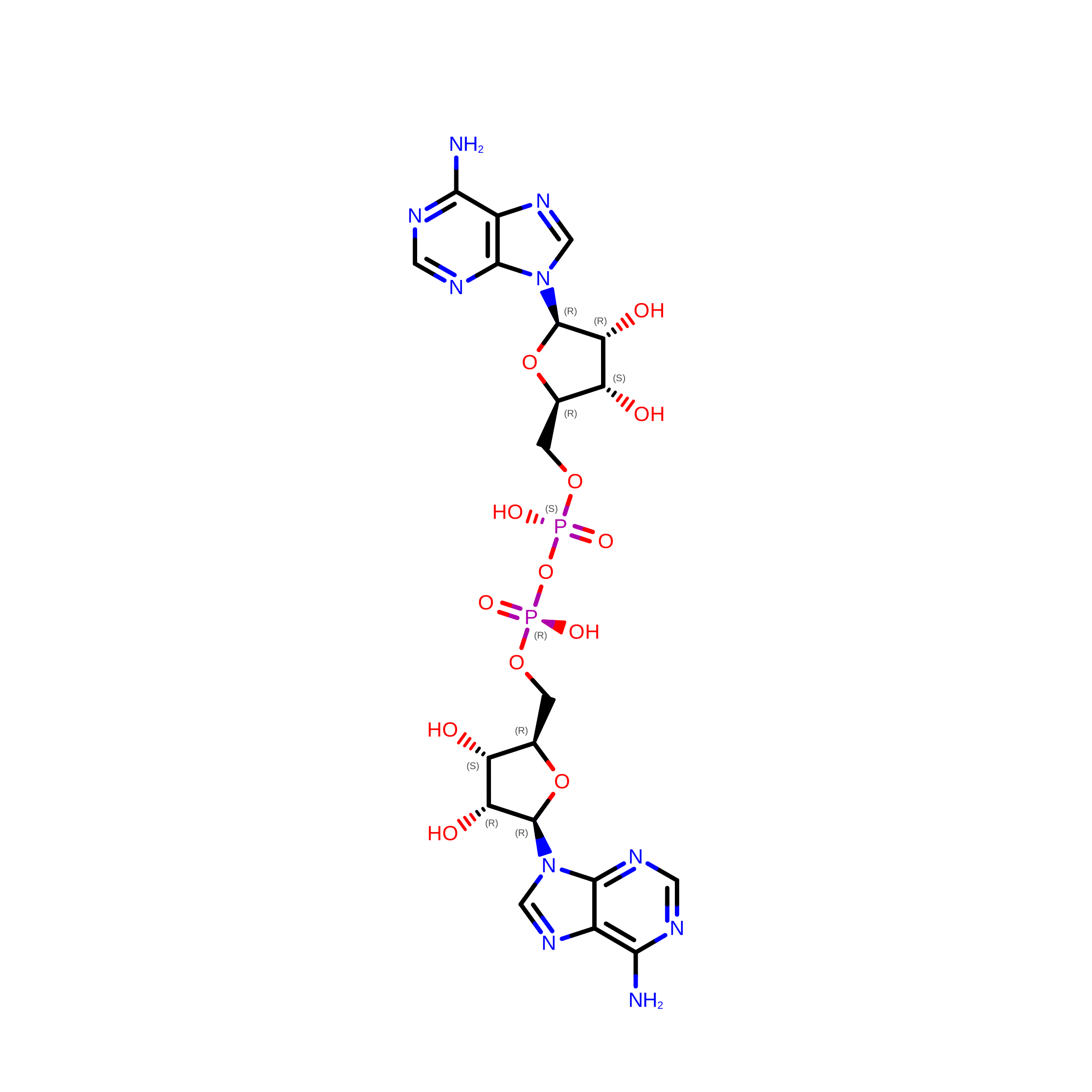
A2D

Query on A2D


Download:Ideal Coordinates CCD File
B [auth A]BIS{[(2R,3S,4R,5R)-5-(6-AMINO-9H-PURIN-9-YL)-3,4-DIHYDROXYTETRAHYDROFURAN-2-YL]METHYL} DIHYDROGEN DIPHOSPHATE
C20 H26 N10 O13 P2
AKDJDUXNKGWGAZ-XPWFQUROSA-N
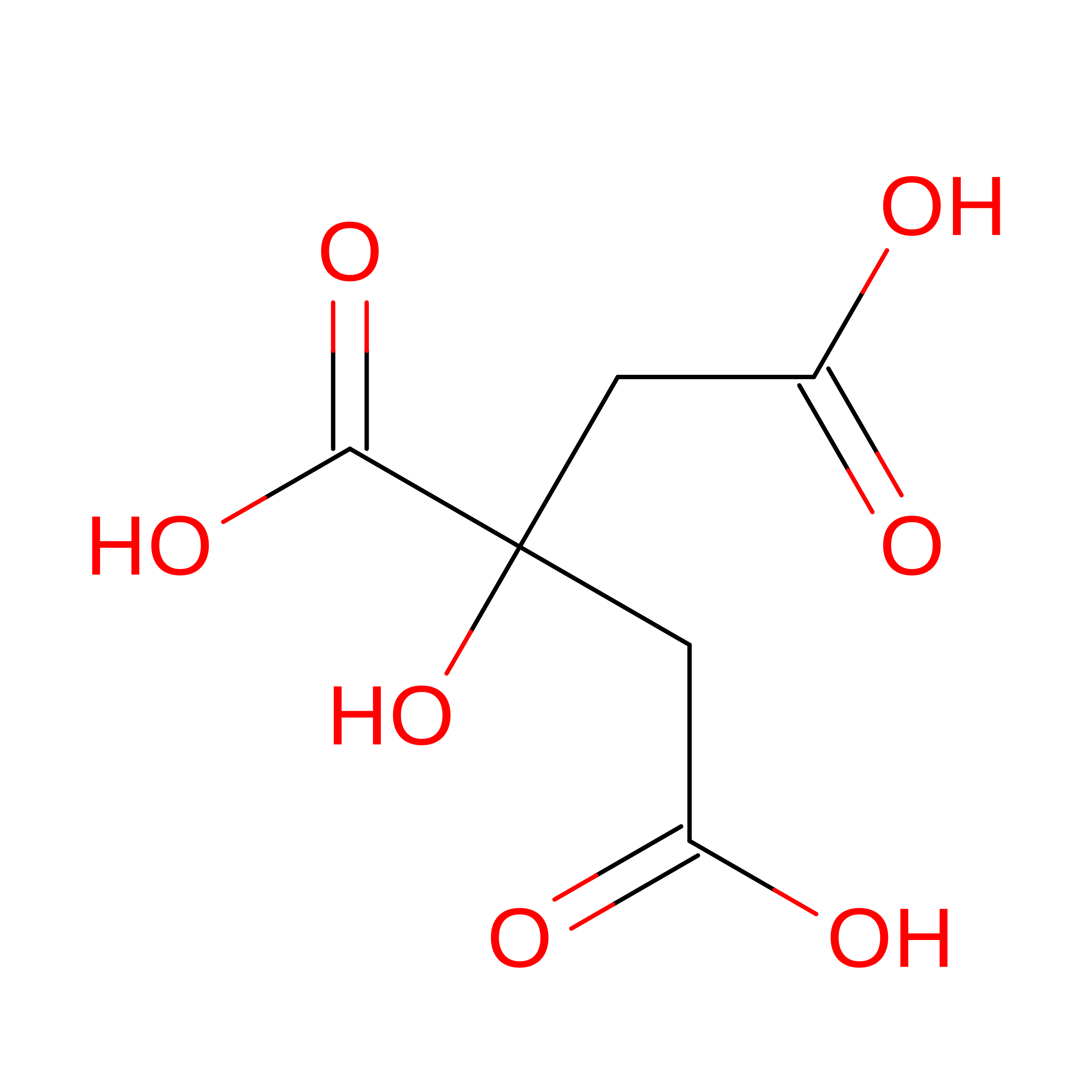
CIT

Query on CIT


Download:Ideal Coordinates CCD File
C [auth A]CITRIC ACID
C6 H8 O7
KRKNYBCHXYNGOX-UHFFFAOYSA-N

Experimental Data & Validation

Experimental Data

  • Method: X-RAY DIFFRACTION
  • Resolution: 2.22 Å
  • R-Value Free:  0.252 (Depositor), 0.254 (DCC) 
  • R-Value Work:  0.207 (Depositor) 
  • R-Value Observed: 0.208 (Depositor) 
Space Group: I 2 2 2
Unit Cell:
Length ( Å )Angle ( ˚ )
a = 62.481α = 90
b = 75.851β = 90
c = 118.35γ = 90
Software Package:
Software NamePurpose
REFMACrefinement
PDB_EXTRACTdata extraction
ADSCdata collection
MOSFLMdata reduction
SCALAdata scaling
MOLREPphasing

Structure Validation

View Full Validation Report


Ligand Structure Quality Assessment 


Entry History 

Deposition Data

Revision History  (Full details and data files)

  • Version 1.0: 2007-08-07
    Type: Initial release
  • Version 1.1: 2011-07-13
    Changes: Advisory, Refinement description, Version format compliance
  • Version 1.2: 2018-02-14
    Changes: Experimental preparation
  • Version 1.3: 2023-08-30
    Changes: Data collection, Database references, Derived calculations, Refinement description