2BJ0 | pdb_00002bj0

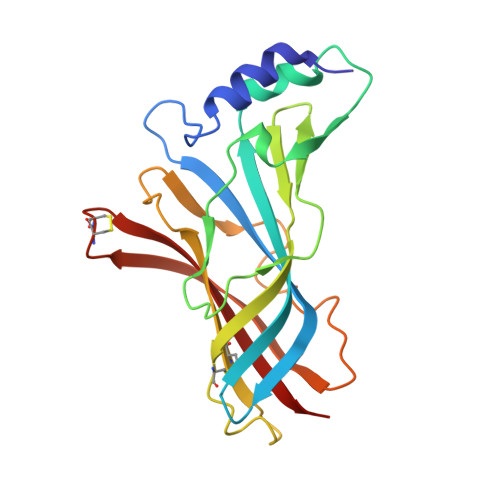
Crystal Structure of AChBP from Bulinus truncatus revals the conserved structural scaffold and sites of variation in nicotinic acetylcholine receptors


Experimental Data Snapshot

  • Method: X-RAY DIFFRACTION
  • Resolution: 2.00 Å
  • R-Value Free: 
    0.249 (Depositor), 0.252 (DCC) 
  • R-Value Work: 
    0.210 (Depositor), 0.211 (DCC) 
  • R-Value Observed: 
    0.212 (Depositor) 

Starting Model: experimental
View more details

wwPDB Validation 3D Report Full Report

Validation slider image for 2BJ0

Ligand Structure Quality Assessment 


This is version 1.4 of the entry. See complete history

Literature

Crystal Structure of Acetylcholine-Binding Protein from Bulinus Truncatus Reveals the Conserved Structural Scaffold and Sites of Variation in Nicotinic Acetylcholine Receptors.

Celie, P.H.N.Klaassen, R.V.Van Rossum-Fikkert, S.E.Van Elk, R.Van Nierop, P.Smit, A.B.Sixma, T.K.

(2005) J Biological Chem 280: 26457

  • DOI: https://doi.org/10.1074/jbc.M414476200
  • Primary Citation Related Structures: 
    2BJ0

  • PubMed Abstract: 

    The crystal structure of acetylcholine-binding protein (AChBP) from the mollusk Lymnaea stagnalis is the established model for the ligand binding domains of the ligand-gated ion channel family, which includes nicotinic acetylcholine, 5-hydroxytryptamine (5-HT3), gamma-aminobutyric acid (GABA), types A and C, and glycine receptors. Here we present the crystal structure of a remote homolog, AChBP from Bulinus truncatus, which reveals both the conserved structural scaffold and the sites of variation in this receptor family. These include rigid body movements of loops that are close to the transmembrane interface in the receptors and changes in the intermonomer contacts, which alter the pentamer stability drastically. Structural, pharmacological and mutational analysis of both AChBPs shows how 3 amino acid changes in the binding site contribute to a 5-10-fold difference in affinity for nicotinic ligands. Comparison of these structures will be valuable for improving structure-function studies of ligand-gated ion channel receptors, including signal transduction, homology modeling, and drug design.


  • Organizational Affiliation
    • Division of Molecular Carcinogenesis, Netherlands Cancer Institute, Plesmanlaan 121, 1066 CX Amsterdam, The Netherlands.

Macromolecule Content 

  • Total Structure Weight: 115.43 kDa 
  • Atom Count: 8,566 
  • Modeled Residue Count: 1,015 
  • Deposited Residue Count: 1,015 
  • Unique protein chains: 1

Macromolecules

Find similar proteins by:|  3D Structure
Entity ID: 1
MoleculeChains  Sequence LengthOrganismDetailsImage
ACETYLCHOLINE-BINDING PROTEIN
A, B, C, D, E
203Bulinus truncatusMutation(s): 0 

Experimental Data & Validation

Experimental Data

  • Method: X-RAY DIFFRACTION
  • Resolution: 2.00 Å
  • R-Value Free:  0.249 (Depositor), 0.252 (DCC) 
  • R-Value Work:  0.210 (Depositor), 0.211 (DCC) 
  • R-Value Observed: 0.212 (Depositor) 
Space Group: C 2 2 21
Unit Cell:
Length ( Å )Angle ( ˚ )
a = 76.945α = 90
b = 219.018β = 90
c = 166.965γ = 90
Software Package:
Software NamePurpose
REFMACrefinement
MOSFLMdata reduction
SCALEPACKdata scaling
AMoREphasing

Structure Validation

View Full Validation Report


Ligand Structure Quality Assessment 


Entry History 

Deposition Data

Revision History  (Full details and data files)

  • Version 1.0: 2005-05-24
    Type: Initial release
  • Version 1.1: 2011-05-08
    Changes: Version format compliance
  • Version 1.2: 2011-07-13
    Changes: Version format compliance
  • Version 1.3: 2023-12-13
    Changes: Data collection, Database references, Other, Refinement description
  • Version 1.4: 2024-10-23
    Changes: Structure summary