2ZTG | pdb_00002ztg

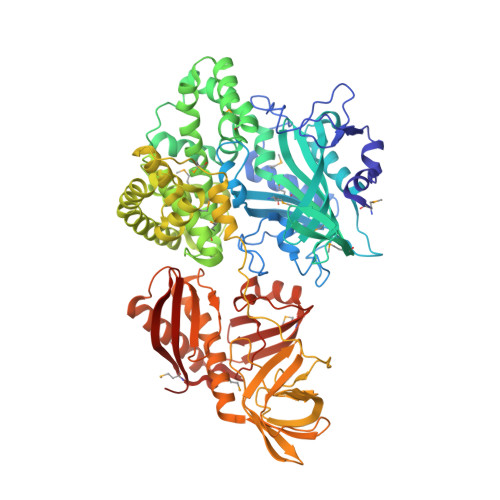
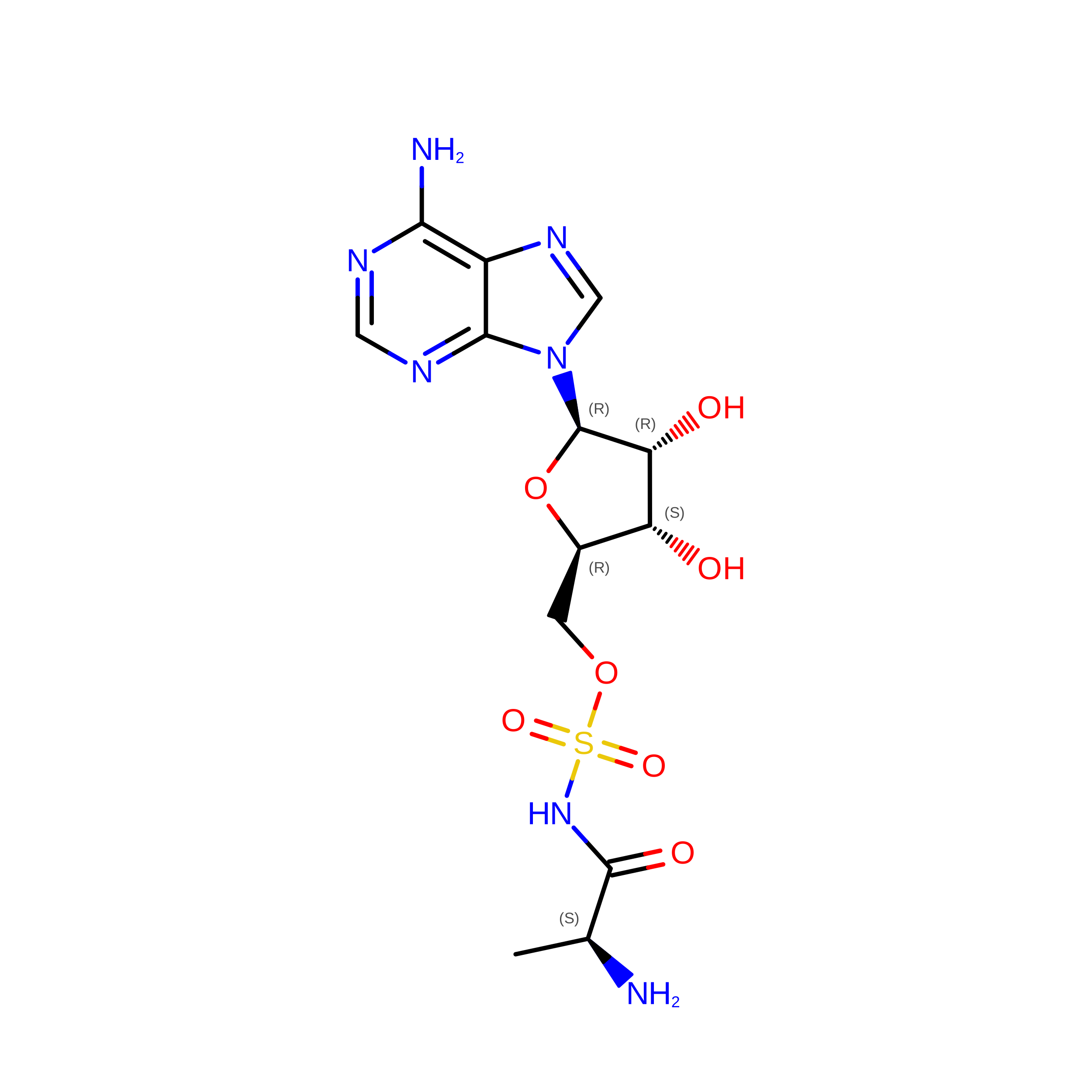
Crystal structure of Archaeoglobus fulgidus alanyl-tRNA synthetase lacking the C-terminal dimerization domain in complex with Ala-SA


Experimental Data Snapshot

  • Method: X-RAY DIFFRACTION
  • Resolution: 2.20 Å
  • R-Value Free: 
    0.264 (Depositor), 0.263 (DCC) 
  • R-Value Work: 
    0.215 (Depositor), 0.215 (DCC) 
  • R-Value Observed: 
    0.215 (Depositor) 

wwPDB Validation 3D Report Full Report

Validation slider image for 2ZTG

Ligand Structure Quality Assessment 


This is version 1.2 of the entry. See complete history

Literature

Unique protein architecture of alanyl-tRNA synthetase for aminoacylation, editing, and dimerization.

Naganuma, M.Sekine, S.Fukunaga, R.Yokoyama, S.

(2009) Proc Natl Acad Sci U S A 106: 8489-8494

  • DOI: https://doi.org/10.1073/pnas.0901572106
  • Primary Citation Related Structures: 
    2ZTG, 2ZVF

  • PubMed Abstract: 

    Alanyl-tRNA synthetase (AlaRS) specifically recognizes the major identity determinant, the G3:U70 base pair, in the acceptor stem of tRNA(Ala) by both the tRNA-recognition and editing domains. In this study, we solved the crystal structures of 2 halves of Archaeoglobus fulgidus AlaRS: AlaRS-DeltaC, comprising the aminoacylation, tRNA-recognition, and editing domains, and AlaRS-C, comprising the dimerization domain. The aminoacylation/tRNA-recognition domains contain an insertion incompatible with the class-specific tRNA-binding mode. The editing domain is fixed tightly via hydrophobic interactions to the aminoacylation/tRNA-recognition domains, on the side opposite from that in threonyl-tRNA synthetase. A groove formed between the aminoacylation/tRNA-recognition domains and the editing domain appears to be an alternative tRNA-binding site, which might be used for the aminoacylation and/or editing reactions. Actually, the amino acid residues required for the G3:U70 recognition are mapped in this groove. The dimerization domain consists of helical and globular subdomains. The helical subdomain mediates dimerization by forming a helix-loop-helix zipper. The globular subdomain, which is important for the aminoacylation and editing activities, has a positively-charged face suitable for tRNA binding.


  • Organizational Affiliation
    • Department of Biophysics and Biochemistry, Graduate School of Science, University of Tokyo, 7-3-1 Hongo, Bunkyo-ku, Tokyo 113-0033, Japan.

Macromolecule Content 

  • Total Structure Weight: 85.04 kDa 
  • Atom Count: 6,076 
  • Modeled Residue Count: 739 
  • Deposited Residue Count: 739 
  • Unique protein chains: 1

Macromolecules

Find similar proteins by:|  3D Structure
Entity ID: 1
MoleculeChains  Sequence LengthOrganismDetailsImage
Alanyl-tRNA synthetase739Archaeoglobus fulgidusMutation(s): 0 
Gene Names: AF_2255alaS
EC: 6.1.1.7
UniProt
Find proteins for O28029 (Archaeoglobus fulgidus (strain ATCC 49558 / DSM 4304 / JCM 9628 / NBRC 100126 / VC-16))
Explore O28029 
Go to UniProtKB:  O28029
Entity Groups
Sequence Clusters30% Identity50% Identity70% Identity90% Identity95% Identity100% Identity
UniProt GroupO28029
Sequence Annotations
Expand
Reference Sequence

Small Molecules

Modified Residues  1 Unique
IDChains TypeFormula2D DiagramParent
MSE
Query on MSE
A
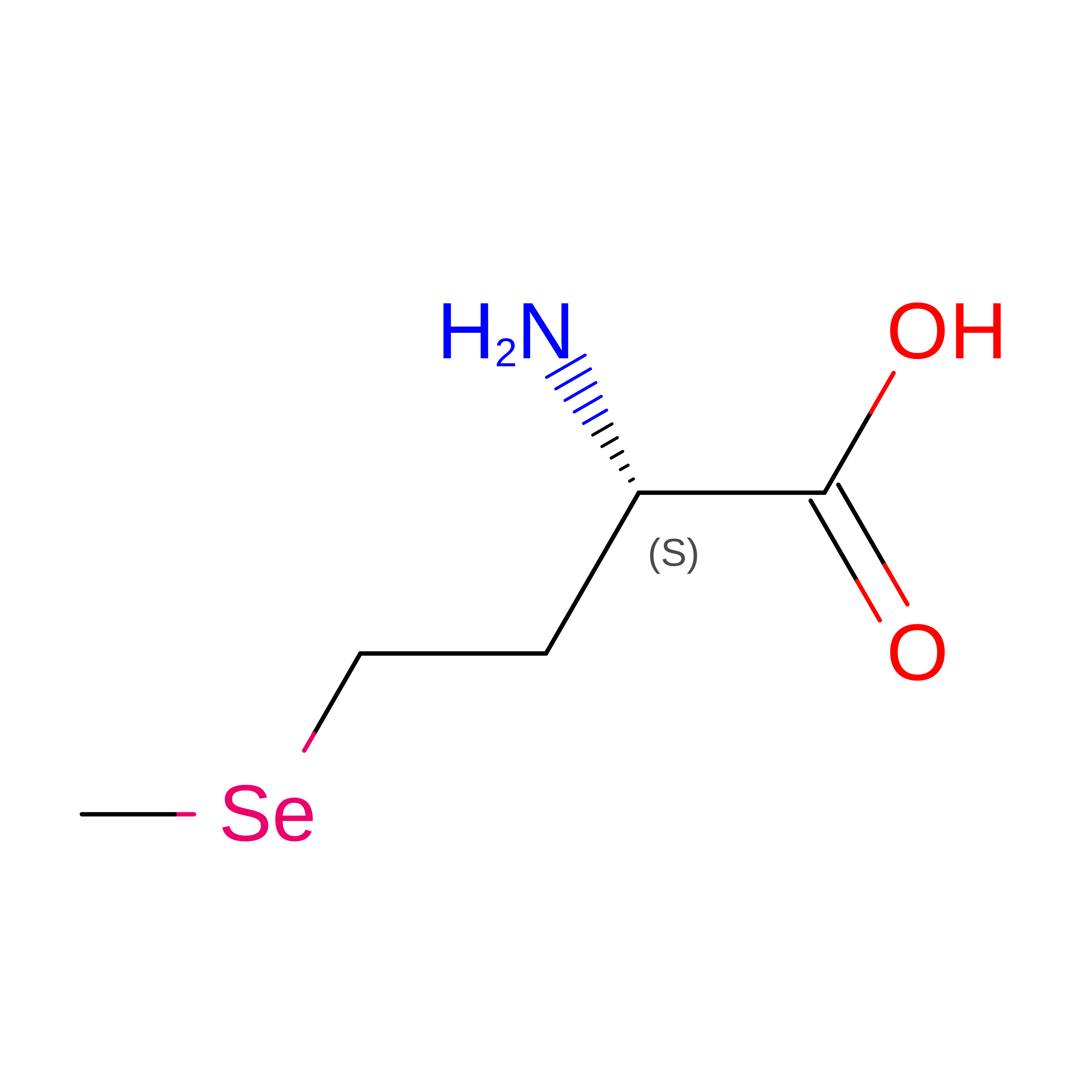
L-PEPTIDE LINKINGC5 H11 N O2 SeMET

Experimental Data & Validation

Experimental Data

  • Method: X-RAY DIFFRACTION
  • Resolution: 2.20 Å
  • R-Value Free:  0.264 (Depositor), 0.263 (DCC) 
  • R-Value Work:  0.215 (Depositor), 0.215 (DCC) 
  • R-Value Observed: 0.215 (Depositor) 
Space Group: C 1 2 1
Unit Cell:
Length ( Å )Angle ( ˚ )
a = 160.391α = 90
b = 49.082β = 108.08
c = 98.044γ = 90
Software Package:
Software NamePurpose
CNSrefinement
HKL-2000data collection
HKL-2000data reduction
HKL-2000data scaling
SHARPphasing

Structure Validation

View Full Validation Report


Ligand Structure Quality Assessment 


Entry History 

Deposition Data

Revision History  (Full details and data files)

  • Version 1.0: 2009-06-30
    Type: Initial release
  • Version 1.1: 2011-07-13
    Changes: Version format compliance
  • Version 1.2: 2024-10-30
    Changes: Data collection, Database references, Derived calculations, Structure summary