2ZSH | pdb_00002zsh

Structural basis of gibberellin(GA3)-induced DELLA recognition by the gibberellin receptor


Experimental Data Snapshot

  • Method: X-RAY DIFFRACTION
  • Resolution: 1.80 Å
  • R-Value Free: 
    0.229 (Depositor), 0.229 (DCC) 
  • R-Value Work: 
    0.205 (Depositor), 0.207 (DCC) 

wwPDB Validation 3D Report Full Report

Validation slider image for 2ZSH

Ligand Structure Quality Assessment 


This is version 1.2 of the entry. See complete history

Literature

Gibberellin-induced DELLA recognition by the gibberellin receptor GID1

Murase, K.Hirano, Y.Sun, T.-P.Hakoshima, T.

(2008) Nature 456: 459-463

  • DOI: https://doi.org/10.1038/nature07519
  • Primary Citation Related Structures: 
    2ZSH, 2ZSI

  • PubMed Abstract: 

    Gibberellins control a range of growth and developmental processes in higher plants and have been widely used in the agricultural industry. By binding to a nuclear receptor, GIBBERELLIN INSENSITIVE DWARF1 (GID1), gibberellins regulate gene expression by promoting degradation of the transcriptional regulator DELLA proteins, including GIBBERELLIN INSENSITIVE (GAI). The precise manner in which GID1 discriminates and becomes activated by bioactive gibberellins for specific binding to DELLA proteins remains unclear. Here we present the crystal structure of a ternary complex of Arabidopsis thaliana GID1A, a bioactive gibberellin and the amino-terminal DELLA domain of GAI. In this complex, GID1A occludes gibberellin in a deep binding pocket covered by its N-terminal helical switch region, which in turn interacts with the DELLA domain containing DELLA, VHYNP and LExLE motifs. Our results establish a structural model of a plant hormone receptor that is distinct from the mechanism of the hormone perception and effector recognition of the known auxin receptors.


  • Organizational Affiliation
    • Structural Biology Laboratory, Nara Institute of Science and Technology, 8916-5 Takayama, Ikoma, Nara 630-0192, Japan.

Macromolecule Content 

  • Total Structure Weight: 51.9 kDa 
  • Atom Count: 3,375 
  • Modeled Residue Count: 397 
  • Deposited Residue Count: 461 
  • Unique protein chains: 2

Macromolecules

Find similar proteins by:|  3D Structure
Entity ID: 1
MoleculeChains  Sequence LengthOrganismDetailsImage
Probable gibberellin receptor GID1L1351Arabidopsis thalianaMutation(s): 0 
EC: 3
UniProt
Find proteins for Q9MAA7 (Arabidopsis thaliana)
Explore Q9MAA7 
Go to UniProtKB:  Q9MAA7
Entity Groups
Sequence Clusters30% Identity50% Identity70% Identity90% Identity95% Identity100% Identity
UniProt GroupQ9MAA7
Sequence Annotations
Expand
Reference Sequence
Find similar proteins by:|  3D Structure
Entity ID: 2
MoleculeChains  Sequence LengthOrganismDetailsImage
DELLA protein GAI110Arabidopsis thalianaMutation(s): 0 
Gene Names: GAI
UniProt
Find proteins for Q9LQT8 (Arabidopsis thaliana)
Explore Q9LQT8 
Go to UniProtKB:  Q9LQT8
Entity Groups
Sequence Clusters30% Identity50% Identity70% Identity90% Identity95% Identity100% Identity
UniProt GroupQ9LQT8
Sequence Annotations
Expand
Reference Sequence

Small Molecules

Ligands 1 Unique
IDChains Name / Formula / InChI Key2D Diagram3D Interactions
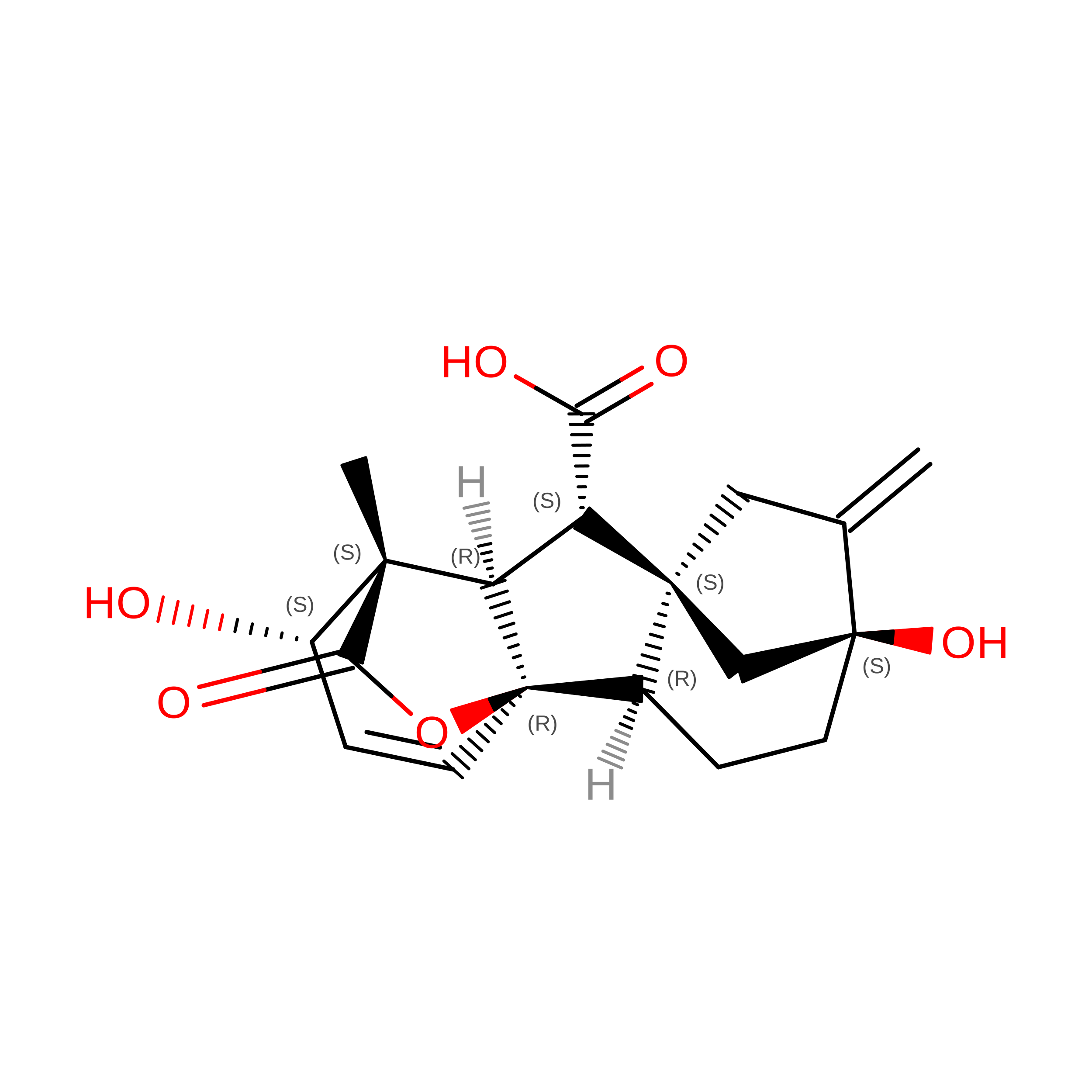
GA3

Query on GA3


Download:Ideal Coordinates CCD File
C [auth A]GIBBERELLIN A3
C19 H22 O6
IXORZMNAPKEEDV-OBDJNFEBSA-N

Experimental Data & Validation

Experimental Data

  • Method: X-RAY DIFFRACTION
  • Resolution: 1.80 Å
  • R-Value Free:  0.229 (Depositor), 0.229 (DCC) 
  • R-Value Work:  0.205 (Depositor), 0.207 (DCC) 
Space Group: P 43 21 2
Unit Cell:
Length ( Å )Angle ( ˚ )
a = 82.018α = 90
b = 82.018β = 90
c = 130.08γ = 90
Software Package:
Software NamePurpose
HKL-2000data collection
SnBphasing
CNSrefinement
HKL-2000data reduction
HKL-2000data scaling

Structure Validation

View Full Validation Report


Ligand Structure Quality Assessment 


Entry History 

Deposition Data

Revision History  (Full details and data files)

  • Version 1.0: 2008-11-25
    Type: Initial release
  • Version 1.1: 2011-07-13
    Changes: Version format compliance
  • Version 1.2: 2024-03-13
    Changes: Data collection, Database references, Derived calculations, Structure summary