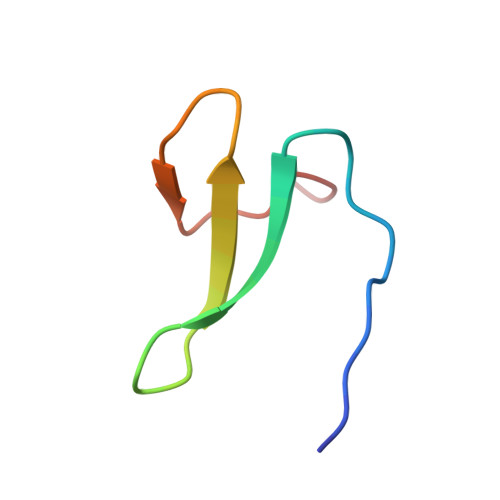
2YSF | pdb_00002ysf

Solution structure of the fourth WW domain from the human E3 ubiquitin-protein ligase Itchy homolog, ITCH


Experimental Data Snapshot

  • Method: SOLUTION NMR
  • Conformers Calculated: 100 
  • Conformers Submitted: 20 
  • Selection Criteria: structures with the least restraint violations, target function 

wwPDB Validation 3D Report Full Report

Validation slider image for 2YSF

This is version 1.3 of the entry. See complete history

Literature

Solution structure of the fourth WW domain from the human E3 ubiquitin-protein ligase Itchy homolog, ITCH

Ohnishi, S.Li, H.Koshiba, S.Harada, T.Watanabe, S.Kigawa, T.Yokoyama, S.

To be published.

Macromolecule Content 

  • Total Structure Weight: 4.47 kDa 
  • Atom Count: 314 
  • Modeled Residue Count: 40 
  • Deposited Residue Count: 40 
  • Unique protein chains: 1

Macromolecules

Find similar proteins by:|  3D Structure
Entity ID: 1
MoleculeChains  Sequence LengthOrganismDetailsImage
E3 ubiquitin-protein ligase Itchy homolog40Homo sapiensMutation(s): 0 
Gene Names: ITCH
EC: 6.3.2 (PDB Primary Data), 2.3.2.26 (UniProt)
UniProt & NIH Common Fund Data Resources
Find proteins for Q96J02 (Homo sapiens)
Explore Q96J02 
Go to UniProtKB:  Q96J02
PHAROS:  Q96J02
GTEx:  ENSG00000078747 
Entity Groups
Sequence Clusters30% Identity50% Identity70% Identity90% Identity95% Identity100% Identity
UniProt GroupQ96J02
Sequence Annotations
Expand
Reference Sequence

Experimental Data & Validation

Experimental Data

  • Method: SOLUTION NMR
  • Conformers Calculated: 100 
  • Conformers Submitted: 20 
  • Selection Criteria: structures with the least restraint violations, target function 

Structure Validation

View Full Validation Report


Entry History 

Revision History  (Full details and data files)

  • Version 1.0: 2007-10-09
    Type: Initial release
  • Version 1.1: 2011-07-13
    Changes: Version format compliance
  • Version 1.2: 2022-03-16
    Changes: Data collection, Database references, Derived calculations
  • Version 1.3: 2024-05-29
    Changes: Data collection