2YMT | pdb_00002ymt

gamma 2 adaptin EAR domain crystal structure with phage peptide GEEWGPWV


Experimental Data Snapshot

  • Method: X-RAY DIFFRACTION
  • Resolution: 1.80 Å
  • R-Value Free: 
    0.242 (Depositor), 0.234 (DCC) 
  • R-Value Work: 
    0.185 (Depositor), 0.184 (DCC) 
  • R-Value Observed: 
    0.188 (Depositor) 

Starting Model: experimental
View more details

wwPDB Validation 3D Report Full Report

Validation slider image for 2YMT

This is version 1.6 of the entry. See complete history. 

Literature

The Hepatitis B Virus Pres1 Domain Hijacks Host Trafficking Proteins by Motif Mimicry.

Jurgens, M.C., Voros, J., Rautureau, G.J.P., Shepherd, D.A., Pye, V.E., Muldoon, J., Johnson, C.M., Ashcroft, A.E., Freund, S.M.V., Ferguson, N.

(2013) Nat Chem Biol 9: 540

  • DOI: https://doi.org/10.1038/nchembio.1294
  • Primary Citation Related Structures: 
    2YMT, 3ZHF, 4BCX

  • PubMed Abstract: 

    Hepatitis B virus (HBV) is an infectious, potentially lethal human pathogen. However, there are no effective therapies for chronic HBV infections. Antiviral development is hampered by the lack of high-resolution structures for essential HBV protein-protein interactions. The interaction between preS1, an HBV surface-protein domain, and its human binding partner, γ2-adaptin, subverts the membrane-trafficking apparatus to mediate virion export. This interaction is a putative drug target. We report here atomic-resolution descriptions of the binding thermodynamics and structural biology of the interaction between preS1 and the EAR domain of γ2-adaptin. NMR, protein engineering, X-ray crystallography and MS showed that preS1 contains multiple γ2-EAR-binding motifs that mimic the membrane-trafficking motifs (and binding modes) of host proteins. These motifs localize together to a relatively rigid, functionally important region of preS1, an intrinsically disordered protein. The preS1-γ2-EAR interaction was relatively weak and efficiently outcompeted by a synthetic peptide. Our data provide the structural road map for developing peptidomimetic antivirals targeting the γ2-EAR-preS1 interaction.


  • Organizational Affiliation: 
    • 1] School of Medicine and Medical Science, University College Dublin, Dublin, Ireland. [2].

Macromolecule Content 

  • Total Structure Weight: 14.8 kDa 
  • Atom Count: 1,172 
  • Modeled Residue Count: 129 
  • Deposited Residue Count: 133 
  • Unique protein chains: 2

Macromolecules

Find similar proteins by:|  3D Structure
Entity ID: 1
MoleculeChains  Sequence LengthOrganismDetailsImage
AP-1 COMPLEX SUBUNIT GAMMA-LIKE 2124Homo sapiensMutation(s): 0 
UniProt & NIH Common Fund Data Resources
Find proteins for O75843 (Homo sapiens)
Explore O75843 
Go to UniProtKB:  O75843
PHAROS:  O75843
GTEx:  ENSG00000213983 
Entity Groups
Sequence Clusters30% Identity50% Identity70% Identity90% Identity95% Identity100% Identity
UniProt GroupO75843
Sequence Annotations
Expand
Reference Sequence
Find similar proteins by:  Sequence   |   3D Structure  
Entity ID: 2
MoleculeChains  Sequence LengthOrganismDetailsImage
PHAGE DISPLAY DERIVED GAMMA 2 ADAPTIN EAR DOMAIN BINDING PEPTIDE9synthetic constructMutation(s): 0 
Sequence Annotations
Expand
Reference Sequence

Small Molecules

Ligands 1 Unique
IDChains Name / Formula / InChI Key2D Diagram3D Interactions
PDO

Query on PDO


Download:Ideal Coordinates CCD File
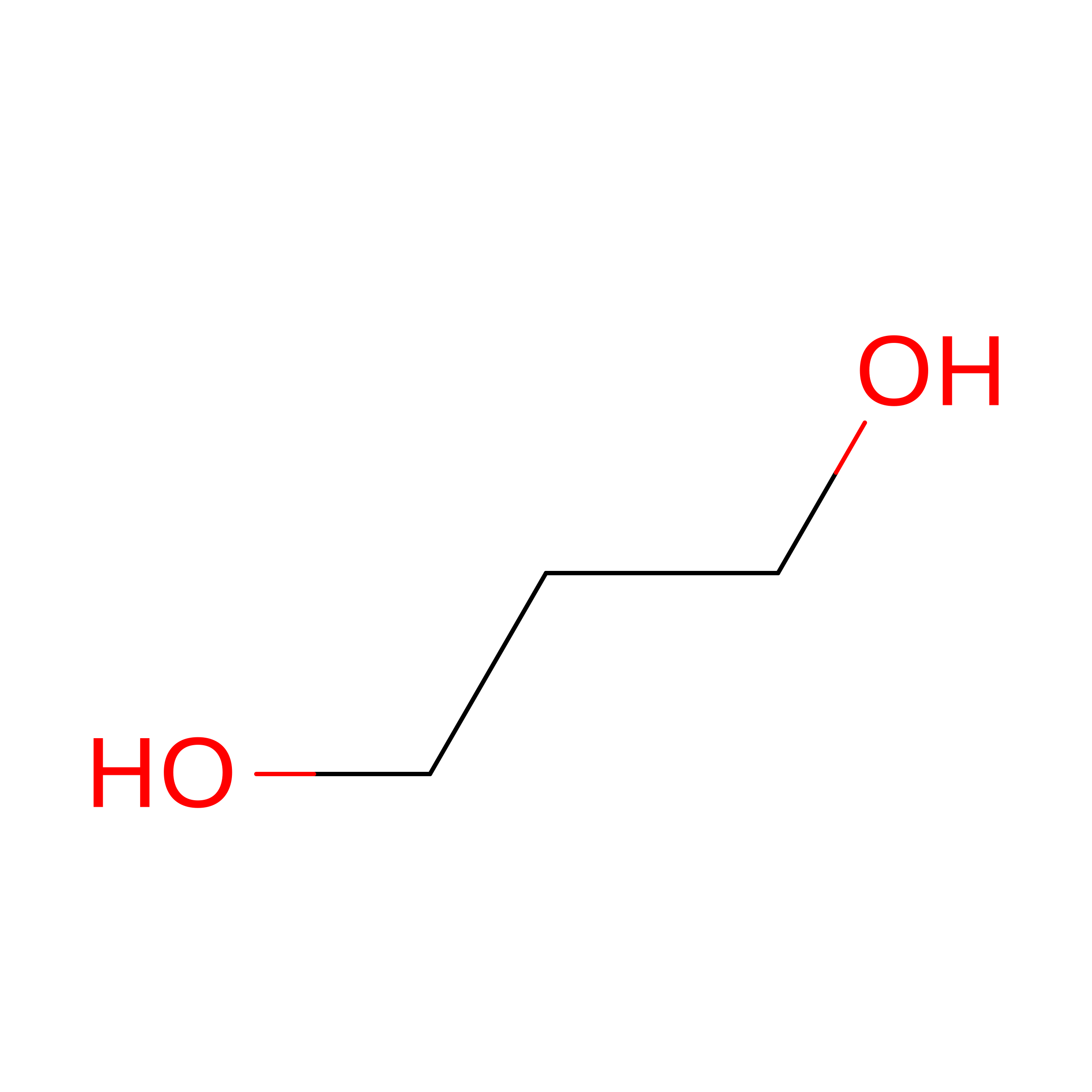
C [auth A]1,3-PROPANDIOL
C3 H8 O2
YPFDHNVEDLHUCE-UHFFFAOYSA-N

Experimental Data & Validation

Experimental Data

  • Method: X-RAY DIFFRACTION
  • Resolution: 1.80 Å
  • R-Value Free:  0.242 (Depositor), 0.234 (DCC) 
  • R-Value Work:  0.185 (Depositor), 0.184 (DCC) 
  • R-Value Observed: 0.188 (Depositor) 
Space Group: P 21 21 21
Unit Cell:
Length ( Å )Angle ( ˚ )
a = 34.803α = 90
b = 37.772β = 90
c = 105.471γ = 90
Software Package:
Software NamePurpose
PHENIXrefinement
XDSdata reduction
SCALAdata scaling
PHASERphasing

Structure Validation

View Full Validation Report


Entry History 

Deposition Data

Revision History  (Full details and data files)

  • Version 1.0: 2013-07-10
    Type: Initial release
  • Version 1.1: 2013-07-17
    Changes: Database references
  • Version 1.2: 2013-07-24
    Changes: Database references
  • Version 1.3: 2013-08-28
    Changes: Database references
  • Version 1.4: 2017-07-12
    Changes: Data collection
  • Version 1.5: 2023-12-20
    Changes: Data collection, Database references, Derived calculations, Other, Refinement description
  • Version 1.6: 2024-11-20
    Changes: Structure summary