2YLP | pdb_00002ylp

TARGETING THE BINDING FUNCTION 3 SITE OF THE ANDROGEN RECEPTOR THROUGH IN SILICO MOLECULAR MODELING


Experimental Data Snapshot

  • Method: X-RAY DIFFRACTION
  • Resolution: 2.30 Å
  • R-Value Free: 
    0.249 (Depositor), 0.246 (DCC) 
  • R-Value Work: 
    0.195 (Depositor), 0.193 (DCC) 
  • R-Value Observed: 
    0.197 (Depositor) 

Starting Model: experimental
View more details

wwPDB Validation 3D Report Full Report

Validation slider image for 2YLP

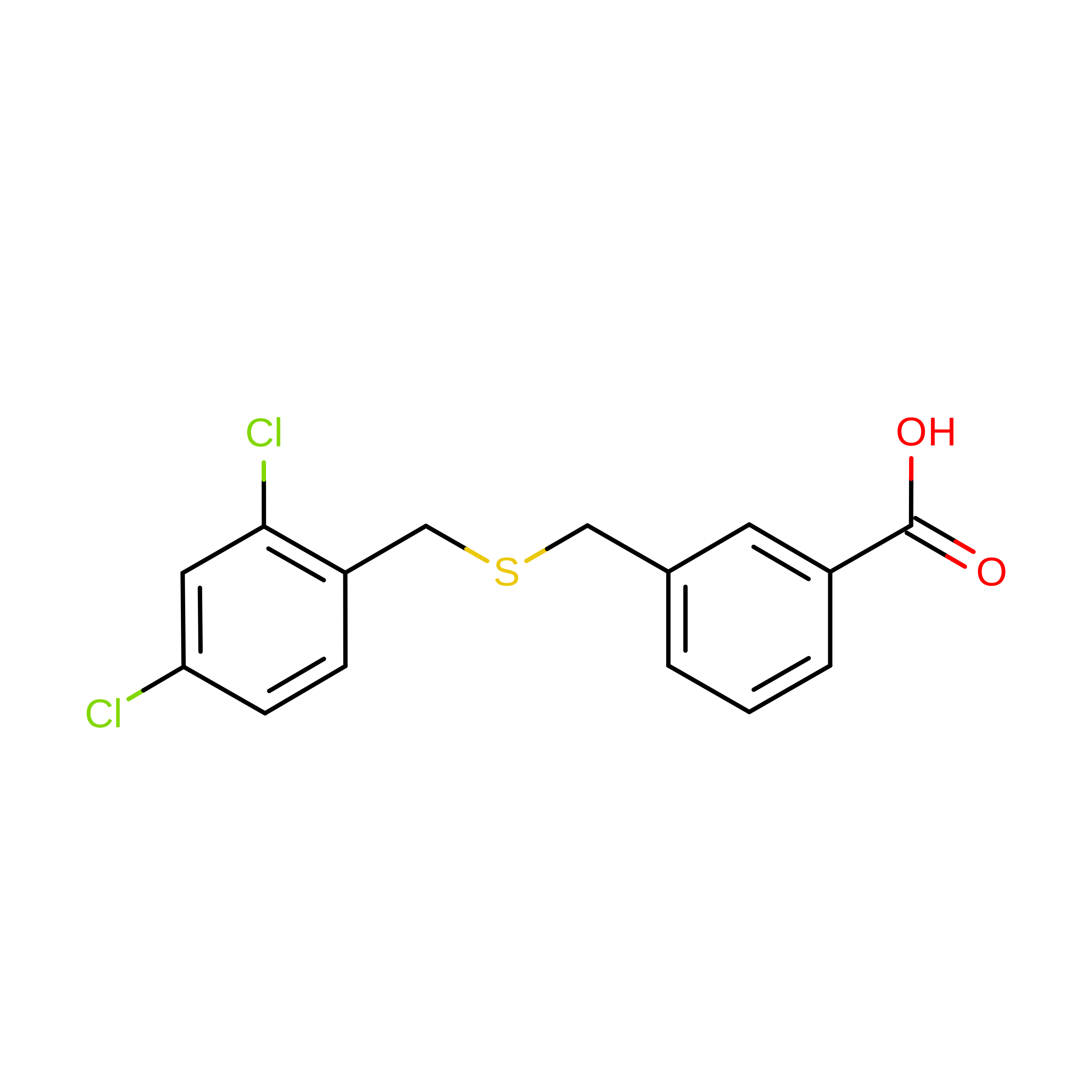
Ligand Structure Quality Assessment 


This is version 1.3 of the entry. See complete history

Literature

Targeting the Binding Function 3 (Bf3) Site of the Human Androgen Receptor Through Virtual Screening.

Lack, N.A.Axerio-Cilies, P.Tavassoli, P.Han, F.Q.Chan, K.H.Feau, C.Leblanc, E.Guns, E.T.Guy, R.K.Rennie, P.S.Cherkasov, A.

(2011) J Med Chem 54: 8563

  • DOI: https://doi.org/10.1021/jm201098n
  • Primary Citation Related Structures: 
    2YLO, 2YLP, 2YLQ, 3ZQT

  • PubMed Abstract: 

    The androgen receptor (AR) is the best studied drug target for the treatment of prostate cancer. While there are a number of drugs that target the AR, they all work through the same mechanism of action and are prone to the development of drug resistance. There is a large unmet need for novel AR inhibitors which work through alternative mechanism(s). Recent studies have identified a novel site on the AR called binding function 3 (BF3) that is involved into AR transcriptional activity. In order to identify inhibitors that target the BF3 site, we have conducted a large-scale in silico screen followed by experimental evaluation. A number of compounds were identified that effectively inhibited the AR transcriptional activity with no obvious cytotoxicity. The mechanism of action of these compounds was validated by biochemical assays and X-ray crystallography. These findings lay a foundation for the development of alternative or supplementary therapies capable of combating prostate cancer even in its antiandrogen resistant forms.


  • Organizational Affiliation
    • Vancouver Prostate Centre, University of British Columbia, 2660 Oak Street, Vancouver, British Columbia V6H 3Z6, Canada.

Macromolecule Content 

  • Total Structure Weight: 30.91 kDa 
  • Atom Count: 2,124 
  • Modeled Residue Count: 249 
  • Deposited Residue Count: 256 
  • Unique protein chains: 1

Macromolecules

Find similar proteins by:|  3D Structure
Entity ID: 1
MoleculeChains  Sequence LengthOrganismDetailsImage
ANDROGEN RECEPTOR256Homo sapiensMutation(s): 0 
UniProt & NIH Common Fund Data Resources
Find proteins for P10275 (Homo sapiens)
Explore P10275 
Go to UniProtKB:  P10275
PHAROS:  P10275
GTEx:  ENSG00000169083 
Entity Groups
Sequence Clusters30% Identity50% Identity70% Identity90% Identity95% Identity100% Identity
UniProt GroupP10275
Sequence Annotations
Expand
Reference Sequence

Small Molecules

Binding Affinity Annotations 
IDSourceBinding Affinity
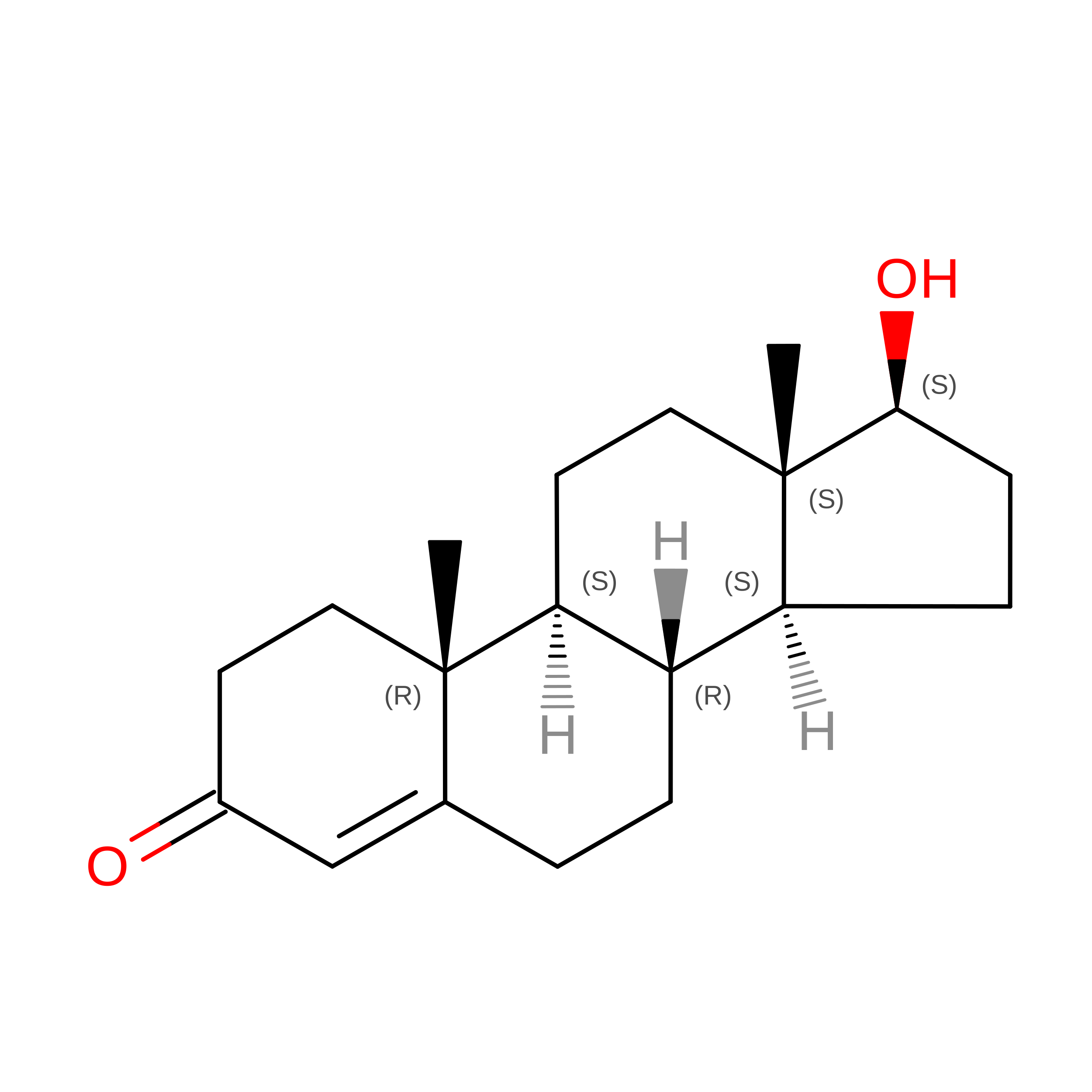
TES BindingDB:  2YLP Ki: min: 1.4, max: 29 (nM) from 5 assay(s)
Kd: 0.4 (nM) from 1 assay(s)
IC50: min: 2.7, max: 3090.3 (nM) from 11 assay(s)
EC50: min: 1.1, max: 3.16 (nM) from 4 assay(s)

Experimental Data & Validation

Experimental Data

  • Method: X-RAY DIFFRACTION
  • Resolution: 2.30 Å
  • R-Value Free:  0.249 (Depositor), 0.246 (DCC) 
  • R-Value Work:  0.195 (Depositor), 0.193 (DCC) 
  • R-Value Observed: 0.197 (Depositor) 
Space Group: P 21 21 21
Unit Cell:
Length ( Å )Angle ( ˚ )
a = 56.71α = 90
b = 66.48β = 90
c = 73.49γ = 90
Software Package:
Software NamePurpose
REFMACrefinement
MOSFLMdata reduction
MOSFLMdata scaling
PHASERphasing

Structure Validation

View Full Validation Report


Ligand Structure Quality Assessment 


Entry History 

Revision History  (Full details and data files)

  • Version 1.0: 2011-07-06
    Type: Initial release
  • Version 1.1: 2011-12-07
    Changes: Database references, Version format compliance
  • Version 1.2: 2012-01-11
    Changes: Other
  • Version 1.3: 2023-12-20
    Changes: Data collection, Database references, Derived calculations, Other, Refinement description