2Y92 | pdb_00002y92

Crystal structure of MAL adaptor protein


Experimental Data Snapshot

  • Method: X-RAY DIFFRACTION
  • Resolution: 3.01 Å
  • R-Value Free: 
    0.251 (Depositor), 0.280 (DCC) 
  • R-Value Work: 
    0.230 (Depositor), 0.241 (DCC) 
  • R-Value Observed: 
    0.231 (Depositor) 

Starting Model: experimental
View more details

wwPDB Validation 3D Report Full Report

Validation slider image for 2Y92

This is version 1.3 of the entry. See complete history

Literature

Crystal Structure of Toll-Like Receptor Adaptor Mal/Tirap Reveals the Molecular Basis for Signal Transduction and Disease Protection.

Valkov, E.Stamp, A.Dimaio, F.Baker, D.Verstak, B.Roversi, P.Kellie, S.Sweet, M.J.Mansell, A.Gay, N.J.Martin, J.L.Kobe, B.

(2011) Proc Natl Acad Sci U S A 108: 14879

  • DOI: https://doi.org/10.1073/pnas.1104780108
  • Primary Citation Related Structures: 
    2Y92

  • PubMed Abstract: 

    Initiation of the innate immune response requires agonist recognition by pathogen-recognition receptors such as the Toll-like receptors (TLRs). Toll/interleukin-1 receptor (TIR) domain-containing adaptors are critical in orchestrating the signal transduction pathways after TLR and interleukin-1 receptor activation. Myeloid differentiation primary response gene 88 (MyD88) adaptor-like (MAL)/TIR domain-containing adaptor protein (TIRAP) is involved in bridging MyD88 to TLR2 and TLR4 in response to bacterial infection. Genetic studies have associated a number of unique single-nucleotide polymorphisms in MAL with protection against invasive microbial infection, but a molecular understanding has been hampered by a lack of structural information. The present study describes the crystal structure of MAL TIR domain. Significant structural differences exist in the overall fold of MAL compared with other TIR domain structures: A sequence motif comprising a β-strand in other TIR domains instead corresponds to a long loop, placing the functionally important "BB loop" proline motif in a unique surface position in MAL. The structure suggests possible dimerization and MyD88-interacting interfaces, and we confirm the key interface residues by coimmunoprecipitation using site-directed mutants. Jointly, our results provide a molecular and structural basis for the role of MAL in TLR signaling and disease protection.


  • Organizational Affiliation
    • School of Chemistry and Molecular Biosciences, University of Queensland, Brisbane, QLD 4072, Australia. ev269@cam.ac.uk

Macromolecule Content 

  • Total Structure Weight: 16.07 kDa 
  • Atom Count: 989 
  • Modeled Residue Count: 127 
  • Deposited Residue Count: 145 
  • Unique protein chains: 1

Macromolecules

Find similar proteins by:|  3D Structure
Entity ID: 1
MoleculeChains  Sequence LengthOrganismDetailsImage
TOLL/INTERLEUKIN-1 RECEPTOR DOMAIN-CONTAINING ADAPTER PROTEIN,145Homo sapiensMutation(s): 0 
UniProt & NIH Common Fund Data Resources
Find proteins for P58753 (Homo sapiens)
Explore P58753 
Go to UniProtKB:  P58753
PHAROS:  P58753
GTEx:  ENSG00000150455 
Entity Groups
Sequence Clusters30% Identity50% Identity70% Identity90% Identity95% Identity100% Identity
UniProt GroupP58753
Sequence Annotations
Expand
Reference Sequence

Small Molecules

Ligands 1 Unique
IDChains Name / Formula / InChI Key2D Diagram3D Interactions
DTT

Query on DTT


Download:Ideal Coordinates CCD File
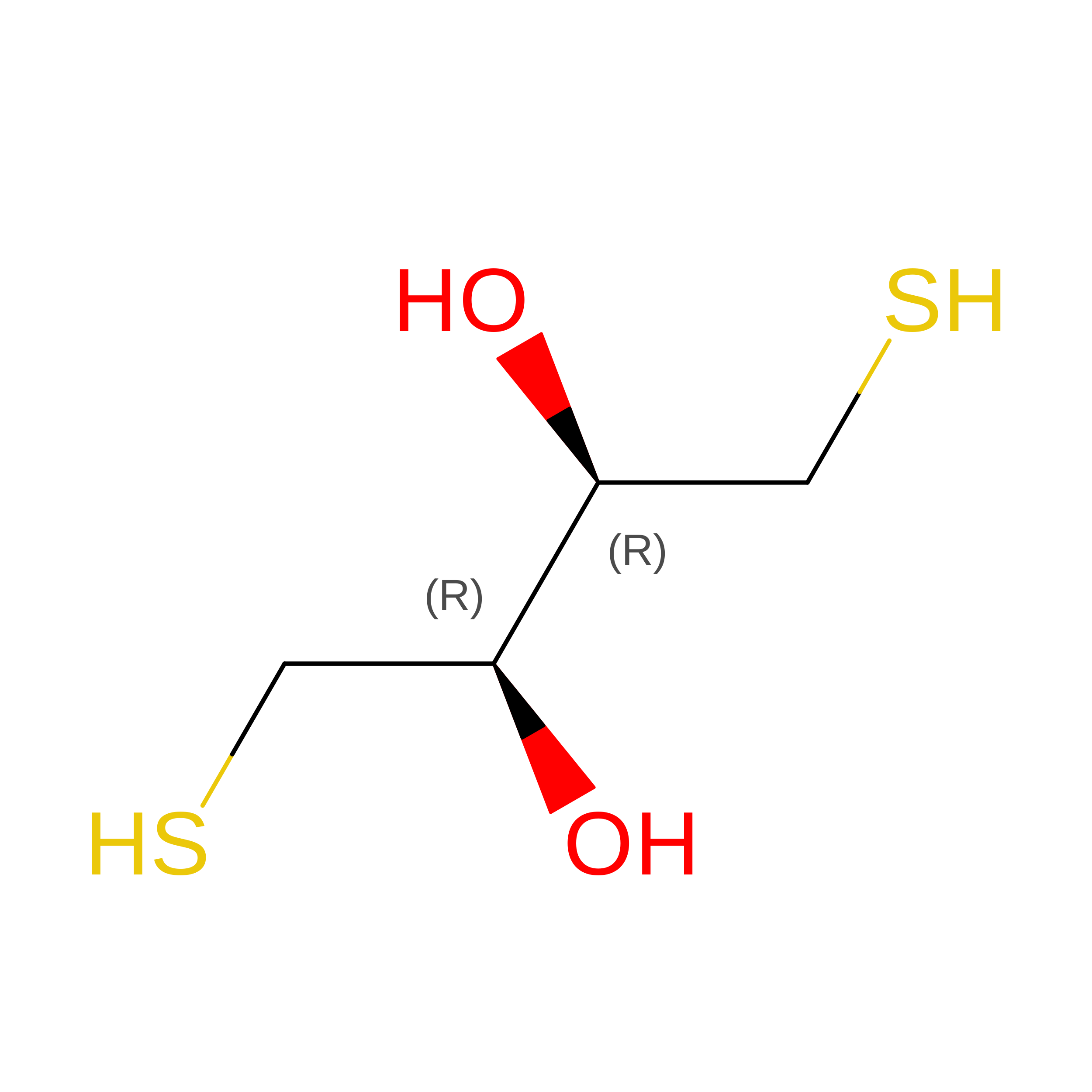
B [auth A]2,3-DIHYDROXY-1,4-DITHIOBUTANE
C4 H10 O2 S2
VHJLVAABSRFDPM-IMJSIDKUSA-N

Experimental Data & Validation

Experimental Data

  • Method: X-RAY DIFFRACTION
  • Resolution: 3.01 Å
  • R-Value Free:  0.251 (Depositor), 0.280 (DCC) 
  • R-Value Work:  0.230 (Depositor), 0.241 (DCC) 
  • R-Value Observed: 0.231 (Depositor) 
Space Group: P 43 21 2
Unit Cell:
Length ( Å )Angle ( ˚ )
a = 88.146α = 90
b = 88.146β = 90
c = 78.793γ = 90
Software Package:
Software NamePurpose
BUSTERrefinement
XDSdata reduction
SCALAdata scaling
PHENIXphasing

Structure Validation

View Full Validation Report


Entry History 

Deposition Data

Revision History  (Full details and data files)

  • Version 1.0: 2011-09-14
    Type: Initial release
  • Version 1.1: 2011-10-19
    Changes: Database references
  • Version 1.2: 2023-12-20
    Changes: Data collection, Database references, Derived calculations, Other, Refinement description
  • Version 1.3: 2024-10-16
    Changes: Structure summary