2Y2F | pdb_00002y2f

Crystal structure of Yersinia pestis YopH in complex with an aminooxy- containing platform compound for inhibitor design


Experimental Data Snapshot

  • Method: X-RAY DIFFRACTION
  • Resolution: 1.78 Å
  • R-Value Free: 
    0.210 (Depositor), 0.203 (DCC) 
  • R-Value Work: 
    0.165 (Depositor) 
  • R-Value Observed: 
    0.167 (Depositor) 

Starting Model: experimental
View more details

wwPDB Validation 3D Report Full Report

Validation slider image for 2Y2F

Ligand Structure Quality Assessment 


This is version 1.2 of the entry. See complete history

Literature

Utilization of Nitrophenylphosphates and Oxime-Based Ligation for the Development of Nanomolar Affinity Inhibitors of the Yersinia Pestis Outer Protein H (Yoph) Phosphatase.

Bahta, M.Lountos, G.T.Dyas, B.Kim, S.Ulrich, R.G.Waugh, D.S.Burke, T.R.

(2011) J Med Chem 54: 2933

  • DOI: https://doi.org/10.1021/jm200022g
  • Primary Citation Related Structures: 
    2Y2F

  • PubMed Abstract: 

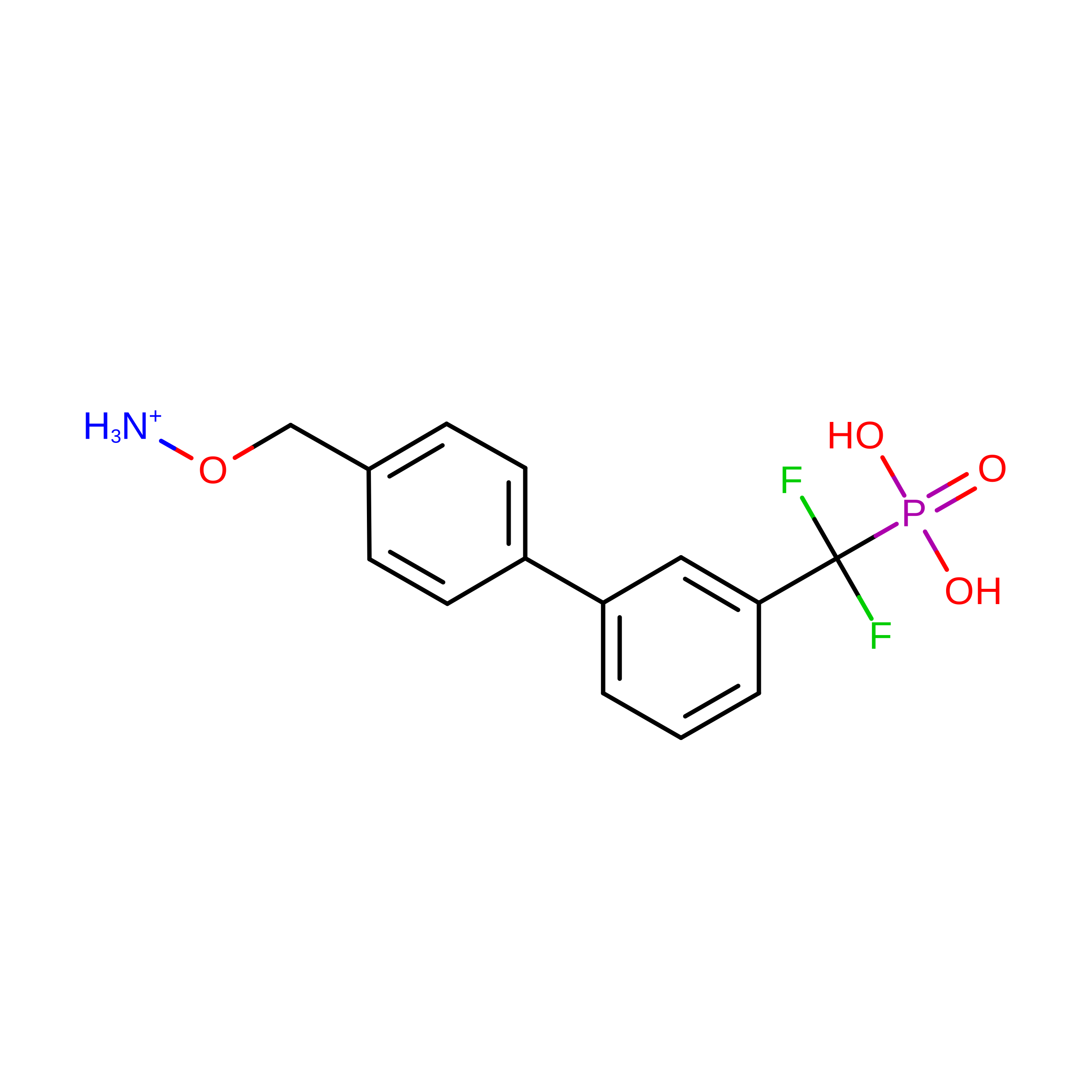
    Our current study reports the first K(M) optimization of a library of nitrophenylphosphate-containing substrates for generating an inhibitor lead against the Yersinia pestis outer protein phosphatase (YopH). A high activity substrate identified by this method (K(M) = 80 μM) was converted from a substrate into an inhibitor by replacement of its phosphate group with difluoromethylphosphonic acid and by attachment of an aminooxy handle for further structural optimization by oxime ligation. A cocrystal structure of this aminooxy-containing platform in complex with YopH allowed the identification of a conserved water molecule proximal to the aminooxy group that was subsequently employed for the design of furanyl-based oxime derivatives. By this process, a potent (IC(50) = 190 nM) and nonpromiscuous inhibitor was developed with good YopH selectivity relative to a panel of phosphatases. The inhibitor showed significant inhibition of intracellular Y. pestis replication at a noncytotoxic concentration. The current work presents general approaches to PTP inhibitor development that may be useful beyond YopH.


  • Organizational Affiliation
    • Chemical Biology Laboratory, Molecular Discovery Program, Center for Cancer Research, National Cancer Institute, National Institutes of Health, NCI-Frederick, Frederick, Maryland 21702, United States.

Macromolecule Content 

  • Total Structure Weight: 33.88 kDa 
  • Atom Count: 2,533 
  • Modeled Residue Count: 282 
  • Deposited Residue Count: 306 
  • Unique protein chains: 1

Macromolecules

Find similar proteins by:|  3D Structure
Entity ID: 1
MoleculeChains  Sequence LengthOrganismDetailsImage
PROTEIN-TYROSINE PHOSPHATASE YOPH306Yersinia pestisMutation(s): 0 
EC: 3.1.3.48
UniProt
Find proteins for O68720 (Yersinia pestis)
Explore O68720 
Go to UniProtKB:  O68720
Entity Groups
Sequence Clusters30% Identity50% Identity70% Identity90% Identity95% Identity100% Identity
UniProt GroupO68720
Sequence Annotations
Expand
Reference Sequence

Small Molecules

Ligands 1 Unique
IDChains Name / Formula / InChI Key2D Diagram3D Interactions
YI1

Query on YI1


Download:Ideal Coordinates CCD File
B [auth A][4-[3-(DIFLUORO-PHOSPHONO-METHYL)PHENYL]PHENYL]METHOXYAZANIUM
C14 H15 F2 N O4 P
FWYIUZIHUWHORI-UHFFFAOYSA-O

Experimental Data & Validation

Experimental Data

  • Method: X-RAY DIFFRACTION
  • Resolution: 1.78 Å
  • R-Value Free:  0.210 (Depositor), 0.203 (DCC) 
  • R-Value Work:  0.165 (Depositor) 
  • R-Value Observed: 0.167 (Depositor) 
Space Group: P 21 21 21
Unit Cell:
Length ( Å )Angle ( ˚ )
a = 49.243α = 90
b = 55.48β = 90
c = 100.081γ = 90
Software Package:
Software NamePurpose
REFMACrefinement
HKL-3000data reduction
SCALEPACKdata scaling
MOLREPphasing

Structure Validation

View Full Validation Report


Ligand Structure Quality Assessment 


Entry History 

Deposition Data

Revision History  (Full details and data files)

  • Version 1.0: 2011-03-16
    Type: Initial release
  • Version 1.1: 2011-09-28
    Changes: Database references, Version format compliance
  • Version 1.2: 2023-12-20
    Changes: Data collection, Database references, Derived calculations, Other, Refinement description