2XEL | pdb_00002xel

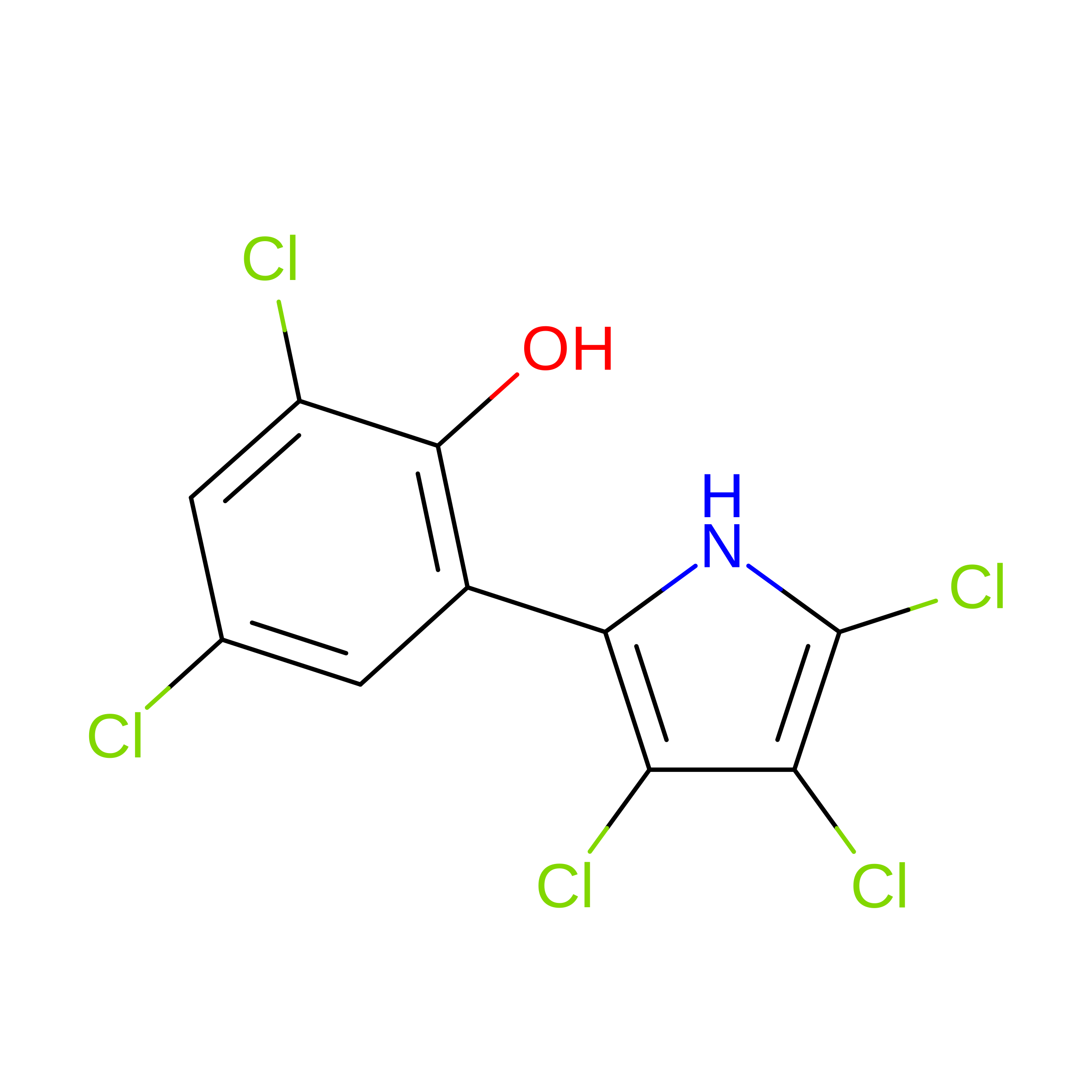
Molecular Mechanism of Pentachloropseudilin Mediated Inhibition of Myosin Motor Activity


Experimental Data Snapshot

  • Method: X-RAY DIFFRACTION
  • Resolution: 2.50 Å
  • R-Value Free: 
    0.253 (Depositor), 0.249 (DCC) 
  • R-Value Work: 
    0.229 (Depositor), 0.222 (DCC) 
  • R-Value Observed: 
    0.229 (Depositor) 

wwPDB Validation 3D Report Full Report

Validation slider image for 2XEL

Ligand Structure Quality Assessment 


This is version 1.2 of the entry. See complete history

Literature

Mechanism and Specificity of Pentachloropseudilin-Mediated Inhibition of Myosin Motor Activity.

Chinthalapudi, K.Taft, M.H.Martin, R.Heissler, S.M.Preller, M.Hartmann, F.K.Brandstaetter, H.Kendrick-Jones, J.Tsiavaliaris, G.Gutzeit, H.O.Fedorov, R.Buss, F.Knoelker, H.J.Coluccio, L.M.Manstein, D.J.

(2011) J Biological Chem 286: 29700

  • DOI: https://doi.org/10.1074/jbc.M111.239210
  • Primary Citation Related Structures: 
    2XEL

  • PubMed Abstract: 

    Here, we report that the natural compound pentachloropseudilin (PClP) acts as a reversible and allosteric inhibitor of myosin ATPase and motor activity. IC(50) values are in the range from 1 to 5 μm for mammalian class-1 myosins and greater than 90 μm for class-2 and class-5 myosins, and no inhibition was observed with class-6 and class-7 myosins. We show that in mammalian cells, PClP selectively inhibits myosin-1c function. To elucidate the structural basis for PClP-induced allosteric coupling and isoform-specific differences in the inhibitory potency of the compound, we used a multifaceted approach combining direct functional, crystallographic, and in silico modeling studies. Our results indicate that allosteric inhibition by PClP is mediated by the combined effects of global changes in protein dynamics and direct communication between the catalytic and allosteric sites via a cascade of small conformational changes along a conserved communication pathway.


  • Organizational Affiliation
    • Research Centre for Structural Analysis, Hannover Medical School, Hannover, Germany.

Macromolecule Content 

  • Total Structure Weight: 89.4 kDa 
  • Atom Count: 6,746 
  • Modeled Residue Count: 776 
  • Deposited Residue Count: 776 
  • Unique protein chains: 1

Macromolecules

Find similar proteins by:|  3D Structure
Entity ID: 1
MoleculeChains  Sequence LengthOrganismDetailsImage
MYOSIN-2 HEAVY CHAIN776Dictyostelium discoideumMutation(s): 0 
UniProt
Find proteins for P08799 (Dictyostelium discoideum)
Explore P08799 
Go to UniProtKB:  P08799
Entity Groups
Sequence Clusters30% Identity50% Identity70% Identity90% Identity95% Identity100% Identity
UniProt GroupP08799
Sequence Annotations
Expand
Reference Sequence

Experimental Data & Validation

Experimental Data

  • Method: X-RAY DIFFRACTION
  • Resolution: 2.50 Å
  • R-Value Free:  0.253 (Depositor), 0.249 (DCC) 
  • R-Value Work:  0.229 (Depositor), 0.222 (DCC) 
  • R-Value Observed: 0.229 (Depositor) 
Space Group: C 2 2 21
Unit Cell:
Length ( Å )Angle ( ˚ )
a = 89.53α = 90
b = 147.49β = 90
c = 153.78γ = 90
Software Package:
Software NamePurpose
CNSrefinement
XDSdata reduction
XSCALEdata scaling
CNSphasing

Structure Validation

View Full Validation Report


Ligand Structure Quality Assessment 


Entry History 

Revision History  (Full details and data files)

  • Version 1.0: 2011-06-15
    Type: Initial release
  • Version 1.1: 2011-08-31
    Changes: Database references, Version format compliance
  • Version 1.2: 2024-05-08
    Changes: Data collection, Database references, Derived calculations, Other