2WMT | pdb_00002wmt

Crystal structure of checkpoint kinase 1 (Chk1) in complex with inhibitors


Experimental Data Snapshot

  • Method: X-RAY DIFFRACTION
  • Resolution: 2.55 Å
  • R-Value Free: 
    0.257 (Depositor), 0.244 (DCC) 
  • R-Value Work: 
    0.214 (Depositor), 0.208 (DCC) 
  • R-Value Observed: 
    0.216 (Depositor) 

Starting Model: experimental
View more details

wwPDB Validation 3D Report Full Report

Validation slider image for 2WMT

Ligand Structure Quality Assessment 


This is version 1.3 of the entry. See complete history

Literature

Identification of Inhibitors of Checkpoint Kinase 1 Through Template Screening.

Matthews, T.P.Klair, S.Burns, S.Boxall, K.Cherry, M.Fisher, M.Westwood, I.M.Walton, M.I.Mchardy, T.Cheung, K.-M.J.Van Montfort, R.Williams, D.Aherne, G.W.Garrett, M.D.Reader, J.Collins, I.

(2009) J Med Chem 52: 4810

  • DOI: https://doi.org/10.1021/jm900314j
  • Primary Citation Related Structures: 
    2WMQ, 2WMR, 2WMS, 2WMT, 2WMU, 2WMV, 2WMW, 2WMX

  • PubMed Abstract: 

    Checkpoint kinase 1 (CHK1) is an oncology target of significant current interest. Inhibition of CHK1 abrogates DNA damage-induced cell cycle checkpoints and sensitizes p53 deficient cancer cells to genotoxic therapies. Using template screening, a fragment-based approach to small molecule hit generation, we have identified multiple CHK1 inhibitor scaffolds suitable for further optimization. The sequential combination of in silico low molecular weight template selection, a high concentration biochemical assay and hit validation through protein-ligand X-ray crystallography provided 13 template hits from an initial in silico screening library of ca. 15000 compounds. The use of appropriate counter-screening to rule out nonspecific aggregation by test compounds was essential for optimum performance of the high concentration bioassay. One low molecular weight, weakly active purine template hit was progressed by iterative structure-based design to give submicromolar pyrazolopyridines with good ligand efficiency and appropriate CHK1-mediated cellular activity in HT29 colon cancer cells.


  • Organizational Affiliation
    • Cancer Research UK Centre for Cancer Therapeutics, The Institute of Cancer Research, 15 Cotswold Road, Sutton, Surrey SM2 5NG, UK.

Macromolecule Content 

  • Total Structure Weight: 33.27 kDa 
  • Atom Count: 2,070 
  • Modeled Residue Count: 248 
  • Deposited Residue Count: 289 
  • Unique protein chains: 1

Macromolecules

Find similar proteins by:|  3D Structure
Entity ID: 1
MoleculeChains  Sequence LengthOrganismDetailsImage
SERINE/THREONINE-PROTEIN KINASE CHK1289Homo sapiensMutation(s): 0 
EC: 2.7.11.1
UniProt & NIH Common Fund Data Resources
Find proteins for O14757 (Homo sapiens)
Explore O14757 
Go to UniProtKB:  O14757
PHAROS:  O14757
GTEx:  ENSG00000149554 
Entity Groups
Sequence Clusters30% Identity50% Identity70% Identity90% Identity95% Identity100% Identity
UniProt GroupO14757
Sequence Annotations
Expand
Reference Sequence

Small Molecules

Ligands 1 Unique
IDChains Name / Formula / InChI Key2D Diagram3D Interactions
ZYT

Query on ZYT


Download:Ideal Coordinates CCD File
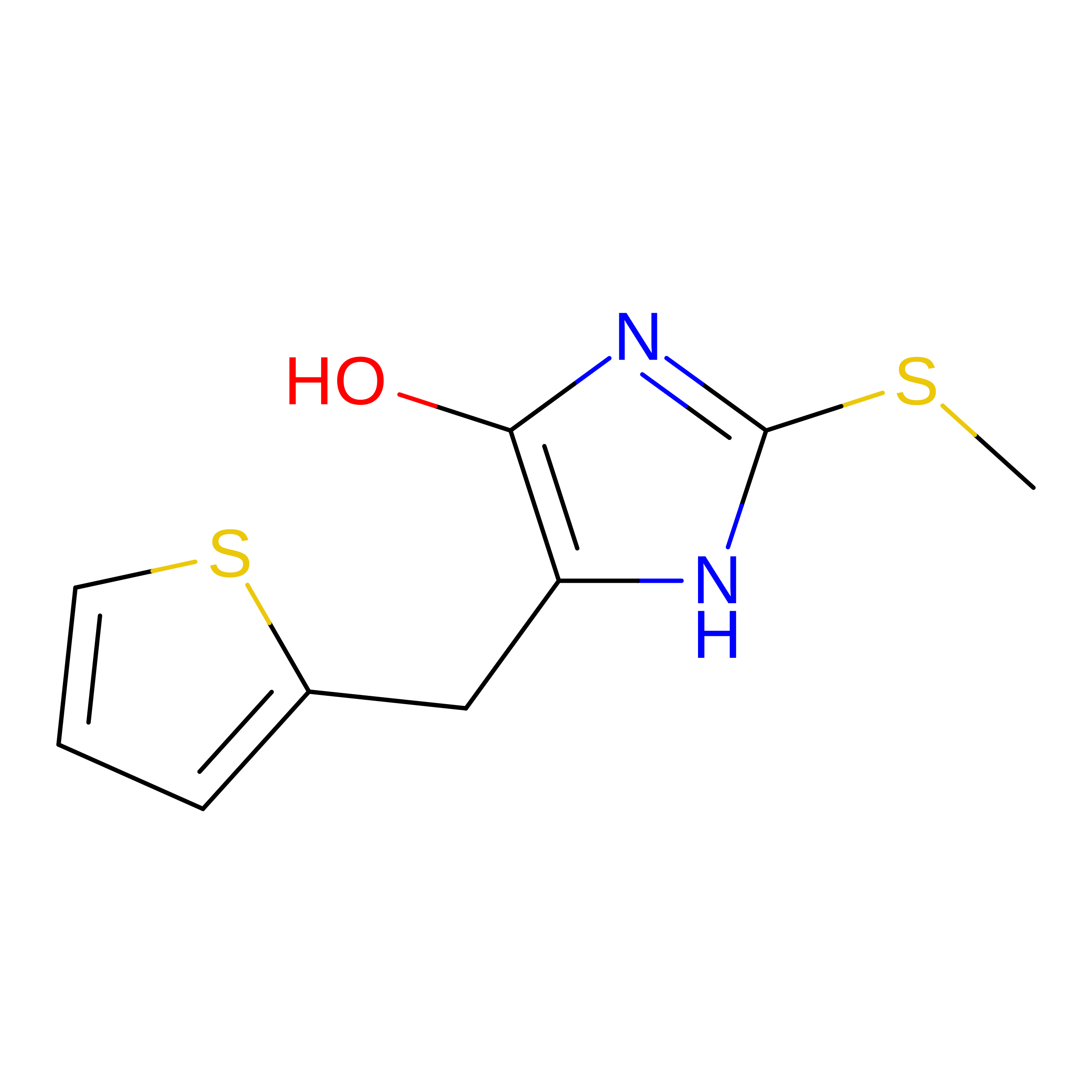
B [auth A]2-(methylsulfanyl)-5-(thiophen-2-ylmethyl)-1H-imidazol-4-ol
C9 H10 N2 O S2
QWYGHJVEZLVLSU-UHFFFAOYSA-N

Experimental Data & Validation

Experimental Data

  • Method: X-RAY DIFFRACTION
  • Resolution: 2.55 Å
  • R-Value Free:  0.257 (Depositor), 0.244 (DCC) 
  • R-Value Work:  0.214 (Depositor), 0.208 (DCC) 
  • R-Value Observed: 0.216 (Depositor) 
Space Group: P 1 21 1
Unit Cell:
Length ( Å )Angle ( ˚ )
a = 44.83α = 90
b = 65.15β = 102.18
c = 53.99γ = 90
Software Package:
Software NamePurpose
PHENIXrefinement
MOSFLMdata reduction
SCALAdata scaling
PHASERphasing

Structure Validation

View Full Validation Report


Ligand Structure Quality Assessment 


Entry History 

Revision History  (Full details and data files)

  • Version 1.0: 2009-07-28
    Type: Initial release
  • Version 1.1: 2011-10-12
    Changes: Database references, Derived calculations, Non-polymer description, Other, Refinement description, Version format compliance
  • Version 1.2: 2017-06-28
    Changes: Data collection
  • Version 1.3: 2023-12-13
    Changes: Data collection, Database references, Derived calculations, Other, Refinement description