2WL9 | pdb_00002wl9

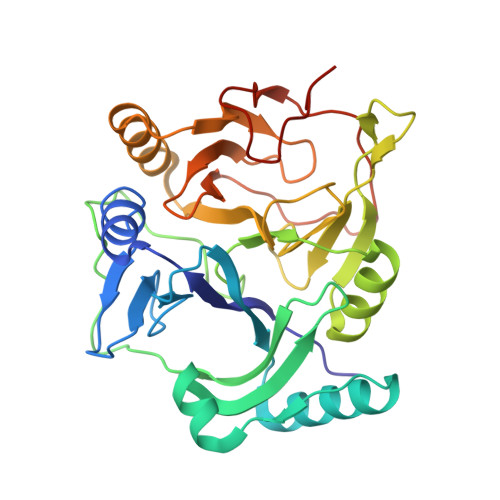
Crystal structure of catechol 2,3-dioxygenase


Experimental Data Snapshot

  • Method: X-RAY DIFFRACTION
  • Resolution: 1.90 Å
  • R-Value Free: 
    0.176 (Depositor), 0.187 (DCC) 
  • R-Value Work: 
    0.151 (Depositor) 
  • R-Value Observed: 
    0.152 (Depositor) 

Starting Model: experimental
View more details

wwPDB Validation 3D Report Full Report

Validation slider image for 2WL9

This is version 1.3 of the entry. See complete history

Literature

Substrate-Binding Mechanism of a Type I Extradiol Dioxygenase.

Cho, H.J.Kim, K.Sohn, S.Y.Cho, H.Y.Kim, K.J.Kim, M.H.Kim, D.Kim, E.Kang, B.S.

(2010) J Biological Chem 285: 34643

  • DOI: https://doi.org/10.1074/jbc.M110.130310
  • Primary Citation Related Structures: 
    2WL3, 2WL9

  • PubMed Abstract: 

    A meta-cleavage pathway for the aerobic degradation of aromatic hydrocarbons is catalyzed by extradiol dioxygenases via a two-step mechanism: catechol substrate binding and dioxygen incorporation. The binding of substrate triggers the release of water, thereby opening a coordination site for molecular oxygen. The crystal structures of AkbC, a type I extradiol dioxygenase, and the enzyme substrate (3-methylcatechol) complex revealed the substrate binding process of extradiol dioxygenase. AkbC is composed of an N-domain and an active C-domain, which contains iron coordinated by a 2-His-1-carboxylate facial triad motif. The C-domain includes a β-hairpin structure and a C-terminal tail. In substrate-bound AkbC, 3-methylcatechol interacts with the iron via a single hydroxyl group, which represents an intermediate stage in the substrate binding process. Structure-based mutagenesis revealed that the C-terminal tail and β-hairpin form part of the substrate binding pocket that is responsible for substrate specificity by blocking substrate entry. Once a substrate enters the active site, these structural elements also play a role in the correct positioning of the substrate. Based on the results presented here, a putative substrate binding mechanism is proposed.


  • Organizational Affiliation
    • From the School of Life Science and Biotechnology, Kyungpook National University, Daegu 702-701, Korea.

Macromolecule Content 

  • Total Structure Weight: 137.04 kDa 
  • Atom Count: 9,772 
  • Modeled Residue Count: 1,186 
  • Deposited Residue Count: 1,220 
  • Unique protein chains: 1

Macromolecules

Find similar proteins by:|  3D Structure
Entity ID: 1
MoleculeChains  Sequence LengthOrganismDetailsImage
CATECHOL 2,3-DIOXYGENASE
A, B, C, D
305Rhodococcus sp. DK17Mutation(s): 0 
UniProt
Find proteins for A0ACD6B857 (Rhodococcus sp. DK17)
Explore A0ACD6B857 
Go to UniProtKB:  A0ACD6B857
Entity Groups
Sequence Clusters30% Identity50% Identity70% Identity90% Identity95% Identity100% Identity
UniProt GroupA0ACD6B857
Sequence Annotations
Expand
Reference Sequence

Small Molecules

Ligands 4 Unique
IDChains Name / Formula / InChI Key2D Diagram3D Interactions
MBD

Query on MBD


Download:Ideal Coordinates CCD File
J [auth B],
N [auth D]
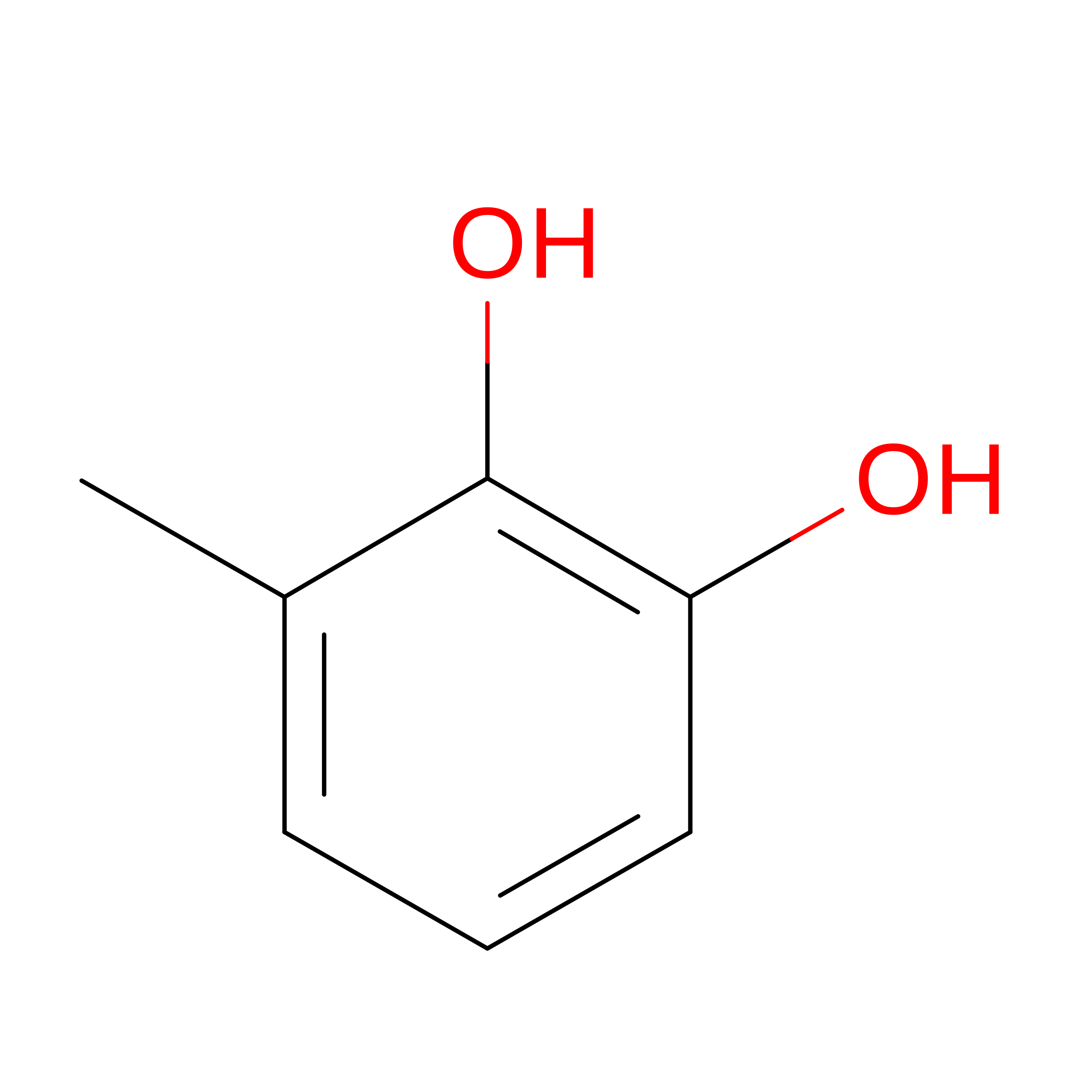
3-METHYLCATECHOL
C7 H8 O2
PGSWEKYNAOWQDF-UHFFFAOYSA-N
GOL

Query on GOL


Download:Ideal Coordinates CCD File
G [auth A],
H [auth A],
M [auth D]
GLYCEROL
C3 H8 O3
PEDCQBHIVMGVHV-UHFFFAOYSA-N
FE

Query on FE


Download:Ideal Coordinates CCD File
E [auth A],
I [auth B],
K [auth C],
L [auth D]
FE (III) ION
Fe
VTLYFUHAOXGGBS-UHFFFAOYSA-N
MG

Query on MG


Download:Ideal Coordinates CCD File
F [auth A]MAGNESIUM ION
Mg
JLVVSXFLKOJNIY-UHFFFAOYSA-N

Experimental Data & Validation

Experimental Data

  • Method: X-RAY DIFFRACTION
  • Resolution: 1.90 Å
  • R-Value Free:  0.176 (Depositor), 0.187 (DCC) 
  • R-Value Work:  0.151 (Depositor) 
  • R-Value Observed: 0.152 (Depositor) 
Space Group: P 4
Unit Cell:
Length ( Å )Angle ( ˚ )
a = 102.562α = 90
b = 102.562β = 90
c = 142.132γ = 90
Software Package:
Software NamePurpose
REFMACrefinement
HKL-2000data reduction
HKL-2000data scaling
MOLREPphasing

Structure Validation

View Full Validation Report


Entry History 

Deposition Data

Revision History  (Full details and data files)

  • Version 1.0: 2010-09-01
    Type: Initial release
  • Version 1.1: 2011-05-08
    Changes: Version format compliance
  • Version 1.2: 2011-07-13
    Changes: Version format compliance
  • Version 1.3: 2023-12-13
    Changes: Data collection, Database references, Derived calculations, Other, Refinement description