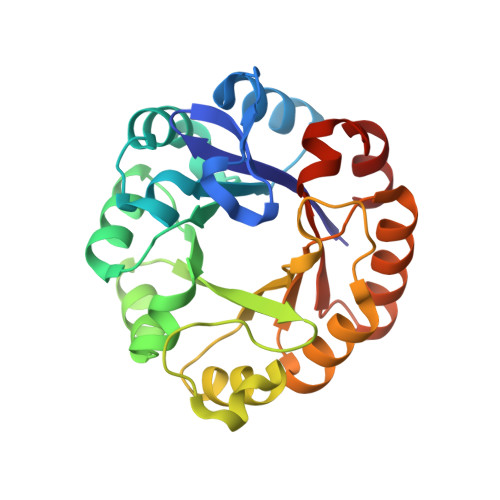
2W79 | pdb_00002w79

Establishing wild-type levels of catalytic activity on natural and artificial (ba)8-barrel protein scaffolds


Experimental Data Snapshot

  • Method: X-RAY DIFFRACTION
  • Resolution: 1.85 Å
  • R-Value Free: 
    0.267 (Depositor), 0.268 (DCC) 
  • R-Value Work: 
    0.202 (Depositor), 0.202 (DCC) 
  • R-Value Observed: 
    0.206 (Depositor) 

Starting Model: experimental
View more details

wwPDB Validation 3D Report Full Report

Validation slider image for 2W79

This is version 1.2 of the entry. See complete history

Literature

Establishing Wild-Type Levels of Catalytic Activity on Natural and Artificial (Beta Alpha)8- Barrel Protein Scaffolds.

Claren, J.Malisi, C.Hocker, B.Sterner, R.

(2009) Proc Natl Acad Sci U S A 106: 3704

  • DOI: https://doi.org/10.1073/pnas.0810342106
  • Primary Citation Related Structures: 
    2W79

  • PubMed Abstract: 

    The generation of high levels of new catalytic activities on natural and artificial protein scaffolds is a major goal of enzyme engineering. Here, we used random mutagenesis and selection in vivo to establish a sugar isomerisation reaction on both a natural (beta alpha)(8)-barrel enzyme and a catalytically inert chimeric (beta alpha)(8)-barrel scaffold, which was generated by the recombination of 2 (beta alpha)(4)-half barrels. The best evolved variants show turnover numbers and substrate affinities that are similar to those of wild-type enzymes catalyzing the same reaction. The determination of the crystal structure of the most proficient variant allowed us to model the substrate sugar in the novel active site and to elucidate the mechanistic basis of the newly established activity. The results demonstrate that natural and inert artificial protein scaffolds can be converted into highly proficient enzymes in the laboratory, and provide insights into the mechanisms of enzyme evolution.


  • Organizational Affiliation
    • Institute of Biophysics and Physical Biochemistry, University of Regensburg, Universitätsstrasse 31, D-93053 Regensburg, Germany.

Macromolecule Content 

  • Total Structure Weight: 54.04 kDa 
  • Atom Count: 4,182 
  • Modeled Residue Count: 480 
  • Deposited Residue Count: 482 
  • Unique protein chains: 1

Macromolecules

Find similar proteins by:|  3D Structure
Entity ID: 1
MoleculeChains  Sequence LengthOrganismDetailsImage
1-(5-PHOSPHORIBOSYL)-5-[(5-PHOSPHORIBOSYLAMINO) METHYLIDENEAMINO] IMIDAZOLE-4-CARBOXAMIDE ISOMERASE
A, B
241Thermotoga maritimaMutation(s): 4 
EC: 5.3.1.16
UniProt
Find proteins for Q9X0C7 (Thermotoga maritima (strain ATCC 43589 / DSM 3109 / JCM 10099 / NBRC 100826 / MSB8))
Explore Q9X0C7 
Go to UniProtKB:  Q9X0C7
Entity Groups
Sequence Clusters30% Identity50% Identity70% Identity90% Identity95% Identity100% Identity
UniProt GroupQ9X0C7
Sequence Annotations
Expand
Reference Sequence

Small Molecules

Ligands 1 Unique
IDChains Name / Formula / InChI Key2D Diagram3D Interactions
CL

Query on CL


Download:Ideal Coordinates CCD File
C [auth B]CHLORIDE ION
Cl
VEXZGXHMUGYJMC-UHFFFAOYSA-M

Experimental Data & Validation

Experimental Data

  • Method: X-RAY DIFFRACTION
  • Resolution: 1.85 Å
  • R-Value Free:  0.267 (Depositor), 0.268 (DCC) 
  • R-Value Work:  0.202 (Depositor), 0.202 (DCC) 
  • R-Value Observed: 0.206 (Depositor) 
Space Group: P 1 21 1
Unit Cell:
Length ( Å )Angle ( ˚ )
a = 49α = 90
b = 64.1β = 94
c = 79.2γ = 90
Software Package:
Software NamePurpose
REFMACrefinement
XDSdata reduction
MOLREPphasing

Structure Validation

View Full Validation Report


Entry History 

Deposition Data

Revision History  (Full details and data files)

  • Version 1.0: 2009-02-17
    Type: Initial release
  • Version 1.1: 2011-07-13
    Changes: Advisory, Version format compliance
  • Version 1.2: 2023-12-13
    Changes: Data collection, Database references, Other, Refinement description