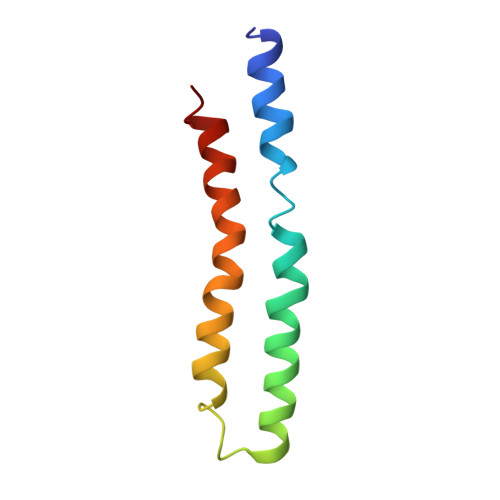
2W5J | pdb_00002w5j

Structure of the c14-rotor ring of the proton translocating chloroplast ATP synthase


Experimental Data Snapshot

  • Method: X-RAY DIFFRACTION
  • Resolution: 3.80 Å
  • R-Value Free: 
    0.335 (Depositor), 0.336 (DCC) 
  • R-Value Work: 
    0.317 (Depositor), 0.323 (DCC) 
  • R-Value Observed: 
    0.318 (Depositor) 

Starting Model: experimental
View more details

wwPDB Validation 3D Report Full Report

Validation slider image for 2W5J

This is version 1.3 of the entry. See complete history

Literature

Structure of the c14 rotor ring of the proton translocating chloroplast ATP synthase.

Vollmar, M.Schlieper, D.Winn, M.Buchner, C.Groth, G.

(2009) J Biological Chem 284: 18228-18235

  • DOI: https://doi.org/10.1074/jbc.M109.006916
  • Primary Citation Related Structures: 
    2W5J

  • PubMed Abstract: 

    The structure of the membrane integral rotor ring of the proton translocating F(1)F(0) ATP synthase from spinach chloroplasts was determined to 3.8 A resolution by x-ray crystallography. The rotor ring consists of 14 identical protomers that are symmetrically arranged around a central pore. Comparisons with the c(11) rotor ring of the sodium translocating ATPase from Ilyobacter tartaricus show that the conserved carboxylates involved in proton or sodium transport, respectively, are 10.6-10.8 A apart in both c ring rotors. This finding suggests that both ATPases have the same gear distance despite their different stoichiometries. The putative proton-binding site at the conserved carboxylate Glu(61) in the chloroplast ATP synthase differs from the sodium-binding site in Ilyobacter. Residues adjacent to the conserved carboxylate show increased hydrophobicity and reduced hydrogen bonding. The crystal structure reflects the protonated form of the chloroplast c ring rotor. We propose that upon deprotonation, the conformation of Glu(61) is changed to another rotamer and becomes fully exposed to the periphery of the ring. Reprotonation of Glu(61) by a conserved arginine in the adjacent a subunit returns the carboxylate to its initial conformation.


  • Organizational Affiliation
    • Institut für Biochemie der Pflanzen, Heinrich-Heine-Universität Düsseldorf, 40225 Düsseldorf, Germany.

Macromolecule Content 

  • Total Structure Weight: 106.4 kDa 
  • Atom Count: 6,860 
  • Modeled Residue Count: 1,092 
  • Deposited Residue Count: 1,092 
  • Unique protein chains: 1

Macromolecules

Find similar proteins by:|  3D Structure
Entity ID: 1
MoleculeChains  Sequence LengthOrganismDetailsImage
ATP SYNTHASE C CHAIN, CHLOROPLASTIC
A,
B,
C,
D,
E,
F,
G,
H,
I,
J,
K,
L,
M,
N [auth V]
78Spinacia oleraceaMutation(s): 0 
EC: 3.6.3.14
Membrane Entity: Yes 
UniProt
Find proteins for P69447 (Spinacia oleracea)
Explore P69447 
Go to UniProtKB:  P69447
Entity Groups
Sequence Clusters30% Identity50% Identity70% Identity90% Identity95% Identity100% Identity
UniProt GroupP69447
Sequence Annotations
Expand
Reference Sequence

Experimental Data & Validation

Experimental Data

  • Method: X-RAY DIFFRACTION
  • Resolution: 3.80 Å
  • R-Value Free:  0.335 (Depositor), 0.336 (DCC) 
  • R-Value Work:  0.317 (Depositor), 0.323 (DCC) 
  • R-Value Observed: 0.318 (Depositor) 
Space Group: C 1 2 1
Unit Cell:
Length ( Å )Angle ( ˚ )
a = 128.601α = 90
b = 89.996β = 104.7
c = 124.893γ = 90
Software Package:
Software NamePurpose
MOSFLMdata reduction
SCALAdata scaling
MOLREPphasing
PHASERphasing
REFMACrefinement

Structure Validation

View Full Validation Report


Entry History 

Deposition Data

Revision History  (Full details and data files)

  • Version 1.0: 2009-05-19
    Type: Initial release
  • Version 1.1: 2011-07-13
    Changes: Advisory, Version format compliance
  • Version 1.2: 2018-04-25
    Changes: Data collection, Database references
  • Version 1.3: 2023-12-13
    Changes: Data collection, Database references, Other, Refinement description